The support forum is built with (1) General and FAQ forums for common trading queries received from aspiring and experienced traders, and (2) forums for course video topics. How to Trade Price Action and How to Trade Forex Price Action videos are consolidated into common forums.
Brooks Trading Course social media communities
Brooks Trading Course Learning Resources >>>

Hi all,
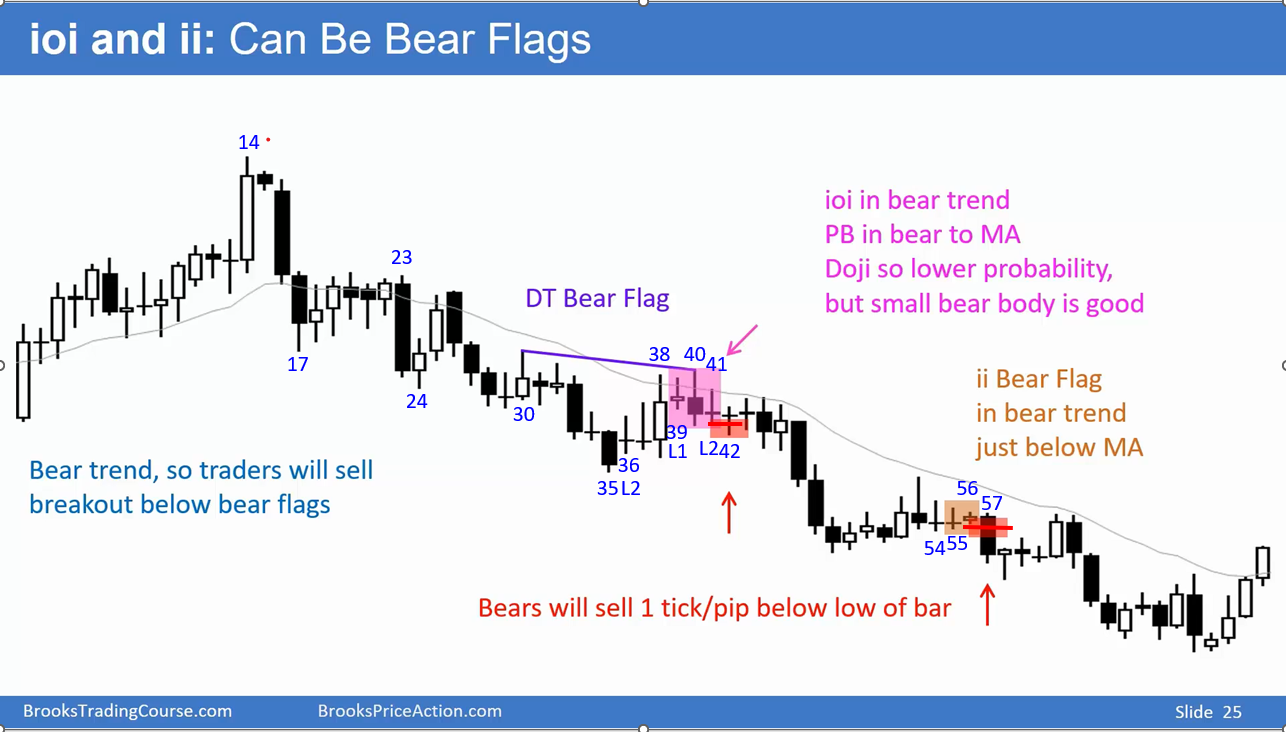
In slide 25 of Video 8C, Al said there is a double top bear flag (in bar 30 and 40), Low 2 (bar 36), Low 1 (bar 39), and Low 2 (bar 41). I don't quite understand why bar 36 is a Low 2 and bar 39 is a Low 1, and bar 41 is Low 2. I do all the marking based on Al's pointer, so I am not sure if I interpret that correctly. Can anyone help? Many thanks!
Hey Joman,
Sheesh! I'm impressed. You are asking about a comment Al made at exactly 32:11 in that video, and the comment is only background to the main point of that lesson. You focus very closely, but what should traders focus on, in order to become profitable?
Al teaches about pullbacks and Low 1s and 2s in Lesson 9, so Al's side comment will make more sense after you've absorbed those videos.
However, here is an answer to your question: in the video you are asking about, I would say that bar 32 sets up the Low 1 because bar 33 falls below it after a two legged pullback. Bar 36 pulls back above bar 35, ending a first leg and setting up a Low 2. The Low 2 in that case does not trigger until Bar 38 falls below bar 37.
Then, because the market pulled back to the MA and finishes a second leg up, maybe we could restart the count. Doing so would make bar 39 set up a Low 1. In that case bar 40 triggers it right away. However, the ioi set up then creates a Low 2 set up near the MA in a Bear trend, which is a very good entry.
I hope that helps, and now I have a question for you:
If traders enter on bar 57, just like Al suggests on the chart above, why would they continue to hold after bar 61, the bull trend bar closing on its high? Remember, traders are 20 minutes into the trade, late in the Bear trend, and the market has formed three doji bars instead of continuing down. Why keep holding after such a strong Bull trend bar?
Dear Ryan,
Thanks for your thorough and in-depth explanation! So I would interpret like this, see if I am correct.
bar 36 -> triggering L2 and having bull pullback at bar 37, and since bar 38 has low below both bar 36 an bar 37, then bar 37 becomes the L2 signal bar.
bar 39 -> since it is recounted, bar 39 on a smaller time frame is going down, then pulling back to high and close above the open, triggering L1, then in bar 40 it's low is below close of bar 39, and bar 39 becomes the L1
bar 41 -> it sets up a L2 as it's an implied pullback, and L2 got confirmed once the low of bar 42 is lower than bar 41.
For your question, I think the traders hold based on these arguments:
- although bar 61 closes a strong bull bar, it's still below MA, and closes below open of bar 57
- bar 61 high is regarded as lower high instead of breakout
- no signs of exhaustion.
See if it's the answer 🙂
I think your interpretation of the Low 2 question is probably fine. I'm sure you will be able to evaluate it very well after you study the videos for Lesson 9.
As for the reasons to hold a short and what traders focus on to keep them in a trade, I think there is a stronger one than the one you mentioned.
The focus is on chart features that give traders an edge. The biggest one is the Bear Trend, and the DT Bear Flag helps as well. As you mentioned, there are no signs of exhaustion, so maybe that is what you were getting at.
And, the market is still below the MA, and that also points to the Bear Trend as the primary thing giving traders a 60% probability of a continuation down.
However, Bar 61 is not a lower high until bar 62 closes, and many traders would consider cutting losses after that bar closes and looking for a new set up. Traders would have had a good reason to exit if bar 62 had been a similar Bull bar closing on its high and closing above the MA.
I hope you are able to maintain your focus on important chart features while you are trading.
Good luck!
Dear Ryan,
I am so glad that this community have members like you that could share and point out the question that I raised, indeed that I started learning AL's price action course two years ago, yet I spent over a year to watch his onine courses, and now drill for the second time.
Yet there are still areas which I couldn't grasp well, and I am pleased that you are able to shed lights on my problems 🙂
Happy trading~!
Regards,
Joman


