The support forum is built with (1) General and FAQ forums for common trading queries received from aspiring and experienced traders, and (2) forums for course video topics. How to Trade Price Action and How to Trade Forex Price Action videos are consolidated into common forums.
Brooks Trading Course social media communities
Brooks Trading Course Learning Resources >>>

Hello all, novice here. I would like an explanation of a pullback. Because in a bull trend let's say on a five minute chart Al list a pullback as a long upper wick within the trend as an implied pullback. But then just a few minutes later he also references a pullback as a candle with a long lower wick in a bull trend? So, is it both because they have long wicks or is it the upper or lower wick? Thanks in advance!

Hi,
as far as I understood Al means that even one bar can be seen as a pullback. Also consecutive bars can be a pullback as well. I looked on those one bar pullbacks on a smaller time frame to understand better how they are forming. Try this for yourself to get an understanding what is happening on M1 while a bar is forming on M5 would be my suggestion here. So from my point of view it depends a lot of the context what can be defined as a pullback.

A pullback is counter trend move that is then resume back up into the original trend. So a pullback can be very small like a one bar pullback, or many bars.
he also references a pullback as a candle with a long lower wick in a bull trend
That is an even smaller pullback. The long wick was the result of a counter trend move when the bar was forming that was then reversal up by the bar closed.
Ok. Thank you. But I am talking about in the context of what Al was speaking on. In a bull trend he referenced a pullback as both a long tail on top and also on the bottom of the bar. I am just wondering was that a mistake or is a pull back in a bear trend also when you see a long tail on top and/or the bottom of the bar?
Thank you! This was what my question was about. But I appreciated all the feedback much obliged. GOD you guys sound so smart in here, I hada reread the answer like three times in order to even remotely understand. But I'm on my way. Much obliged.

Is there a percentage of how often the pullback fails and becomes a reversal?

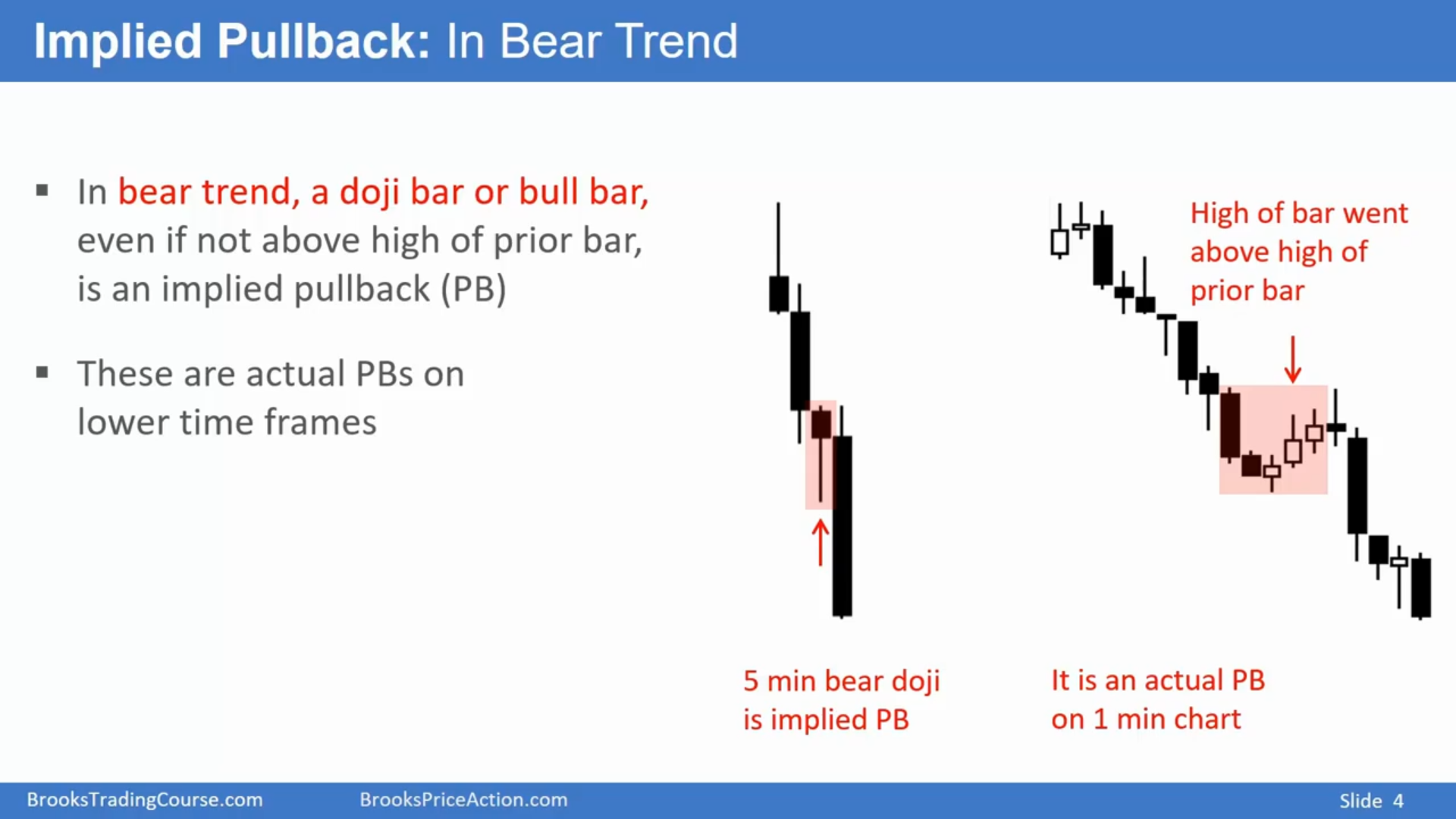
also there is an implied pb

Can a dojo bar in a breakout also be considered as a pause (PB) even if it doesn’t go below the low of the prior bar ( more of an implied PB )

Hi Satya, check out my 2c (i could be wrong)

Hi Satya,
The annotations were my take at describing the pullbacks - the ones that are inside bars, and the breakout bars with the small tails - both imply the inferred pullback 🤔
I could've gotten it all wrong ...
yeah..it seems to be alright, although Al sometimes uses an alternative terminology where pause bars ( dojis which do not fall below the low of prior bars ) are also called as pullbacks. you can go through market cycle videos to learn about this.

Hi all,
Trying to get through the course but so many time a term is used and which has not been explained before so then I stop and try and work out what is means, which makes it quite slow going, but also good in a way as researching and looking for what is meant on live charts helps to solidify the concepts.
So Al is explaining Pullbacks and Implied pullbacks, but I don't see a reason to differentiate these so far. Is there a higher probability of a it being a pullback if it does go below the previous bar on the current time frame vs when one is implied so most probably had a bar close below previous on lower time frame? I guess so but I don't think this is specified so far so I don't know what to put in my notes. So far I have more questions that points to watch for.
Reading through the Q & A here in the videos is great though. Really helpful

There are "a lot of details" because differentiation is important, as well as communication. As there are 3 key variables: support, resistance, and momentum (yeah just 3!) how each is interpreted has many "flavors".
A pullback is a larger decrease in momentum than an implied pullback. With regards to decisions, that means that the implied pullback will have greater momentum strength than a regular pullback bar (QED). However, implied pullbacks are better defined as a complete pullback on a lower timeframe. Lower timeframes have higher variance so they have a higher degree of difficulty assessing in real time.
While there is a lot of vocabulary, this is to express differences in the 3 variables and allows everyone to "see" things a little more concretely. An implied pullback often will happen during a breakout as a H1, and succeed. . .because of strength in successful breakouts.
Hopefully a little helpful and good trades to you!
Thank you for your reply.
Yes makes sense.
I will be going over this section a few more times when I have finished the course. Currently working on understand Al's definition of gaps and the H1,2,3,4,5 etc stuff.
Already seeing an improvement in my backtesting. Lower win rate but much more profits.


