Market Video Report: Bitcoin

Duration 11:05 mins.
Summary
Bitcoin has probably transitioned from a long term bull trend into a major trading range between $50,000 and $125,000. While the daily chart shows a “small pullback bull trend,” the price is facing a weekly resistance that will either push back the price toward $68000 or accelerate it towards $90000.
Transcript
Hi everyone, and welcome back to this week’s Bitcoin price action analysis. My name is Josep Capo, and I am a Trader and an author for the Brooks Trading Course website. Thank you for joining us today as we take a look at Bitcoin on both the weekly and the daily charts. Let us jump right in and start by analyzing the monthly chart.
We will begin with a broad price action narrative to establish context before narrowing our focus to specific trade zones and ideas
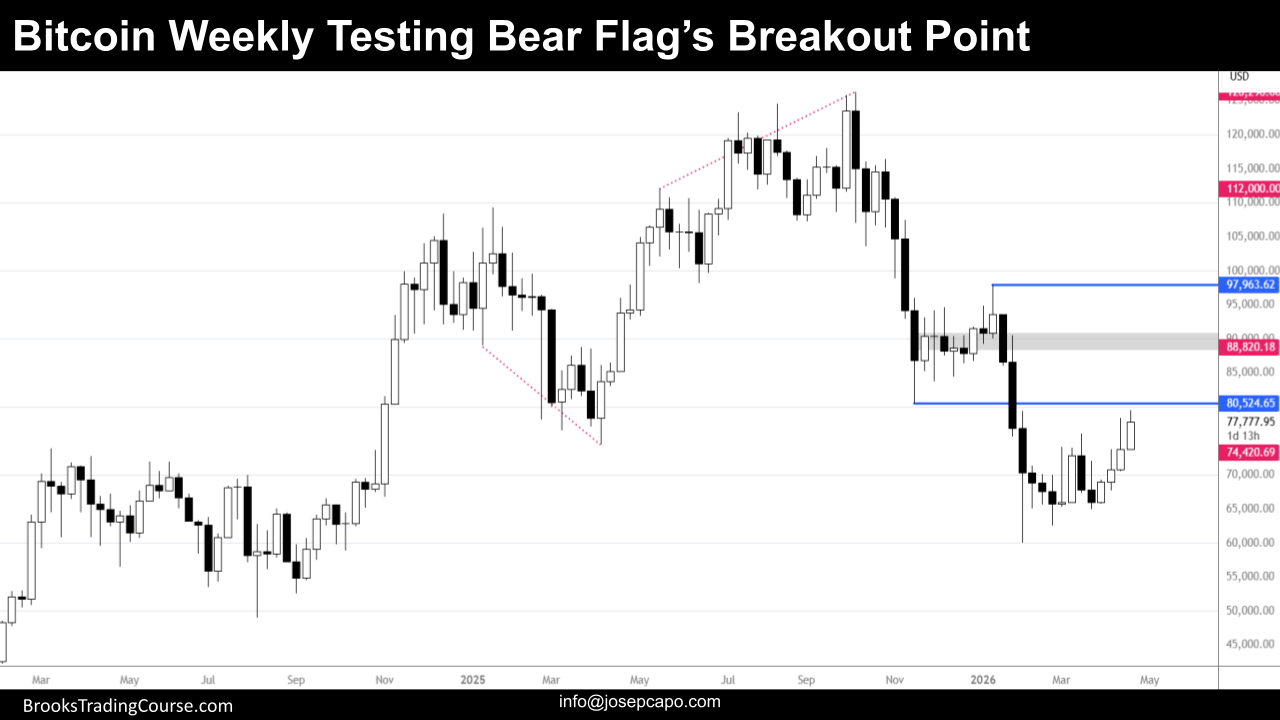
Right now, we are either in a major bear trend or a major trading range. In the medium term, the market is definitely in a bear channel. However, because the market was previously in a very strong long-term bull trend, the natural transition after such a trend is into a trading range. Markets have inertia and they, more often than not, resist changing from a strong bull trend directly into an opposite, strong bear trend.
Trading ranges typically have a couple of legs testing both their upper and lower thirds, establishing an equilibrium zone within the middle third. In this specific case, the current bear leg can be viewed as the second bear leg within a developing trading range. We had one leg down here, a pullback, and then a second leg down there. Market inertia dictates that what follows a second leg down is a couple of legs sideways to up. There is a high probability of a test of the middle third of the trading range, which always acts as a strong magnetic pull on the price as the market searches for equilibrium.
In this case, I suppose the major trading range spans from approximately the $125,000 all-time high down to the $50,000 level. Right now, we are obviously trading within the lower third, and the ultimate area of balance—the middle third—would be between $80,000 and $100,000. So, that is exactly what I expect: the market testing the middle third of the trading range area at some point this year.
In previous weeks, I discussed structuring a long position by buying the low of the bear flag. Instead of dipping to trigger that level, however, price moved higher. This doesn’t bother me at all; I don’t care what the price does, only what I do with the price. Now, price has traded above the bear flag, triggering a bull breakout setup.
Since a bear flag follows bearish price action, a bullish breakout is the setup least likely to succeed, making it a “hard trade” to take. Instead, many traders prefer to sell above bear flags, as that is a higher-probability play.
The magnets on this chart aren’t actually the breakout points; rather, the natural magnets are the apexes of previous trading ranges. Keep in mind that a flag is simply a trading range on a lower timeframe. Looking at the current structure, the overhead magnet sits near $90,000, while the downside magnet aligns around $65,000.
What am I likely doing? I’m currently leaning toward the short side for risk assets. For example, most major US stock indexes are testing resistance in climatic bull breakouts, which are more often than not unsustainable. Consequently, I’m looking to short at the breakout point.
Breakout points that move strongly enough to create a gap—an area of low participation—frequently offer high-velocity moves. This dynamic applies to both reversals and breakouts. Consequently, the entire gap area, rather than a specific price level, will likely see a strong rejection or a swift acceleration toward the apex of the previous bear flag. Because these moves develop so quickly, many traders, myself included, drop down to lower timeframes—such as the daily, 4-hour, or 1-hour charts—to join the move once it is confirmed on that local scale
Now, before jumping into the daily chart, I want to recommend that you learn how to read and trade the markets in a fully independent way. If you want to do that, you can find a link in the description of this video to explore buying the Brooks Trading Course. For less than $500, it is one of the absolute best resources on the internet to learn how to trade. If for any reason you do not like the course, there is a 30-day money-back guarantee, so there is no excuse on your end.
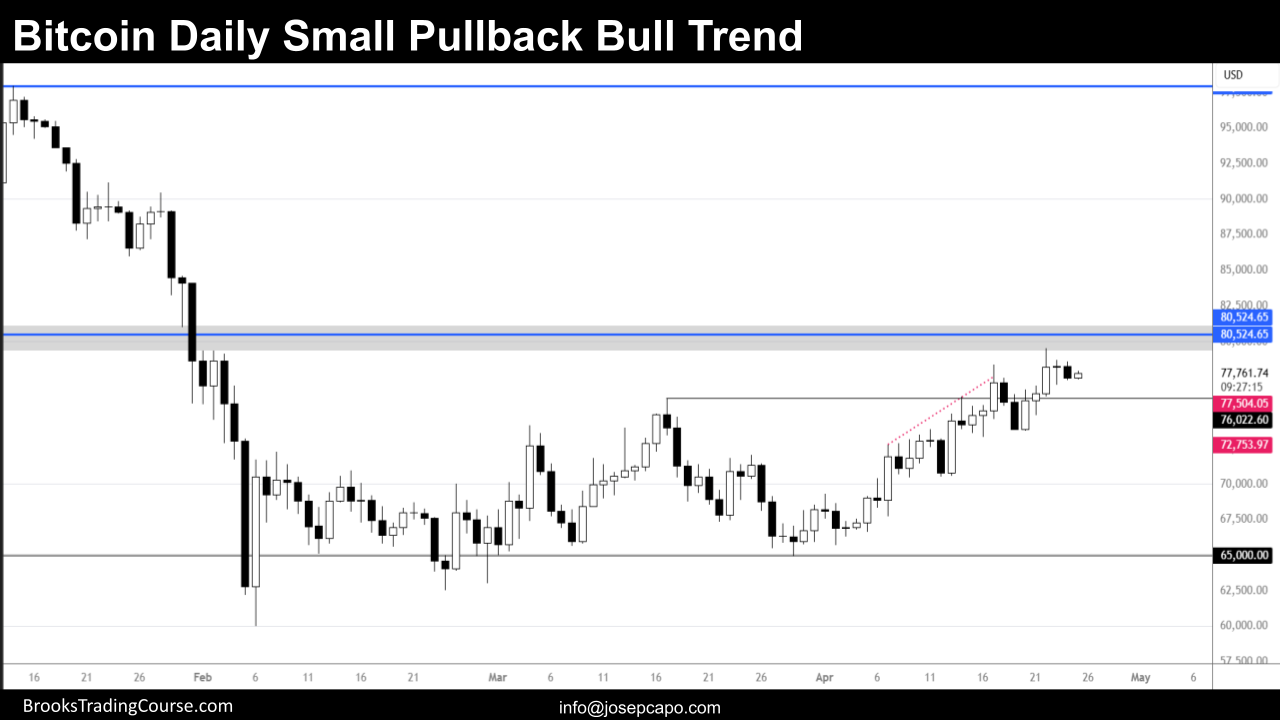
Now, turning to the daily chart: we have been stuck in a trading range since early February, but price has broken above by doing a Small Pullback Bull Trend.
As we have discussed on the weekly chart, the price is facing a critical zone, what I would call a good area to look for structuring trades.
On a lower timeframe, a small pullback bull trend manifests as a sequence of ascending trading ranges. The structure is characterized by a bull breakout followed by a period of consolidation that establishes a new ‘floor’ above the previous range.
This ‘sideways-to-up’ price action is a sign of extreme strength because it consolidates the move in real-time. While vertical breakouts are unsustainable and prone to sharp reversals, this stair-stepping process allows the market to establish. This constant building of structural support is exactly why a small pullback trend is more likely to successfully penetrate major resistance levels—as we’ve just witnessed with the break above the more recent trading range high.
Statistically, 80% of attempts to reverse a strong trend fail. This means the trend is more likely to continue than to break. However, after the fourth attempt at a reversal, the probability increases that the market will either transition into a trading range or shift into a full bear reversal.
We are currently in a small pullback bull trend and have already seen three pullbacks. While the statistics favor the bulls, we have to weigh this against the context of the higher timeframes.
As the saying goes: HTF context trumps LTF patterns. Because higher timeframes represent significantly more volume and a larger number of participants, a weekly resistance level can easily override a lower-timeframe trend. Even if the “80% rule” suggests a trend should continue, a major HTF ceiling can cause a trend to fail on the very first attempt. Statistics are averages, not certainties; the market doesn’t owe us a fourth or fifth leg if it hits a wall of institutional selling.
In a trend like this, downside is often limited because failed bear breakouts of bull flags remain the highest-probability setups. While this strategy requires a wider stop, it offers the most reliable edge.
To navigate this “tricky” zone, I am zooming into the 4-hour and 1-hour charts to look for specific confirmation:
- The Bull Case (The Climactic Finish): I am looking for a consolidation above the current breakout point. If we get a fourth leg followed by a brief consolidation, I expect a climactic fifth leg that drives price directly into the $90,000 magnet.
- The Bear Case (The Structural Shift): If the market begins to consolidate below the previous trading range, it signals that the bears are gaining control. This would shift the narrative and open the door for a retest of the $65,000 area.
And this is all I got for you today. Thank you so much for watching the video, and I hope to read your thoughts in the comments. Moreover, you know we have a Discord channel, and if you tag me there I will happily try to answer your questions. I wish you a wonderful weekend and a good week of trading ahead!
Market analysis reports archive
You can access all weekend reports on the Market Analysis page.


Hi Josep, thanks for the insight.
What is the set-up you use to enter a failed bear BO in a Bull flag? Buy a L2/L3?
Idem for fading (selling) a Bull BO in a Bear flag, do you sell a H2/H3?
That is a great question, Antonio. The logic behind the “Raw” strategy is rooted in understanding how market traps function within a larger trend.
Here is the breakdown of how to approach those failed breakouts without sacrificing your profit potential.
The “Raw” Strategy Logic
The core idea is that once you have discretionally identified a Bull Flag, you are looking for the market to test the established low of that flag. When price tests one tick below that low, it triggers the bear breakout. In a strong bull market, this is often a “trap” for bears.
The Dilemma: Confirmation vs. Profit Margin
You mentioned entering on a High 2 (H2) or High 3 (H3). While these provide higher probability, they come with a distinct disadvantage in this specific setup:Erosion of Gains: Because the primary target is often the high of the bull flag (the “top” of the range), waiting for an H2 or H3 on the signal timeframe often means you are buying right as the move is reaching its exhaustion point or target. (Unless you target a higher target).
Alternative to “Raw” execution: The Lower Timeframe (LTF) Pivot
Instead of waiting for lagging price action signals on the current timeframe, or just place a Limit Order Buy there with a “Blind” Wide Stop Loss, many traders use the following process:
-Identify the Trigger: Wait for the bear breakout below the bull flag low to occur.
-Drop Timeframes: Once the breakout is triggered, move to a lower timeframe.
-Wait for “Always In Long”: Look for the market to flip its trend structure on that lower timeframe to Always In Long (AIL). This is usually characterized by strong bull bars or a bull micro channel, that reverse up from the low of the bull flag.
-Execute: By entering here, you capture the move toward the apex or the top of the bull flag much earlier, allowing for a tighter stop and a much larger profit cushion.
Key Takeaway: The “Raw” setup creates a high-interest scenario. Whether you use the Raw entry, a lower timeframe for a surgical entry or wait for a price action trigger, the goal is to exploit the fact that selling low is a low probability strategy.
即了解了行情,又巩固了学习内容!感谢博主!!!
很高兴能帮到你,火柴!能在分析实际行情的同时,又能让理论知识落地,这正是从“看懂”到“做对”最关键的一步。继续加油,保持这种敏锐的学习状态!🔥 (注:本回复由 AI 协助整理生成)