Market Overview: Nifty 50 Futures
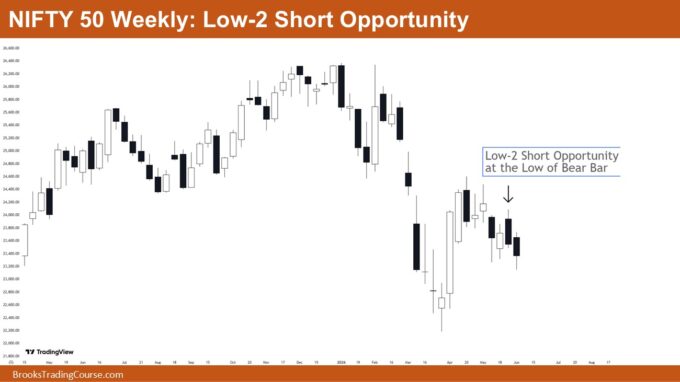
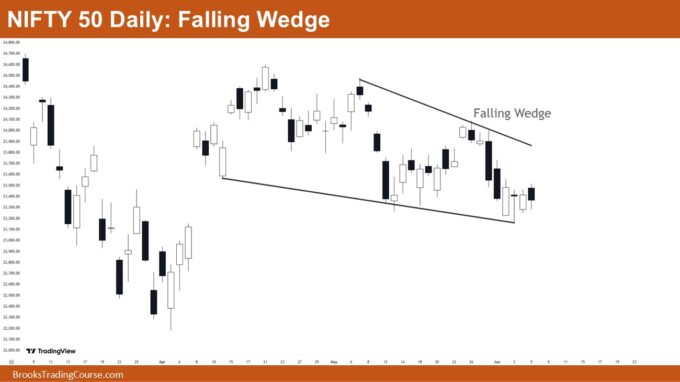
Nifty 50 Low-2 Short Opportunity. On the weekly chart, Nifty 50 is trading in a sustained bear trend after failing to hold gains above 26,200, and the market is currently presenting a Low-2 short opportunity at the low of a bear bar near the 23,400 area. Each rally attempt has formed a lower high with limited bull follow-through, suggesting that bears remain in control and traders may look for continuation of the downtrend on any break below the most recent swing low. Chances are that any pullback into the 24,000–24,200 zone will attract renewed selling pressure. On the daily chart, Nifty 50 is consolidating inside a falling wedge that has been forming since mid-April, with the lower trend line providing repeated support near 23,100. The bars within the wedge lack strong directional follow-through, which is a sign of a trading range, and traders may watch for a decisive breakout above the upper trend line or a failure of the lower trend line to determine the next significant move.
Nifty 50 futures
The Weekly Nifty 50 chart
- General Discussion
- Traders who are holding a long position may want to reconsider their stance given the current price action. The market has formed a Low-2 short setup at the low of a bear bar on the weekly chart, which suggests that the bears are in control. Traders holding longs may tighten their stops or consider exiting, especially if the market continues to make lower lows in the coming weeks.
- Traders who are holding a short position are in a favorable spot. The Low-2 entry at the low of the bear bar is a reliable short setup in Brooks methodology, and the overall context of the weekly chart — with the market well off its highs near 26,200 and now trading in the 23,400 area — supports the bear case. Traders holding shorts may hold with a stop above the most recent swing high.
- Traders who are not holding any position may look to enter short on a break below the current bear bar’s low. This is a Low-2 short entry, and traders may use a wide stop placed above the prior swing high around 24,300. Those who prefer a tighter stop may wait for a small pullback bar and enter on its low.
- Deeper into price action
- The weekly chart shows that after reaching a high near 26,200 in late 2024, the market has been in a sustained bear trend, forming a series of lower highs and lower lows. The recent price action shows a rally attempt into the 24,200–24,400 area that failed to generate strong bull follow-through bars, which is a sign that the bears are still in control of the market.
- The Low-2 short setup is formed after two legs up from the lows. The first leg up from the March 2026 swing low reached around 24,300, and the second leg formed a smaller rally that was unable to close strongly above the prior swing high. This is a classic Low-2 entry, and the annotation on the chart points to a short opportunity at the low of the most recent bear bar, suggesting that traders who missed the first leg down may look here for an entry.
- The market has been making lower highs on every rally attempt since the peak, and each bear bar has been closing near its low, which is a sign of strong bear pressure. Chances are that any rally from current levels will be seen as a selling opportunity by bears, and the market may struggle to reclaim the 24,000–24,200 resistance zone without a significant shift in momentum.
- Patterns
- The dominant pattern on the weekly chart is a bear trend from the high near 26,200, with the market currently trading around 23,400. The series of lower highs and lower lows confirms the bear trend, and the Low-2 setup is a continuation pattern within this bear trend. Traders may use measured move projections from the initial breakdown to estimate downside targets.
- The rally from the March 2026 low into the 24,200 area may be forming a bear flag or a two-legged pullback within the bear trend. If the market breaks below the most recent swing low, it would confirm that the pullback has ended and the bear trend is resuming, which may lead to a move toward the 22,000–22,200 area.
The Daily Nifty 50 chart
- General Discussion
- Traders who are holding a long position within the falling wedge may want to be cautious, as the market is still trading inside the wedge without a confirmed breakout to the upside. The falling wedge is generally considered a bullish reversal pattern after a prolonged decline, but until the market breaks above the upper trend line convincingly with a strong bull bar and follow-through, longs are not yet in a strong position. Traders holding longs may keep their stops below the lower trend line of the wedge.
- Traders who are holding a short position near the top of the wedge may consider taking partial profits as the market approaches the lower trend line. The lower trend line has been tested multiple times and has so far held, which means that shorts may face increased risk of a reversal if the market continues to find support in this area. Traders holding shorts may tighten their stops as the market compresses near the apex of the wedge.
- Traders who are not in a position may wait for a breakout in either direction. A break above the upper trend line of the falling wedge with a strong bull close would be a buy signal, while a break below the lower trend line would suggest the pattern has failed and the bear trend may continue. Entering on the breakout bar’s close with a stop on the opposite side of the trend line is one approach traders may consider.
- Deeper into price action
- The daily chart shows a falling wedge that has been forming since approximately mid-April 2026. The market made a significant low around 22,000 in late March and early April before beginning to form this wedge pattern with higher lows and lower highs converging. This compression of price action suggests that the market is building energy for a potential breakout, and the direction of that breakout will be important for near-term direction.
- The bars within the wedge have been mixed, with both bull and bear bars appearing without clear follow-through in either direction. This is a sign of a trading range environment within the wedge, and traders should be aware that there may be many false breakouts before the market commits to a direction. Chances are that the market will attempt to break out of this wedge in the coming days, and the quality of the breakout bar will be important — a strong bull close above the upper trend line would be more convincing than a weak or overlapping breakout bar.
- The lower trend line of the wedge has acted as support on multiple tests, which suggests that there is buying interest near that area. However, each successive rally has been lower than the previous one, which keeps the overall structure bearish. Traders may look for a failure to break the lower trend line combined with a strong bull reversal bar as a potential long entry signal.
- Patterns
- The primary pattern on the daily chart is the falling wedge, clearly annotated on the chart. Falling wedges after a prolonged bear move are often considered potential reversal patterns, as they represent a slowing of bearish momentum. If the market breaks above the upper trend line with a strong bull bar, traders may look for a measured move up equal to the height of the wedge from the breakout point.
- Within the wedge, the market has been forming a series of small overlapping bars, which is consistent with a trading range. This type of price action often precedes a breakout, and the tightening range near the apex suggests that a resolution is approaching. Traders may watch the next few sessions closely, as a strong directional bar — either bull or bear — may signal the beginning of the next significant move.
Market analysis reports archive
You can access all weekend reports on the Market Analysis page.


