Market Overview: Nifty 50 Futures
Nifty 50 Trading Range Price Action on the weekly chart. The market has been oscillating between major support around 21,600 and major resistance near 26,200 for several months, with neither bulls nor bears able to establish decisive control. The recent price action shows the market pulling back from the resistance zone after multiple failed attempts to break higher, suggesting exhaustion at the top of the range. Traders may wait for a clear breakout with strong follow-through before committing to directional trades. On the daily chart, Nifty 50 recently broke below a rising wedge pattern, creating a bear breakout that has shifted the market to always-in short. The breakdown showed strong consecutive bear bars closing near their lows, and subsequent pullback attempts have been shallow and brief, indicating that bears remain in control and that rallies are likely just pullbacks in what has become a bear trend.
Nifty 50 futures
The Weekly Nifty 50 chart
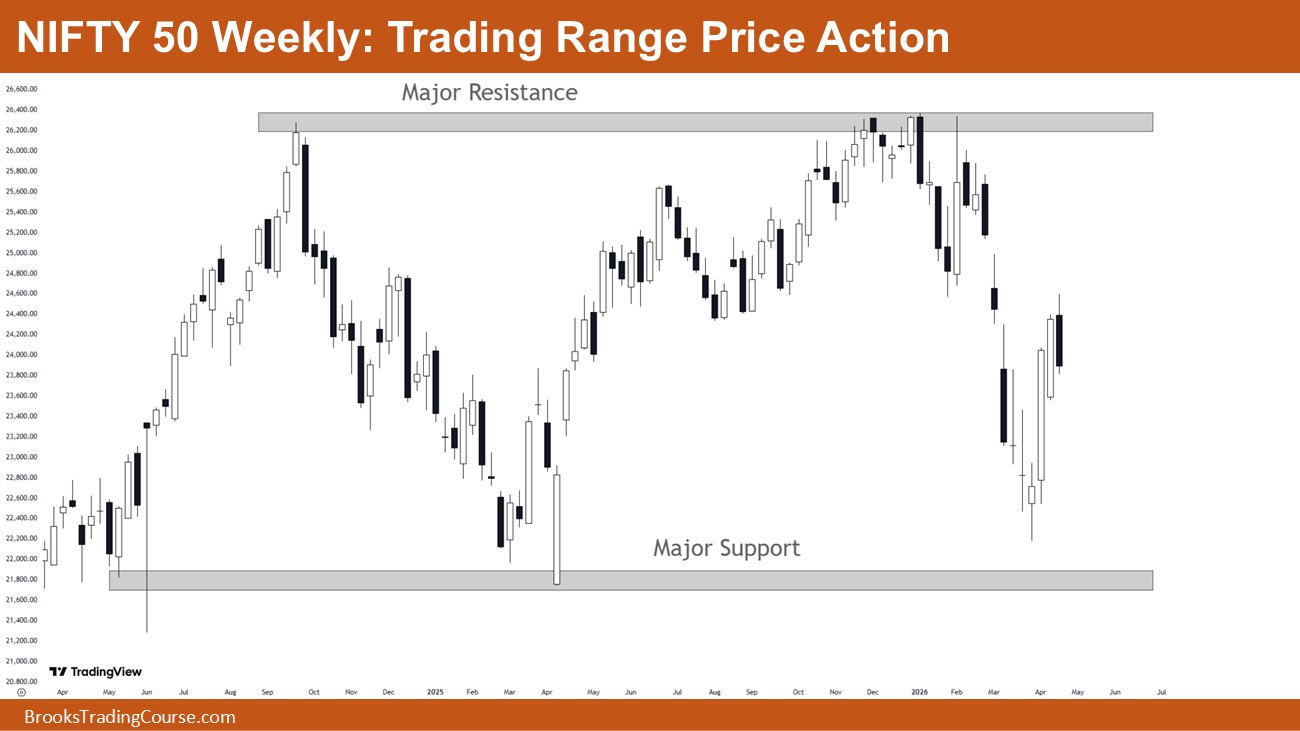
- General Discussion
- Traders who are holding a long position from the major support area may continue to hold with a protective stop below the trading range low around 21,600. The market has been respecting this support zone, and bulls have demonstrated buying pressure every time the index tests this area. Chances are that the bulls will continue to defend this support, making it reasonable to hold longs with wide stops.
- Traders who are holding a short position from the resistance area may also hold, though the context is more challenging for bears. The market has been unable to break below the major support despite several attempts, which suggests strong institutional buying. Bears holding shorts may consider taking partial profits near support and moving their stop to breakeven or just above the most recent swing high to protect against another rally attempt.
- Traders who are not holding any position may wait for a clear breakout from this trading range before committing. If the market breaks above the major resistance around 26,200 with strong follow-through bars, traders may enter a long position on the first pullback with a stop below the breakout bar. Alternatively, if the market breaks below the major support around 21,600, traders may enter a short position on a failed rally back to the breakout point with a stop above that swing high.
- Deeper into price action
- The NIFTY 50 has been trapped in a broad trading range for several months, oscillating between major support and resistance. This type of prolonged sideways movement typically indicates equilibrium between bulls and bears, with neither side able to establish control. The recent price action shows the market testing the upper boundary of the range multiple times, creating a resistance cluster. Each time the bulls pushed toward 26,200, the bears responded with selling pressure, creating overlapping highs that define the ceiling of this range.
- The most recent bars show the market pulling back from the resistance zone, which is typical trading range behavior. After several attempts to break higher failed, profit-taking and short-sellers drove the market back toward the middle of the range. The quality of the pullback matters here – if the bears can create strong consecutive bear bars closing near their lows, it signals strong selling pressure. However, if the pullback stalls with doji bars and weak bear closes, it suggests the bears lack conviction and another rally attempt is likely.
- The major support zone around 21,600-21,800 has held on multiple tests, which is significant for bulls. Each time the market reached this area, buyers stepped in aggressively enough to create reversals back toward the middle or upper part of the range. This behavior creates higher probability for longs near support than for shorts near resistance, simply because support has been more reliable. However, trading ranges eventually break, and when they do, the breakout typically happens when traders least expect it – usually after a quiet period where the range narrows and traders become complacent.
- Patterns
- The chart clearly shows a major trading range defined by the horizontal support and resistance zones. Trading ranges like this one are equilibrium patterns where the market is deciding on its next directional move. The longer a trading range persists, the more significant the eventual breakout typically becomes, as trapped traders on the wrong side scramble to exit when the breakout occurs. Traders should watch for expansion of range – tighter trading and narrower bars often precede breakouts.
- Within this broad range, the market has created several smaller swing patterns, with rallies from support met by resistance from overhead supply. This creates a stair-step pattern of higher lows during the early phase, followed by lower highs more recently, suggesting the bears may be gaining slight control. If the market continues to create lower highs while holding above support, it forms a descending triangle pattern, which typically breaks to the downside.
The Daily Nifty 50 chart

- General Discussion
- Traders who are holding a long position from before the wedge bear breakout may have already exited or should seriously consider exiting now. The wedge break represented a clear trend reversal signal, and the market has followed through with additional selling pressure. Any longs still holding at this point should use tight stops just above the most recent minor swing high, as the odds now favor the bears. The breakout has shifted the market to always-in short, making it difficult for bulls to profit without a significant reversal.
- Traders who are holding a short position from the wedge breakout may continue to hold with a stop above the wedge bottom trend line or above the breakout point. The bear breakout created strong momentum, and the subsequent price action shows bears maintaining control. Shorts may trail their stops lower as the market makes new swing lows, protecting profits while allowing the trade room to develop. Given the strength of the initial breakdown, chances are that the market will test lower support levels before any meaningful rally attempt occurs.
- Traders who are not holding any position may look for short entries on pullbacks to the wedge trend line or on failed bull reversal attempts. The best entry would be to sell a rally back toward the breakout point around 24,000-24,200, which would represent a test of the broken wedge support turned resistance. Alternatively, aggressive traders may sell at the market with a stop above the most recent swing high, though this offers less favorable risk-reward than waiting for a pullback entry.
- Deeper into price action
- The wedge pattern that formed prior to the breakout is a classic topping structure in Brooks methodology. Wedges represent climactic behavior where bulls push higher with each rally, but the momentum weakens with each push. Notice how the rallies within the wedge became progressively weaker – the distance between swing lows and swing highs compressed, and the angle of ascent flattened. This type of buying exhaustion typically precedes reversals, as it signals that bulls are running out of buying power and bears are becoming more aggressive on each rally attempt.
- The bear breakout itself shows good quality with strong consecutive bear bars closing near their lows. When a wedge breaks, traders want to see immediate follow-through with conviction – not hesitant doji bars or bull reversal attempts. This breakdown delivered that conviction, with sellers creating large-bodied bear bars that quickly moved away from the wedge. The speed and strength of this initial selling suggests institutional participation, not just retail profit-taking. This increases the probability that the selling pressure will continue and that rallies will be sold.
- After the initial breakdown, the market has created several bear bars and pullback attempts, but notice that the pullbacks have been shallow and brief. Each rally attempt gets sold quickly, creating bear bars that overlap or exceed the prior bull bar’s range. This behavior indicates that the market is now always-in short, meaning bears are in control and any rally is likely just a pullback in what has become a bear trend. Until bulls can create strong consecutive bull bars with follow-through buying, the path of least resistance remains down.
- Patterns
- The rising wedge pattern is one of the most reliable reversal patterns in price action trading, particularly when it follows an extended rally. Wedges have three distinct pushes higher with trend lines that converge – each push represents weakening momentum. The wedge bear breakout typically leads to a measured move decline equal to the height of the wedge, projected downward from the breakout point. Traders should watch for the market to reach this measured move target, as it often represents a logical profit-taking area for bears and a potential reversal zone for bulls.
- Following the wedge breakdown, the market appears to be forming a bear channel or bear flag pattern in the recent price action. The pullbacks are shallow and brief, with bear trend lines containing the rallies. This type of post-breakout behavior is typical – after a strong initial move, the market often enters a trending channel phase where it grinds lower in a more controlled fashion. Traders can sell rallies to the bear channel trend line or sell breakouts below prior swing lows within this structure, using the channel as a roadmap for entries.
Market analysis reports archive
You can access all weekend reports on the Market Analysis page.


“This behavior creates higher probability for longs near support than for shorts near resistance, simply because support has been more reliable.”
Thanks Rishi for the article.
I am not clear on this assessment. Selling has been equally agressive at Resistance(Long bear bars near resistance band).
In such a case, why is support more reliable – is it because given equal strength in Buying/Selling, Buying strength takes precedence for quality of support ?
Thanks Rishi, as always.