The support forum is built with (1) General and FAQ forums for common trading queries received from aspiring and experienced traders, and (2) forums for course video topics. How to Trade Price Action and How to Trade Forex Price Action videos are consolidated into common forums.
Brooks Trading Course social media communities
Brooks Trading Course Learning Resources >>>

Hello there, I am seeking some help in the pursue of my trading profitability goal.
I have been trading for the past year, and I am regular when it comes to entries. My goal as always been to have the same entries as Al (I check it when he posts the summary of price action) and not really the amount of money I make. So far, I can have 90% of the same entries as Al does, which I think is a good thing.
The real problem comes with the profit taking, throughout my small journey my understanding is that one will never know exactly where to take profits because no one knows how far the market can go, and due to this, I came with the idea that instead of taking profits I would reverse my position once I saw a stop order signal in the opposite direction. And here is where I need some help, because or me is super exhaustive to my mind to have a good 2:1RR profit and then that turn into nothing or even a losing trade.
My real question is, am I better off taking profits at a 2:1RR for example or should I continue trading the way I do ?
I will attach yesterday's (03.02.2025) trading day with my entries and losses.
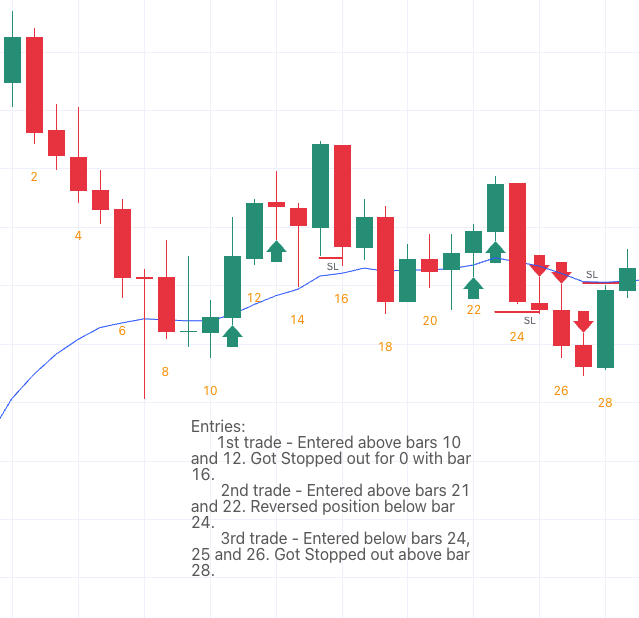
After I got stopped out with bar 28 I was frustrated because I was in profit in all trades and all of them became breakevens or losers and stopped trading to prevent stupid mistakes to happen.

throughout my small journey my understanding is that one will never know exactly where to take profits because no one knows how far the market can go
This is true, but Al also says that experienced traders take profits at supports and resistances. And how the market acts after the test of support or resistance determines further probable price action. So, it is always a good thing to take at least partial profits at 2x your initial risk since you clearly scale into your trades.
If you're someone who hates losing out on a good move, you can decide if you want to re-enter. But, experienced traders are taking profits at reasonable targets and so should you.
I would reverse my position once I saw a stop order signal in the opposite direction
Al also says something about this. He says that you need more reasons to enter a trade than to take profits. You enter a trade on a much better setup than the ones where you decide to take profits. If you're struggling to be consistently profitable, what you should do is to focus on taking just 1-3 good swing trades in a day instead of trying for all of at least most of Al's marked swing entries. The note below his chart markups point to something as such. Most setups don't lead to swing trades and traders quickly scalp out for a small profit or loss. Since this is something a beginner cannot do well consistently, you're better off focusing on the best trades of the day.
Bars 10 and 28 were reasonable buy setups of the day - 20 bar gap setup and EMA gap bar setup. Only when both these failed, did the bears have any real chance at a swing which they got.

You need the watch/re-watch the videos on good trades gone bad (51-52). Also, a trigger in the opposite direction is not always a reason to enter in that direction. You need to STOP automatically reversing on counter trend signals.

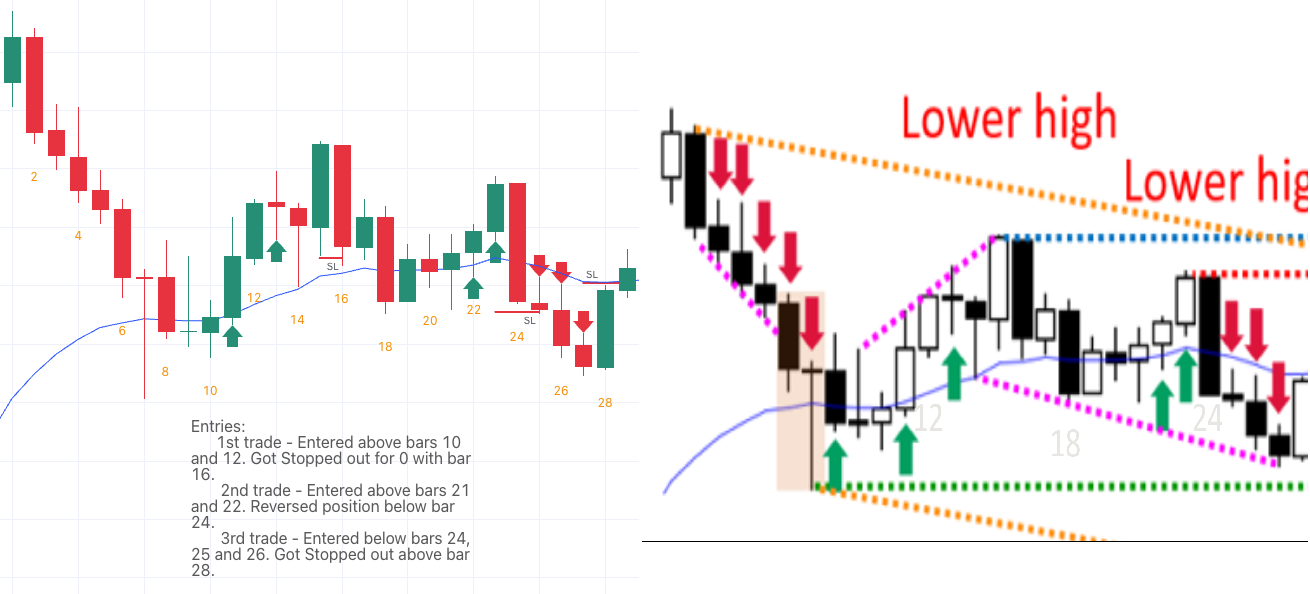
great entry/exits
try an experiment: scale out profits at 1x, 2x, and 3x
(if you can trade 3 contracts)
exit at credible opposition
...or sell the close of bar 3 and trail stop above major lower highs until end of session.
+ 100 points

My opinion, probably better to not add on to your winners until you have a very clear understanding of what is strong trend or reversal setup and what is more scalp or leg in TR setup.
Well, also need this understanding to better understand which setups you should hold until an always-in flip and which ones to take profit on 2-3 leg or 2 iR or whatever

You looked for swings in what turned out to be a trading range. It happens.
But there are also days with plenty of good swings.

I understand what you are saying, I've been there myself. I've only been profitable for a little while now after struggling for 9-10 months. Here is what I changed:
1) I stopped adding to my trades
2) I had noticed that very often when I was moving my stop loss, the market would stop me out and then go in my direction, which was frustrating. So I started to force myself to NOT move my stop loss (very hard to do). Al says to go to Walmart and come back 2 hours later 😉
3) I trade a small size, between .33% to 1% of my account so the losses are not stressing me out.
4) I do not look at my P&L as much as possible.
Hope it helps!

It sounds like you're trying "always in" trading rather than getting in/out and moving on to the next trade. There's times when always in trading can work well, particularly if there's reasonably large swings with relatively clear reversals and minimal amounts of smaller trading ranges within the larger moves. However, on a day where there's lots of overlap between bars and ranges are tempting a trader into looking for stop entries betting on a breakout to succeed for a swing, it's relatively easy to get chopped up. For this reason, I generally don't trade "always in."
Let's talk more about the chart that you shared and the relative quality of entries:
We can't see the strong bull leg up on the far left of the chart, but it can be inferred from how strongly the EMA is rising and the size of the gap between the bull bar (1) and the EMA. That's followed by 7 bear bars with minimal overlap and the best the bulls got during that was some small tails above bar 3 and 4 and a doji on bar 7 - showing that bulls were buying less aggressively than before, the bears were comfortable shorting all the way down, and was likely a sell vacuum test with relatively less buy side liquidity on the way down.
A second entry long off the EMA was somewhat reasonable given the prior bullish strength, especially because the bar 10 signal bar was relatively small and closer to the lows relative to the 3 bars that came before it so would probably at least get a scalp up. However, importantly, given the strength of the bears on the way down and the fact that the signal bar is almost just a doji with a fairly big tail on top, the probability of bears getting a second leg down was relatively high so going for a reward 2x the size of the risk is better trade management if that trade is taken. If I bought the bar 10 H2, used a stop below the signal bar, and the market reached 2x my initial risk, I'd take the profit and move on to the next trade. Another thing, adding above bar 12 was starting to get a bit close to a 50% retracement of the strong bear leg down, the bull bar before it (11) had a fairly large tail on top, and the stop was relatively far away, which makes it a somewhat poor place to add on given the overall context. The follow through bar (13) was a doji, which is disappointing for anyone who did buy the close or a tick above bar 12. That disappointment was confirmed by the fact that bar 14 sold the bar 13 close, likely as bulls exited, and at some point went all the way down to the EMA, never rising above bar 12's close - so bulls who had a limit order to get out at breakeven on the bar 12 close likely did not get filled and those who bought above didn't even have the market come back to that point on bar 14. Bears who did get too short near the low of bar 14 likely gave up on bar 15 and bulls who did buy during and above bar 14 were quick to take profits - which is what traders do in ranges and was a sign of things to come. The bar 9, 12, and 15 highs also formed a wedge.
After bar 16, the likelihood of more sideways movement rather than a retest of the bar 1 high became more significant - what could've happened, but didn't, shows that the bulls weren't as eager as before. However the poor follow through after bar 16 also showed that the bears weren't shorting as aggressively as they were between bars 2-8. The phrase "big up, big down, big confusion: trading range" that Dr. Brooks uses sums up the activity up to this point quite well.
Buying above bars 21 and 22, was buying in the middle and upper third of the trading range between bar 11 to that point. Bar 21 was a doji, which is a 1 bar trading range, preceded by another doji. This is all trading range activity and the range is relatively tight, so buying on a stop with the plan of reversing is a plan that has a fairly poor expectancy since it is turning into more of a limit order market and using stops to enter, and reversing on those, has a higher likelihood of getting whipsawed and continually finding yourself getting too long and too short.
Selling below 24, you were betting on the success of a bear breakout but notice that it was a big bear bar that spanned basically the entire range but did not close below the bar 18 low. That's a large stop for a relatively low probability trade given the activity that came before it. In a range that was more of a limit order market, bulls who bought the bar 24 low actually could've gotten out with a scalp - seen by the tail above it. Selling below 25 was more reasonable, and higher probability than below bar 24, since the bulls had attempted to return the market into the middle of the range, but were unable to do so. Anyone who had bought closer to the EMA on bar 25 was trapped and seeing a low close was enough reason to get out since the big bear bar (24) and the sell off at the beginning of the chart did open up the potential of getting caught on the wrong side and having the market have follow through selling. Selling below bar 26, where there was a tail below the bar and significant overlap with bar 25, was again a relatively risky entry given the overall context of the day. If it had closed at or near the low it would've been a more reasonable entry for a possible measured move down based on the height of the range or the bear leg from the beginning of the day. Overall though, it was essentially a trading range day and selling on a stop far away from the EMA when the selling pressure was reduced going into the close of the bar was a lower probability entry.
The main takeaway is that context matters a lot. Based on your trades, I think you may have a bit of a tendency to want to enter on a stop beyond trend bars without considering the overall context around it.

Nice explanation & good understanding !
Thanks a lot for detailed explanation.

Thank you!


