Market Overview: Bitcoin
- This week, Bitcoin reached the $100,000 level.
- The bounce from Q1 lows gained strength.
- All-time highs are close. A test at some point seems inevitable.
- Still, the current tone shifts.
- From bullish optimism to caution and patience.
Bitcoin
The Weekly chart of Bitcoin

2024 Structure Review
- Bitcoin traded between $50,000 and $75,000 for most of the year
- In late Q3, price broke through $74,000
- Rally extended to $100,000, peaking at $108,000
- A three-month double top formed
- The neckline at $90,000 broke and retested $75,000
$75,000 became a critical level:
- It was the breakout point of the 2024 range
- It matched the IBIT ETF breakaway gap
- Buyers stepped in strongly
- No signs of panic selling appeared
- After the early 2025 lows, a High 3 setup formed
- We identified it as the first valid buy setup since the correction
- The trigger led to ok follow-through, which was also validated within our report
- Bulls hit their 2:1 target this week
Keep in mind:
- The High 3 happened inside a bear channel
- That reduced the probability of success
- But the reward-to-risk was favorable
- Many traders took the trade on that basis
Trend and Supports
- Trend traders may still wait for a close above all-time highs
- But they also need a tight trading range to form
- Without one, stops are wide and risk is high
- A tight range would offer a better entry
Below current prices:
- 26-week EMA may offer dynamic support
- There’s a 4-bar bull micro channel
- Buyers are likely below this week’s low
Bear Positioning
- Bears do not have a clean short entry
- They may wait for a Low 2 or Low 3, or ii, ioi setups
Takeways
- April’s gains followed the Q1 rebalancing play we highlighted
- High 3 buyers took profits, they’re not fueling the rally now
- No clear presence from bulls or bears at this moment
- Ask yourself:
- If no one’s committed, what’s likely to happen next?
- A sideways or pullback seems likely
- But no strong case for either side exists
- We should not care about what happen next, but what do we do next:
- Buy a Breakout Mode Pattern
- Buy a H1, H2, H3
- Buy at hypothetical range’s low, below $75K
- Selling Bitcoin long-term charts is not recommendable, better only look to sell on weekly or monthly if it is profit taking
- If no one’s committed, what’s likely to happen next?
The Daily chart of Bitcoin
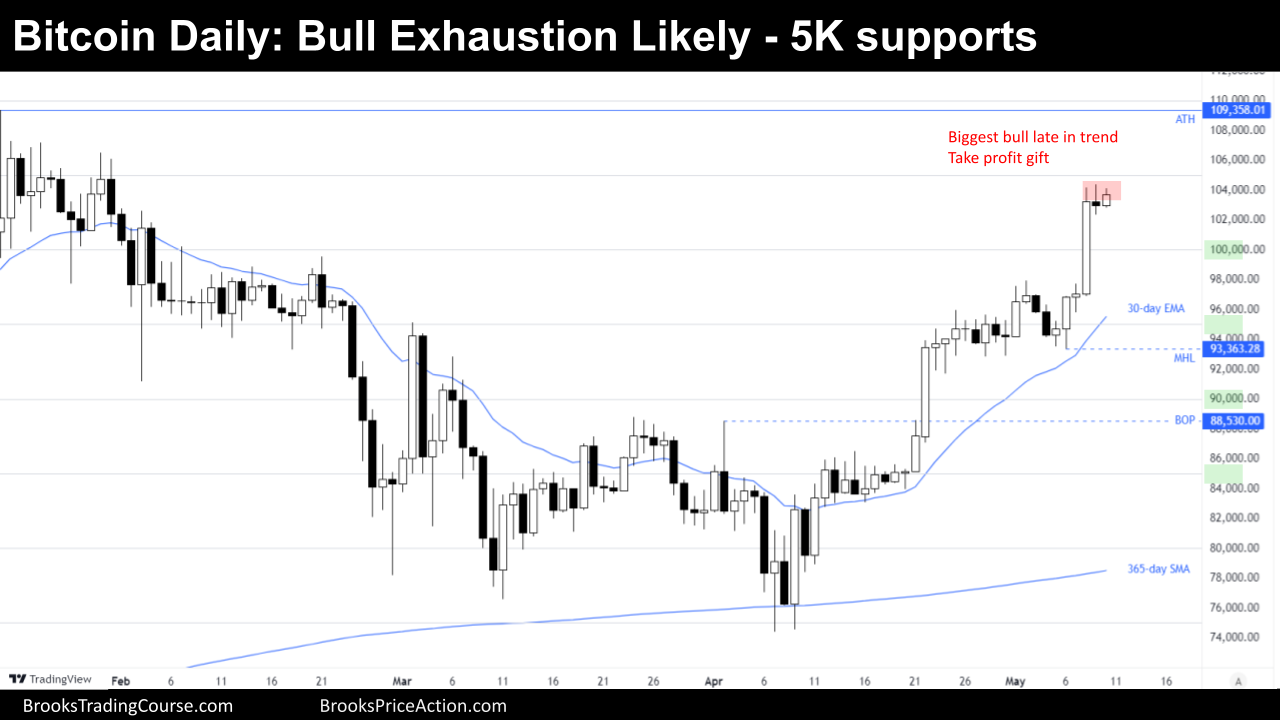
Context and Structure
- Price was in a broad bear channel from all-time highs
- After each bear breakout, the market moved sideways or higher
- That behavior made bears look weak
At $75,000:
- Price tested the breakout point level from the weekly chart
- Filled a Breakaway gap on IBIT zone, created during a major bull breakout in 2024
- Also tested the 365-day EMA
- Institutional support by rebalancing fund demand
Then:
- Bull breakout above the 30-day EMA
- Next, breakout above the neckline of a double bottom around $90,000
- Target of $100,000 was reached this week
- Price even overshot the target
- We expected a second leg up
- Instead, we got a strong continuation breakout
That should raise a flag:
- When a breakout follows a breakout, it often leads to exhaustion
- This smells like FOMO rather than sustainable
Why?
- Weekly bulls took profits, that’s selling
- Who’s buying? Likely emotional, retail traders chasing the move
Still, don’t short blindly:
- Betting against strong bull moves in Bitcoin has historically failed
- That doesn’t mean you buy either
- Risk is challenging to manage with tight stops
- Professionals want structure
- This isn’t it
What are professionals Doing?
- Ask this: Did they buy this breakout?
- Unlikely
So what can they do now?
- Wait for the next Breakout Mode pattern to develop
- Wait for price to pullback to the next round 5k number
- Take advantage of premium pricing through options
A practical idea: Options short put spread (long)
- Sell a put spread at $100K
- Take profits if it hits $105K
- Repeat with $95K, $90K, $85K
Market analysis reports archive
You can access all the weekend reports on the Market Analysis page.


Hi Dawei,
Thank you for your comment and great question!
My preference for a short put spread is based on the ability to sell premium with a defined risk structure and better positive trader’s equation than with bidirectional orders. When the market drops, implied volatility tends to spike, which increases option prices. That’s when option sellers, like in the case of a short put spread, can benefit the most.
Regarding your question on $95K, $90K, and $85K: yes, if we believe there is strong buyer interest or technical support in those areas, as I expect, selling a put spread below those levels can be a strategic way to express that view while collecting premium. The idea is that if price consolidates or rebounds from those zones, the spreads decay in our favor.
This is often more favorable than using outright long calls, especially in a choppy or slowly rising market where time decay works against long options. The short put spread allows for scaling in, rolling, and managing risk in a more structured way—particularly if implied volatility is elevated.
Also, implied volatility not increasing during a drop is an excellent hint. That divergence can indeed suggest that the move down may not have strong institutional conviction behind it, offering useful insights into analysis.
There’s a lot of value in studying options thoroughly and using backtesting tools before deploying strategies. Happy to discuss further if you’d like to explore more setups.
Have a lovely trading week!
Josep
Hi Josep —
Thanks for the great analysis. May I ask about the Options short put spread (long) vs. call options whenever it hits $95K, $90K, $85K? Do we expect sideways up and buyers below $95K, $90K, $85K so that we sell put spread instead of call?
Dawei