Market Video Report: Bitcoin

Duration 16:58 mins.
Summary
Bitcoin prints a weekly bull reversal bar after validating a strong double bottom support. The higher timeframe trading range context now favors a two-legs up structure following a completed corrective phase. A low-probability High 2 buy setup emerges with targets well above $65,000.
Transcript
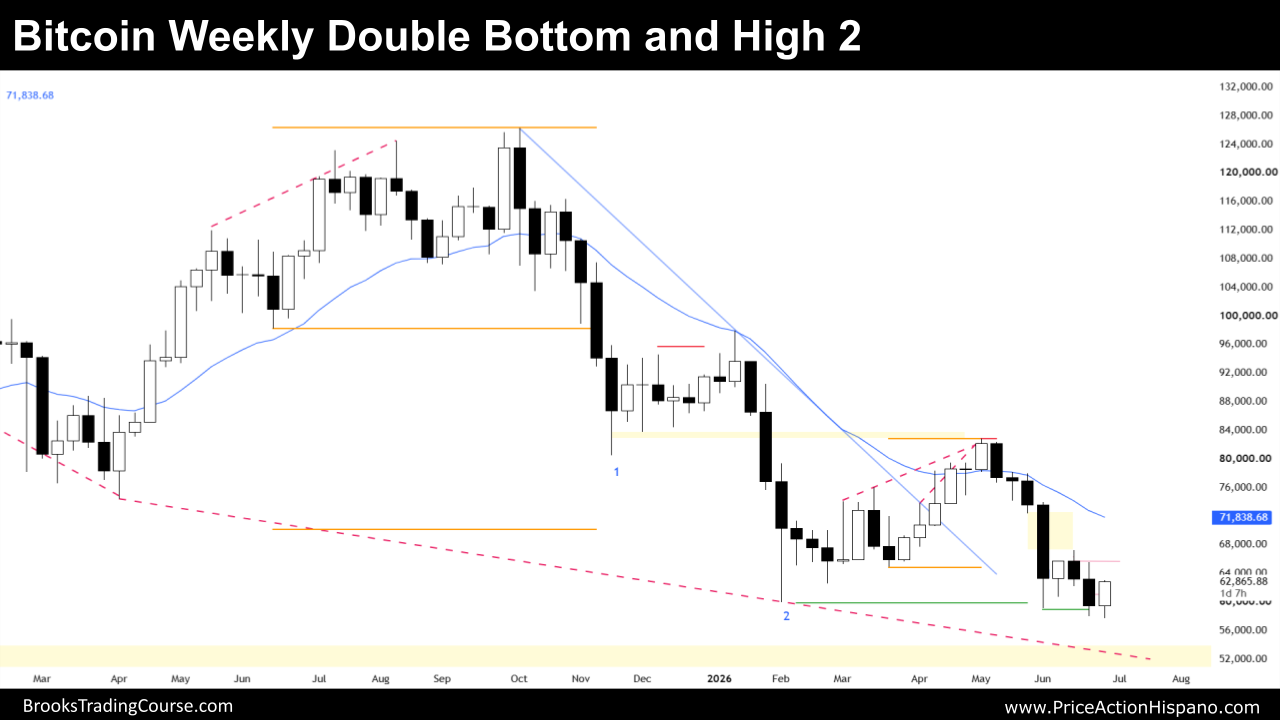
As we noted in our introduction, Bitcoin is currently reversing up. This week, we saw the price break down below the previous week’s low, which triggered a bear breakout. However, the market has shown resilience; the bar is now reversing up and trading near its high, effectively printing a bull reversal bar on the weekly timeframe. Naturally, the question every trader is asking right now is: What does this bull reversal bar really mean for our positions? Let’s analyze the context to understand the broader market picture.
To understand the current setup, we have to look at the market’s history. Bitcoin was previously in a long-term bull trend, which eventually transitioned into a trading range. Typically, when a strong bull trend concludes, the most common transition—and what we are seeing here—is a move into a trading range, often accompanied by a breakdown and a resumption of that range. This strong bull trend was clearly visible on the higher timeframe, specifically on the monthly chart.
Right now, the price has printed a couple of legs down. I interpret this as a complex second leg. After reaching a measured move target based on the previous trading range—specifically on the upper side of the chart—the market broke down. While it may not have perfectly reached the exact height of the first leg, it has certainly printed a second leg of significant height. Markets have completed a structure here, and after a structure of a couple of legs down in a larger timeframe trading range is complete, the most likely outcome is a couple of legs up. We have been discussing this concept for a long time, and we are finally seeing it materialize.
Of course, in trading, we must always leave an open window for the unexpected. There is always a 20 to 30% chance of an unexpected move; that happens two times out of ten, which is actually more frequent than most people assume. However, with the current structures in place, we are waiting for that couple of legs up. The market attempted a bull breakout of this bear flag, but it failed, and bears tested it again to see if there were buyers.
Have bulls taken control with this week’s bull reversal bar? Not yet, at least not on this timeframe. The bulls need a close above the minor lower high—that is, the $65,000 to $66,000 area. Until then, this could simply be a pullback within a small bear leg.
Now, for the bulls who want to buy above this bull reversal bar, I think that is a solid strategy. We are looking at a “High Two” pattern. A High One was the initial bull bar triggered by the breakout, and now this setup presents itself. If next week triggers above this week’s high, it is a high-probability trade with a small risk. Bulls can place a stop-loss one tick below the low of that bull bar.
You have a lot of potential here, but remember: high potential comes with lower probability. If you are going to risk one unit to make two, this trade likely has at least a 40% chance of success. Traders like me often prefer to wait for follow-through because we want a higher probability of at least a small, second leg in the direction of the reversal.
Another bullish point is that this is a double bottom with the February low. Bears did a very strong bear leg here, which made the High One challenging to buy, but the current context provides a strong case. We have higher-timeframe support here, and as a general rule, being a seller at support is not advisable. I believe this High Two has enough good context to be bought, provided that traders manage their trades properly and aim for a minimum 2-to-1 reward-to-risk target.
There is one more crucial element to discuss: we have just closed the June monthly candlestick and, consequently, the second quarter of the year. After each quarter, we often see major rebalancing from institutions. They have to hold specific percentage thresholds for assets in their funds.
If an asset has risen, they must sell to maintain that target; if it has fallen, they have to buy. Bitcoin has been low, and this institutional force is something that has to be taken into account. These quarterly transitions can often trigger major reversals on the weekly, monthly, and daily charts.
Before we move to the daily chart, I want to remind you that the Brooks Trading Course website is the definitive resource for anyone who wants to become a professional trader. Visit the “Learn to Trade” tab—it is pure gold. You will find the “How to Trade” manual, the best price action patterns, and articles like “Becoming a Professional Price Action Trader,” written by arguably the best price action student from Al Brooks, Ali Moin-Afshari. It is a complete reference for me, and it should be for you, too.
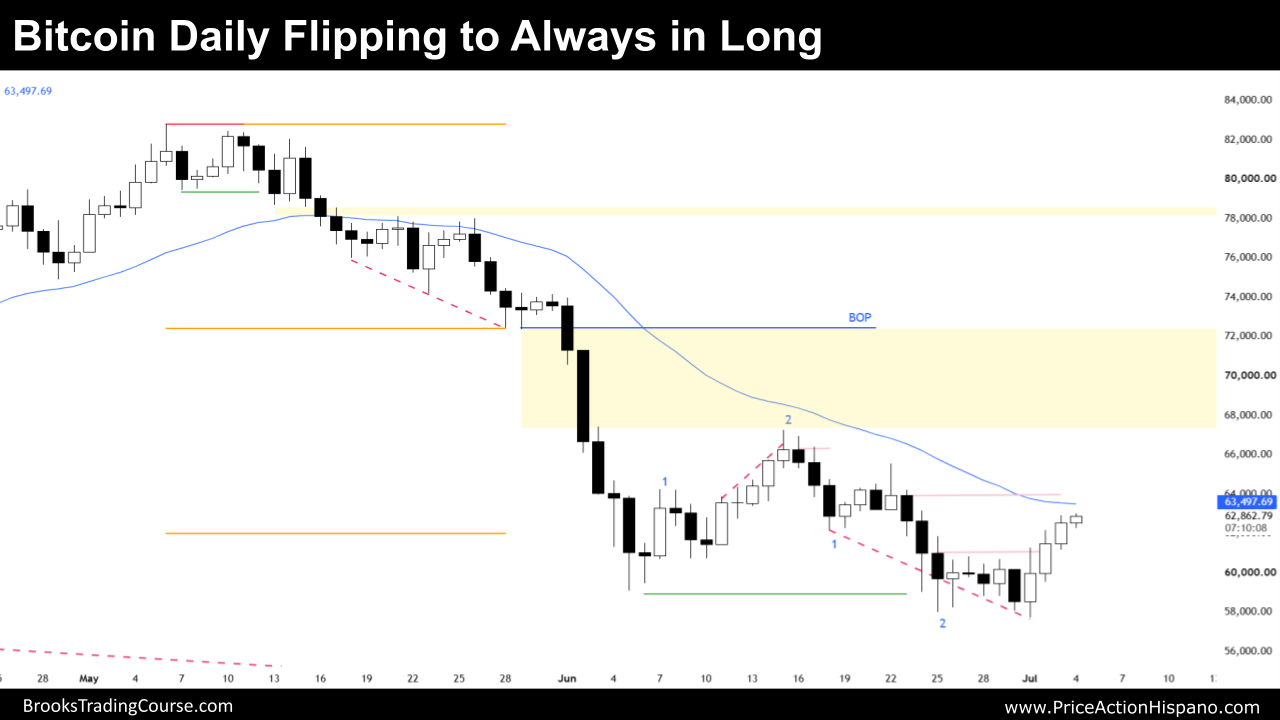
Now, let’s look at the daily chart, which I find very interesting. We see three consecutive bull bars. As always, the first question for any trader is: are we “always-in” long or “always-in” short? If we can answer that, we have a bias. For me, the bulls have taken control above the $60,000 area. If they hadn’t, I would have expected another leg down toward the $50,000 mark. But the bulls have reversed up, and they have created three strong bars.
Some might argue that the bull bars are decreasing in size, suggesting they are losing momentum, or indicating a potential pullback. Those arguments are valid, but the market is likely going to test the area where the bears have control—above $64,000. I expect a second leg sideways to up. I will be looking for long positions, especially since we are low in the trading range on the higher timeframe.
If you are trading this, and you want to trigger an entry, you can wait for a 50% pullback of the bull leg, buy below a strong bull bar, or wait for a strong breakout. If you buy high—chasing the breakout—you need to use a wider stop and a smaller position size to scale in if there is a pullback. For the bears, I wouldn’t be a seller until the bulls lose control. If the bulls fail and the bears take control below this double bottom, then the bears may have another move down to $50,000. But given the current market, the most likely scenario is the bulls testing higher.
For scalpers, take profit on half the position when you hit a scalp target, and then trust your stop-loss to swing the rest. While Al Brooks notes that beginners should focus on the chart in front of them rather than managing data from multiple charts, I believe that having this framework on the weekly chart—which suggests a greater risk-reward equation—is something worth trading.
Again, this analysis is for educational purposes. We are not providing financial advice, but we are traders discussing market scenarios. This is a good situation to trade, and that is all I have for you today. Thank you for your continued support, and I appreciate your comments on these reports week after week. Please visit the Brooks Trading Course website for more, and I will see you next week.
Market analysis reports archive
You can access all weekend reports on the Market Analysis page.


