Market Video Report: Bitcoin

Duration 29:51 mins.
Summary
This Bitcoin Price Action analysis identifies a current trading range on both weekly and daily charts following a strong bear leg. The market shows exhaustion, with higher timeframe support near $48,000 to $50,000. Key upside targets include $80,000 and $90,000. Traders will look to buy low near double bottoms or sell high near double tops.
Transcript
Introduction: Hello everyone and welcome back to this week’s Bitcoin price action analysis. My name is Josep Capo and I am a trader and an author for the Brooks Trading Course website. Thank you for joining us today as we take a look at the weekly and daily charts of Bitcoin using the Al Brooks methodology.
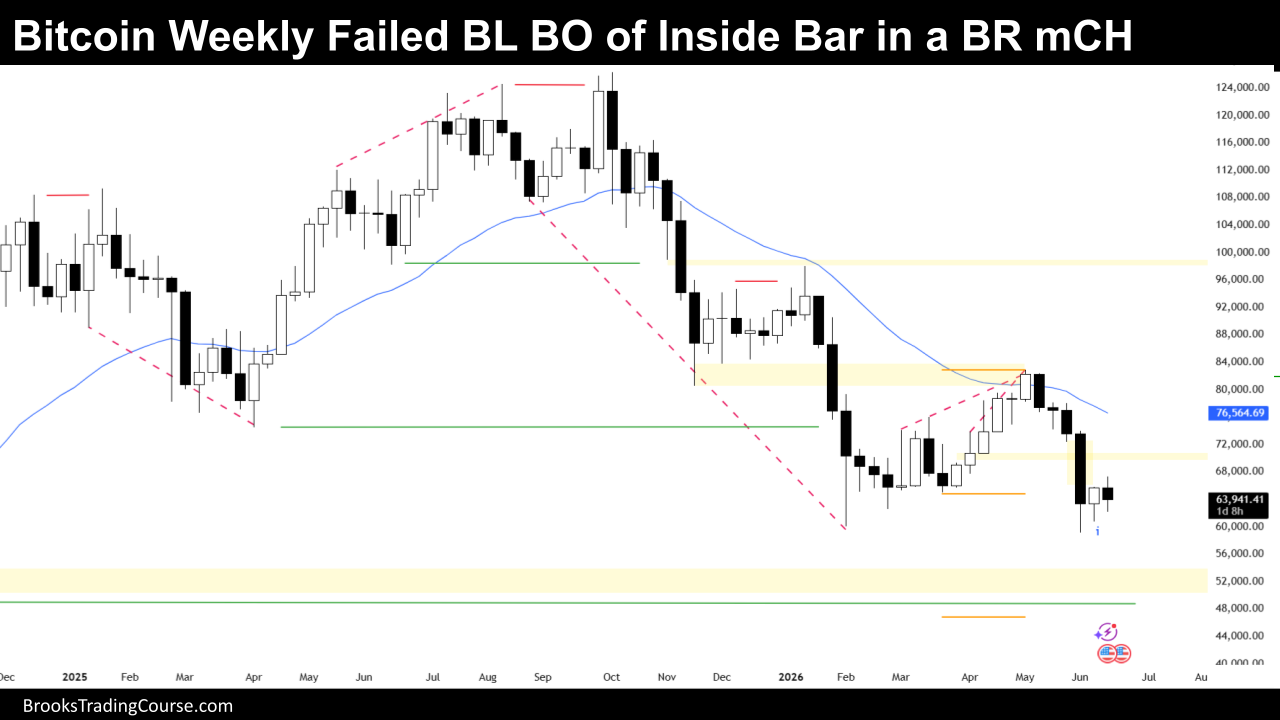
Weekly Chart Overview: This is the weekly chart of Bitcoin and I’m going to explain a bit what the context of this chart is. We have to determine first always whether we are in a trading range or in a trend. In this case, I am thinking that we are in a trading range and I am obviously going to show you why. The main reason why I expect this to be a trading range is because of what’s on the left of this chart. There is a lot of price action.
Market Patterns: There was a bull breakout here, and we have a lot of price action on the left. Then we have a wedge bottom—one pullback, two pullbacks, three—or you can think of it like this is a trading range and we have one leg down and kind of symmetrical two legs down. It doesn’t matter much how you call it. The point is that traders look at this and they think that this bear trend is likely exhausted and that below these lows there might be buyers.
Support Zones: This yellow area is from a higher time frame, say the monthly chart, where you can see more of what’s on the left. It is an area without much participation or trading happening and a lot of reversals from there. The price doesn’t like to spend time there, so that is a support zone. Also, this green line here is a monthly level which is a major higher low on the monthly chart. It’s kind of a double bottom there. The price perfectly can come and test these areas again, but that’s not too far from where the price is currently.
Bull Strategy: Bulls know that if they buy below lows, like happened there, and they scale in lower, they are able to make money or they know that if they buy low, they will be able to get out without a loss. It’s a way of saying that the downside potential is limited. For this reason, this is an incentive for buyers to not be afraid to buy bear breakouts.
Bear Breakout Analysis: This is what created this pattern here. We have this strong bear breakout. If you recall, we have been discussing this bear breakout; everyone was panicking and we were pretty quiet because we know that it was a second leg down. Maybe a low probability event is in play, but normally this is exhaustion. We were actually expecting a couple of legs sideways to up.
Market Magnets: We were discussing the possibility of testing the middle third of this trading range or the middle third of this bear flag, which is also a magnet. That is something that I am expecting. Some Brooks price action traders will say this is not a wedge because this high is above the previous high, but that’s not true. We are very flexible with patterns and it doesn’t matter if you see one pullback, two, and this pullback three. It is an untruncated wedge, which is also a good way to view these kinds of patterns.
Bull and Bear Strength: The point is that the market is reversing up constantly, and that eventually weakens the bear strength. Bulls have tried to reverse the trend here by doing a bull micro channel. They controlled the price action for six weeks, which is more than a month. That demonstrates that in a persistent way, bulls were willing to buy and bears were not willing to sell around these prices.
Weekly Signal Failure: In my opinion, this bear leg here doesn’t have a lot of bearish strength, and I think that it’s more likely that this is just a bear leg in a trading range. What’s important is that the price has reversed up slightly, creating this possible double bottom. If bulls are eager to buy low because they see limited potential for the bears, they may be eager to buy a reversal up. An inside bar alone can be that signal for the bulls after a bear climax.
Inside Bar Dynamics: It is true that because inside bars tend to fail more, the breakout of an inside bar tends to fail more than any other kind of bar pattern. But after a climax, it is a kind of contraction that can have an expansion. Often an inside bar serves as a breakout setup. This is why Al Brooks repeats all the time that signals or candlestick patterns in isolation are meaningless because they are all context-dependent.
Risk Management: I believe that if you are a bull buying above this inside bar, you have to be willing to buy more lower. I don’t think that you have to have a stop loss here. I believe bulls buying there maybe are placing their stop loss at a measured move down based upon the size of this bull micro channel. They project this down and this drive is around $48,000. If you are buying here, you are using a wide stop.
Weekly Expectations: So far this week, the price traded above the previous week’s inside bar, triggering this signal, and the bull signal failed, which is bad for the bulls. This increases the chance that there will be a test of the low of that inside bar, and that’s what I think is likely going to happen next week. If the price tests the low of the inside bar but then reverses up, that is a stronger setup for the bulls for several reasons.
Bear Psychology: Imagine you are a bear seeing this and you start to sell thinking you are going to reach the $50,000 level or a measured move down based upon the height of this bull breakout. Then you see that possible double bottom and a bull inside bar closing around its highs. You are disappointed and start thinking that maybe you were selling too low. If you are selling too low, you are going to try to exit your position. If the price retests your first entry, you may give up.
Upward Targets: If you see a bull reversal, it means those sellers are not pressing on the downside anymore, and bulls have a better setup for a swing up. You have more chances of catching a couple of legs up. You may think the price is going to test either this high or the high of this major lower high. The main targets for me will be this area of $80,000 again, and then the $90,000 area because it is a magnet at the bear flag apex.
Downside Considerations: On the downside, I don’t think the bears that sold there are happy. They probably try to exit on this test down here. Maybe this bull micro channel was just those bears that sold lower during the bear breakout giving up. Buying here with all this bearishness is a bit hard. So maybe this was caused by bears buying back their shorts, and now the market is testing if there are shorts there to continue down. I don’t think so for the reasons explained.
Micro Gap Analysis: I believe the market can perfectly trade down to the $50,000 area, but I believe the market is in a trading range and maybe creating a double bottom. After a double bottom, we can expect a couple of legs sideways to up. Some more nuances: there is a gap between the low of this bar and the high of the inside bar. This is a micro gap, and in a trading range, this gap should be filled. If the price creates another breakout and leaves this gap open, that’s a sign of strength for the bears.
Learning the Methodology: Before going into the daily chart, I would like to address how to best learn the Brooks methodology. Everything you need to know is found in the Brooks Trading course website. When you start, the most important one is the “Learn to Trade” app. There is a “How to Trade” manual, and a “10 Best Patterns” article featuring patterns that are always in front of our charts and create our trading opportunities. There is also an article on becoming a professional price action trader, a trading room, and information about workshops. You can find a link in the description.
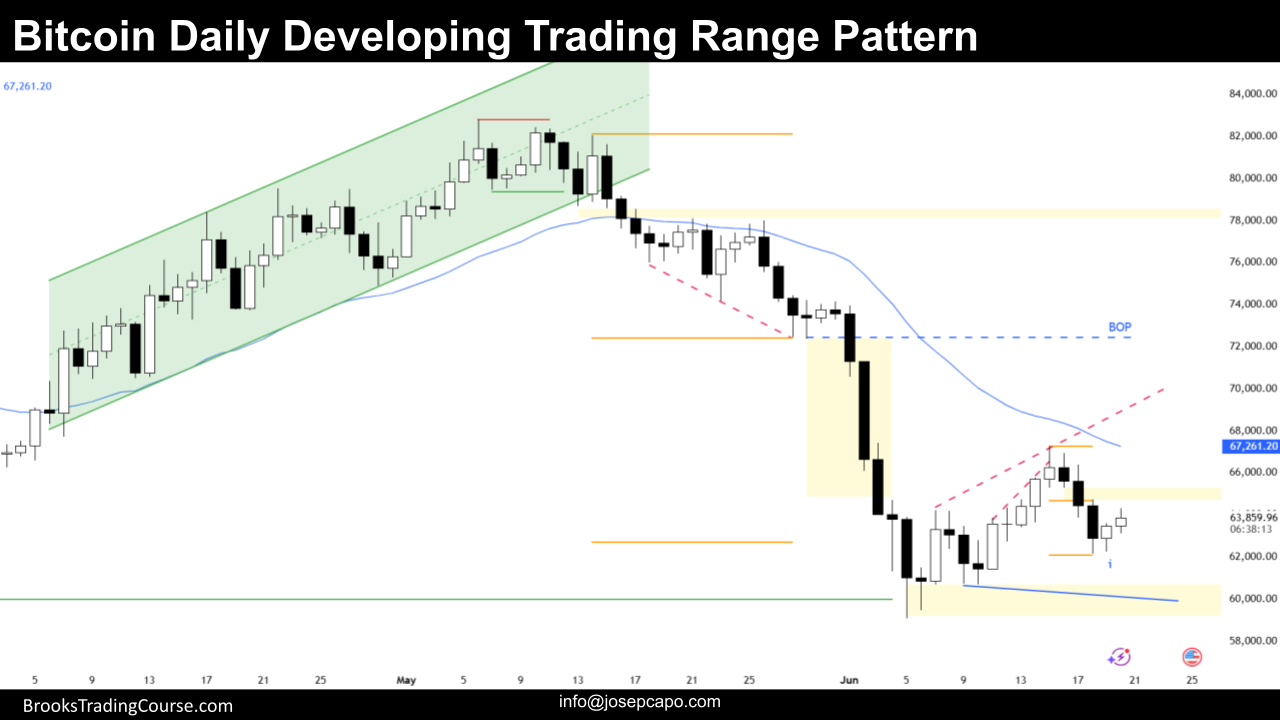
Daily Chart Context: Now this is the daily chart of Bitcoin. Let us remember that we are coming from a major trend reversal. You can see a bull channel on the left that broke down below the bull trend line or the EMA. After this breakdown, traders normally wait for an attempt to resume the trend. If this attempt fails, they look for a major trend reversal setup. After that, they expect a couple of legs sideways to down because the most likely scenario after a bull trend is a trading range.
Daily Chart Breakdown: What happened here is the price didn’t test upwards and created a wedge bottom or tight bear channel. There was a 70% to 75% chance that the price would reverse up for at least a couple of legs. Instead, we have a surprise low probability event: a really strong bear breakout. It did a measured move down based upon the height of the whole pattern. We began to see profit-taking and the market was finding reasons to stop.
Daily Range Evolution: A more important reason is that if you are selling here, your stop loss is far away. You have to enter with smaller position size or wait for a pullback. After such a breakout, especially after you reach targets, the price is likely to become a trading range. Even if you see bull breakout failures, this can be anticipated using the Brooks methodology. Since there was such a big breakout, our expectation is to see more trading range behavior where traders buy low and sell high.
Bull Failure and Retracement: We have seen two legs up and now there is a reversal down. These bulls broke above some kind of triangle and then there was a reversal down. They took this high, created bull follow through, and then there was a bear reversal and bear follow through. Bulls failed here and bears were able to retrace all this bull channel by about 75%. Whenever there is a retracement that is two-thirds of a previous leg, it considerably reduces the chances of testing the high before testing the low of the bull channel.
Daily Market Outlook: For the bears, they left a micro gap between the low of the first bear reversal bar and the high of this third bear bar. We have one small bear bar and two good bear bars. In a trading range environment, we expect one or two legs. The most likely outcome is a test of this week’s low, and it may even go lower to test the low of the bull leg. We expect that to fail and give a good opportunity for longs.
Closing Scenarios: If bulls go up, this might form a wedge bear flag or wedge top, which delivers a 75% chance of a couple of legs sideways to down. I hesitate that bulls will be eager to buy above $68,000. While this micro gap is open, the likelihood is that the price will test lower. If it closes, bulls and bears are confused. It is best to try to buy a reversal up from potential double bottoms or look to sell potential double tops.
Final Summary: At the time of recording this analysis, it is a Saturday. The inside bar on Friday as a bull signal is really weak and I believe there are more sellers than buyers above. Before ending, let me show you how similar the patterns are on the weekly and daily charts—strong bear legs followed by trading ranges. If you enjoy the video, please like and subscribe. See you next time.
Market analysis reports archive
You can access all weekend reports on the Market Analysis page.


