The support forum is built with (1) General and FAQ forums for common trading queries received from aspiring and experienced traders, and (2) forums for course video topics. How to Trade Price Action and How to Trade Forex Price Action videos are consolidated into common forums.
Brooks Trading Course social media communities
Brooks Trading Course Learning Resources >>>

I'm confused about the chance of a successful with-trend breakout of a channel. Is it 25% or is it 25% of 25%, i.e. 6,25%?
In slide 16E (and in the slides before), Al clearly states that there is a 25% chance of a successful breakout of a channel in the direction of the trend while showing the following example:
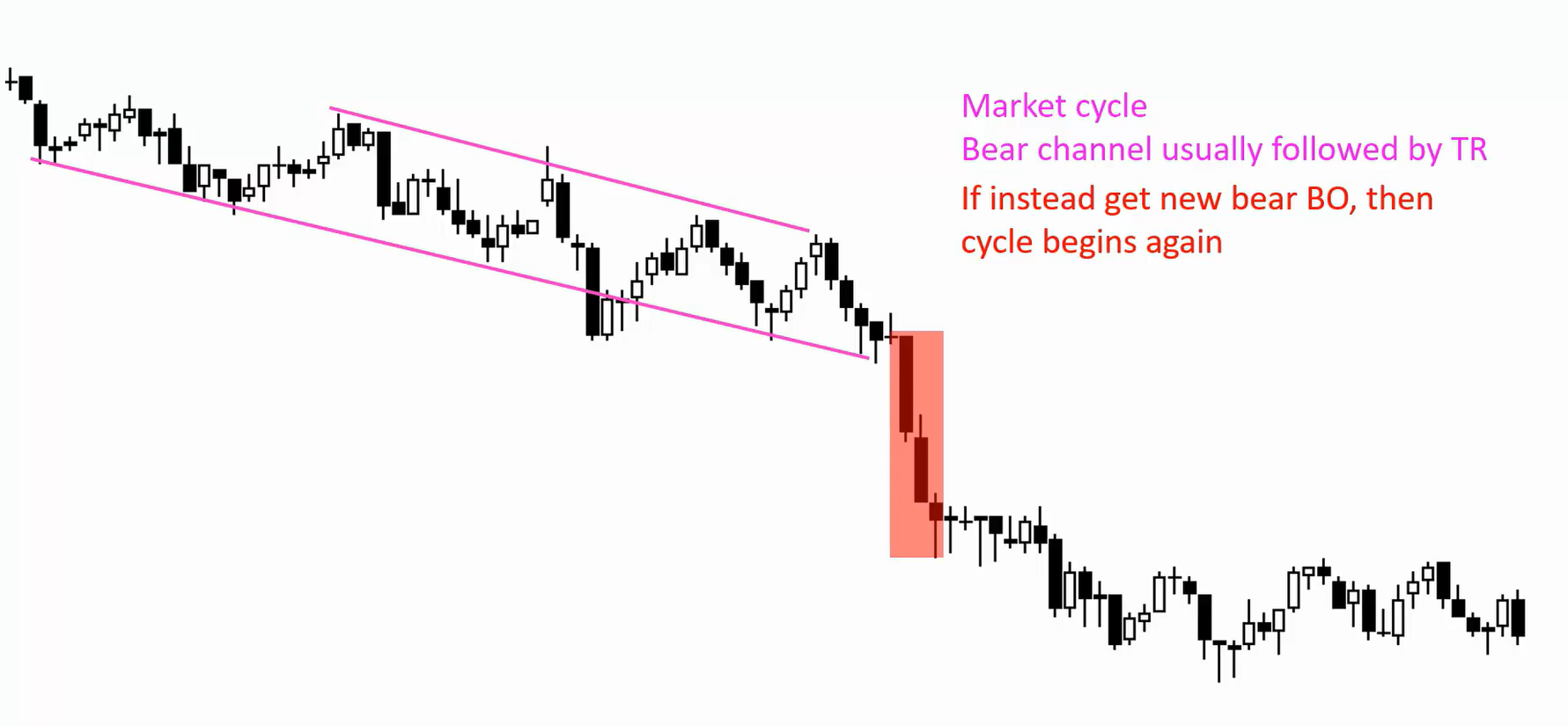
Yet, the 75% rule states that 75% of all channel breakouts fail and reverse within five bars (on the highest timeframe that has the channel). Al repeatedly stresses that this holds true for breakouts in both directions of the channel. Given that we are on the highest timeframe that has the channel, shouldn't the chance of a successful with-trend breakout be lower than 25% and more like 6,25%?

I came here with this exact question! I know it is semantics but I feel like I need clarity on this to better know what I should expect.
I need to watch this video again, but I'm pretty sure that, as wwombat mentioned, there is a 25% chance of a channel Break Out in the direction of the trend succeeding. To make sense of this rule combined with the chard above, we might need to think about the Al Brooks definition of "reversal" and how someone might read the price action after the highlighted BreaK Out as a Trading Range.
First, defining reversal may add clarity: A "reversal" is a change from a trend to a range. Or, a "reversal" is a change from a range to a trend. A reversal, as Al uses the term, is not a change from a bear trend to a bull trend. Some where in his videos he mentions that "V" bottoms are rare. This definition of "reversal" has to do with the market cycle: Bull Break Out, Bull Channel, Trading Range, Bear Break Out, Bear channel, Trading Range, etc. Al sees a Trading Range as a "trend"--a trend in the sense that the market has inertia sideways. So, in the price action above, the Bear Trend "reverses" into a Trading Range.
In light of that, here is my reading of the price action above: There was a two or three bar Break Out of a Bear Channel that is highlighted. Then, a Tight Trading Range started for 7 or 8 bars.
Those six or seven doji-type bars were a Tight Trading Range, and some traders would consider any price action after that as being in a Trading Range until a clear break out formed. One might argue that the two big Bear Trend Bars counted as Break Out and Follow Through. But, I would say that form a Tight Channel in a Trading Range because there is a two bar reversal and a doji between those two Bear Trend Bars.
And, those two Bear Trend Bars form the last two points of a wedge that began with the 3rd bar in the Tight Trading Range, the one that has a longer tail. That wedge creates Support and definitely ends the extra Bear Break Out and Channel because the last 20 bars of the day are a more clear looking Trading Range.
If I don't consider the Tight Trading Range after the Break Out as the end of the Bear Trend, I would definitely consider the Trading Range after the Wedge as the end of the smaller Break Out and Channel that ended the Bear Channel.
So, technically, that Break Out at the end of the Big Bear Channel did not succeed. It transitioned, or "reversed", into a Trading Range.
Does that all make sense?
Hi Ryan. Thanks for taking the time to give your thoughts on it!
I see that slide as an example of a successful bear BO below a bear channel. CC big bear bars closing on their lows and the move got a MM of the distance from the top to the bottom of the channel at the time of the break out, and it reset the MKT cycle - bear break out, channel, TR.
The part where I lacked clarity was in calculating an expectation when I see a bear channel - If only 25% of the time you get a bear BO, and 75% of the time you get a bull BO, AND 75% of either those BOs fail within 5 bars and come back into the channel, then when I see a bear channel I can't think to myself "there is a 25% chance I see a successful bear breakout", I have
to think to myself there is a 25% chance I see a bear breakout, and then there is a 25% chance it succeeds/75% chance it fails and goes back into the channel and likely tries to test the top channel line.
That is where wwombat is saying, when you see a bear channel there is a 6.25% chance of seeing a successful bear breakout, because there is only a 25% chance you see a bear BO and then only a 25% chance it succeeds.
At least this is my interpretation and I could totally be wrong, which is why I came here for input from others.
I read the channels chapter again in the Trends book and I am just trying to think about it in general terms: if you see a bear channel, think of it as a bull flag and you will most likely see a bull breakout and trading range. You may see bear breakout below the channel but the probability of that happening is lower. Either way, the breakouts are likely to "fail" meaning within 5 bars they will test back into the channel. Even though it is much lower probability, sometimes you do get a successful bear breakout below the bear channel that resets the market cycle.
It sounds like you've thought through it and simplified it well. Al Brooks gives a lot of little hints throughout the Trading Course. I found one in the videos on Trading at the End of the Day. He points out that traders should decide if the price action is in a trend or a trading range, and then trade appropriately.
So, I've been working on identifying Trend or TR? This lesson on channels would just keep me on my toes for a change in trend. I mean, yes, I want to keep an eye out for reversals, but I still need to trade a trend like a trend, and in a wider bear channel, I'm still selling at the trend line and buying back at the trend line or sooner if my bracket order gets hit.
Or, if I'm holding a swing order, I'm trailing my stop after new highs and tightening the stops if a reversal becomes apparent. And, I've been putting my bracket orders on the end of the day charts and changing my risk and reward ratios to get comfortable with them. The setups and entry bars are only half of the picture!
Good luck with your trading! I'm still paper trading : )

I think the two percentages you’re quoting are meant to describe the same phenomenon from two different angles, rather than two steps that should be multiplied together.
-
“About 25 % of with-trend channel breakouts succeed.”
– This is Al’s shorthand way of saying that roughly one out of four breakouts in the direction of the channel ends up driving a meaningful new leg (does not quickly reverse). -
“Roughly 75 % of all channel breakouts fail within five bars.”
– This is simply the flip side of the same observation: three-quarters of breakouts (in either direction) stall out and snap back soon after they poke through the channel.
Because those two statements are complements, you don’t multiply them (it isn’t 25 % × 25 %). The “75 % fail / 25 % succeed” rule of thumb is already complete in itself; Al is just emphasizing it from both directions to make the point memorable.
So, if you see a with-trend breakout:
-
Expect failure about 3 times out of 4 (price usually pulls back into the channel within ~5 bars);
-
Expect follow-through about 1 time out of 4 (that’s the ~25 % he quotes).
Hope that clears up the confusion!


