Market Overview: Crude Oil Futures
Crude oil is in middle of the trading range, an area of balance and a magnet. Bears see a potential large double top bear flag (September 26 and January 29). If the market trades lower, bulls want buyers below the first pullback from the bull microchannel and the 20-week EMA to hold as support.
Crude oil futures
The Weekly crude oil chart
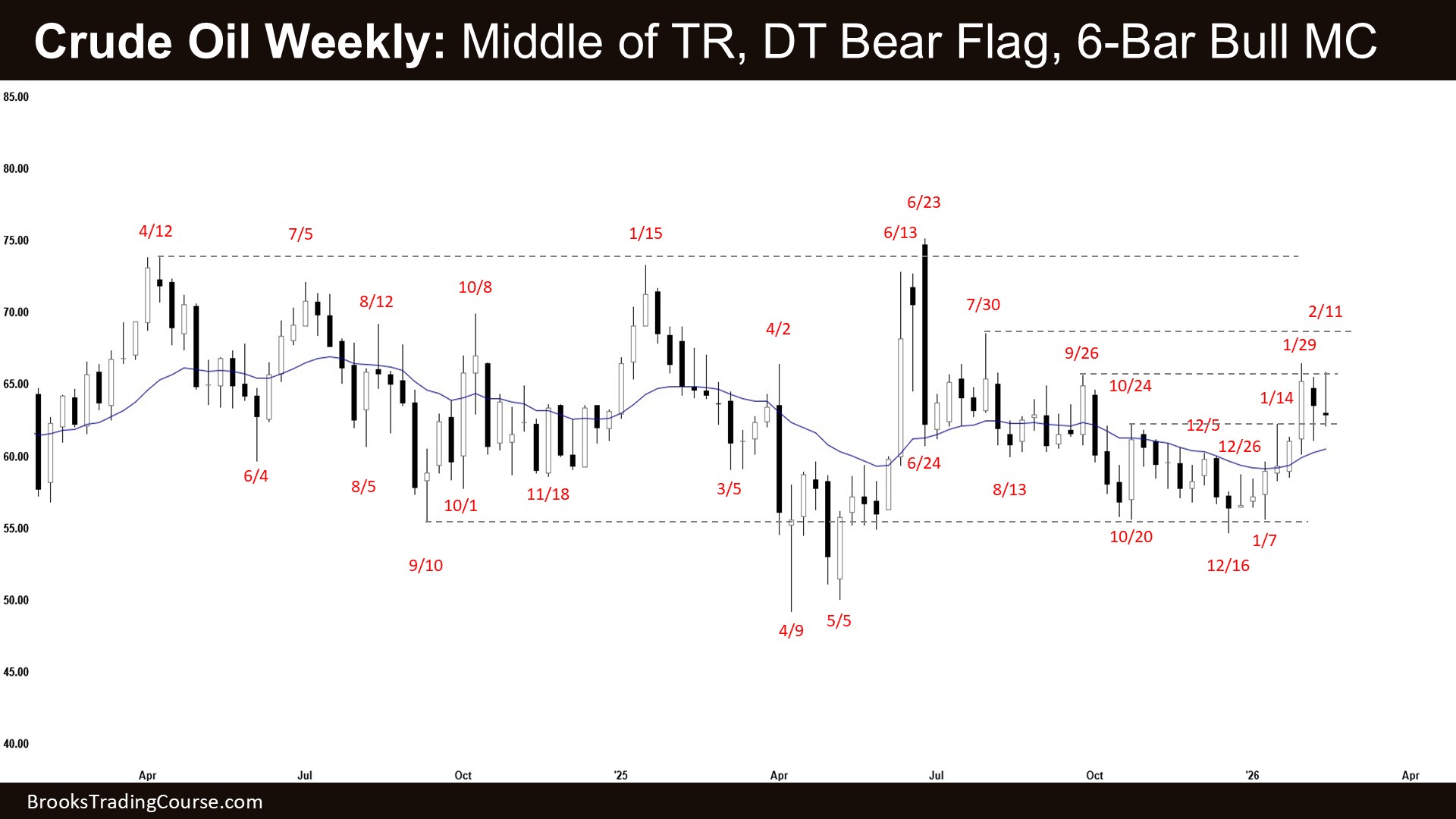
- This week’s candlestick was a bear doji closing in its lower half, with a long tail above.
- Last week, we said traders would watch whether bulls could generate follow-through buying to retest and break above the January 29 high, or whether the market would stall and form a pullback closing below the 20-week EMA.
- The market traded mostly sideways, overlapping within the last two candlesticks’ range.
- Recently, bulls got a retest of the September high in the form of a 6-bar bull microchannel leg.
- They want a retest of the trading range high.
- If the market trades lower, bulls want buyers below the first pullback from the bull microchannel and the 20-week EMA to hold as support.
- Bears want the September 26 or July 30 highs to act as resistance.
- They see a potential large double top bear flag (September 26 and January 29).
- Bears need consecutive strong bear bars closing below the 20-week EMA to show they are regaining control.
- Crude Oil remains in a large trading range.
- Until there is a clear breakout with sustained follow-through, traders will likely continue to Buy Low, Sell High (BLSH), buying near the lower third and selling near the upper third of the range.
- The rally from the January 7 low formed a 6-bar bull microchannel, indicating persistent buying. Traders are watching whether buyers appear below the first pullback from that microchannel.
- The market has formed three overlapping candlesticks, two of them dojis, near the middle of the range, which can act as a magnet and an area of balance.
- For now, traders will watch whether bulls can generate follow-through buying to retest and break above the January 29 high, or whether the market stalls and forms a pullback closing below the 20-week EMA.
- Poor follow-through and frequent reversals remain hallmarks of a trading range environment.
The Daily crude oil chart
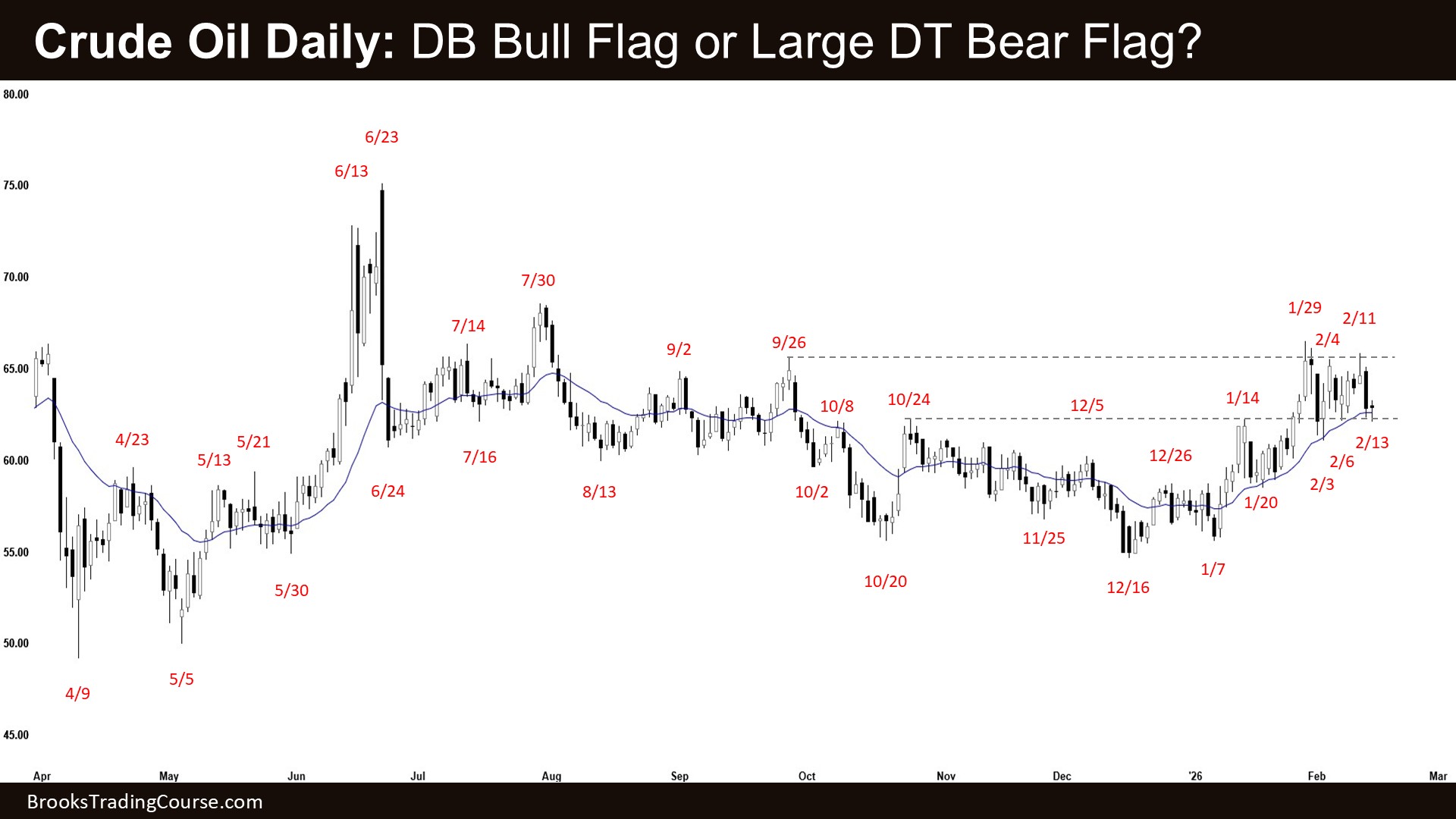
- The market traded higher early in the week, followed by a deep pullback on Thursday testing the 20-day EMA. Friday had limited follow-through selling.
- Last week, we said traders would watch whether bulls could generate follow-through buying above the January 29 high. If the market traded lower, they would watch whether it stalled around the 20-day EMA or the January 20 low.
- Bulls got a bull leg testing the September 26 high.
- Bulls see the February 3 and February 13 moves as a double bottom breakout pullback test of the January 14 breakout point.
- They want another sideways-to-up leg to create a third push up in the wedge pattern, with the first two legs on January 14 and January 29. So far, the third leg (February 11) is a lower high.
- Bulls need consecutive strong bull bars trading well above the January 29 high to show control.
- Bulls want the 20-day EMA or the January 20 low to act as support.
- Bears see the current move as a bull leg testing the middle of the trading range.
- They want the September 26 high to act as resistance, followed by a reversal from a double top bear flag (September 26 and January 29), a large wedge (December 26, January 14, and January 29), and a smaller double top bear flag (February 4 and February 11).
- Bears need consecutive strong bear bars breaking well below the 20-day EMA to flip the market to Always In Short.
- If the market trades higher, bears want it to stall around the January 29 high, forming a double top.
- The market remains in a large trading range.
- Until there is a clear breakout with sustained follow-through, traders will likely continue to Buy Low, Sell High (BLSH), buying near the lower third and selling near the upper third of the range.
- The last 13 candlesticks are overlapping sideways around the middle of the range, which can act as a magnet and area of balance.
- Traders will watch whether bulls can generate further follow-through buying above the January 29 high. If the market trades lower, they will watch whether it stalls above the January 20 low, forming a higher low.
- Alternatively, if bears can produce consecutive strong bear bars well below the 20-day EMA, the market could flip into Always In Short.
- Poor follow-through and frequent reversals remain hallmarks of a trading range environment.
Market analysis reports archive
You can access all weekend reports on the Market Analysis page.


