Market Overview: S&P 500 E-mini Futures
The market is in a weekly E-mini tight trading range near the all-time high. Bears need more follow-through selling closing below the 20-week EMA to flip the market into Always In Short. Bulls need a strong breakout with sustained follow-through buying above the January 28 high to increase the odds of trend resumption.
S&P500 E-mini futures
The Weekly S&P 500 E-mini chart
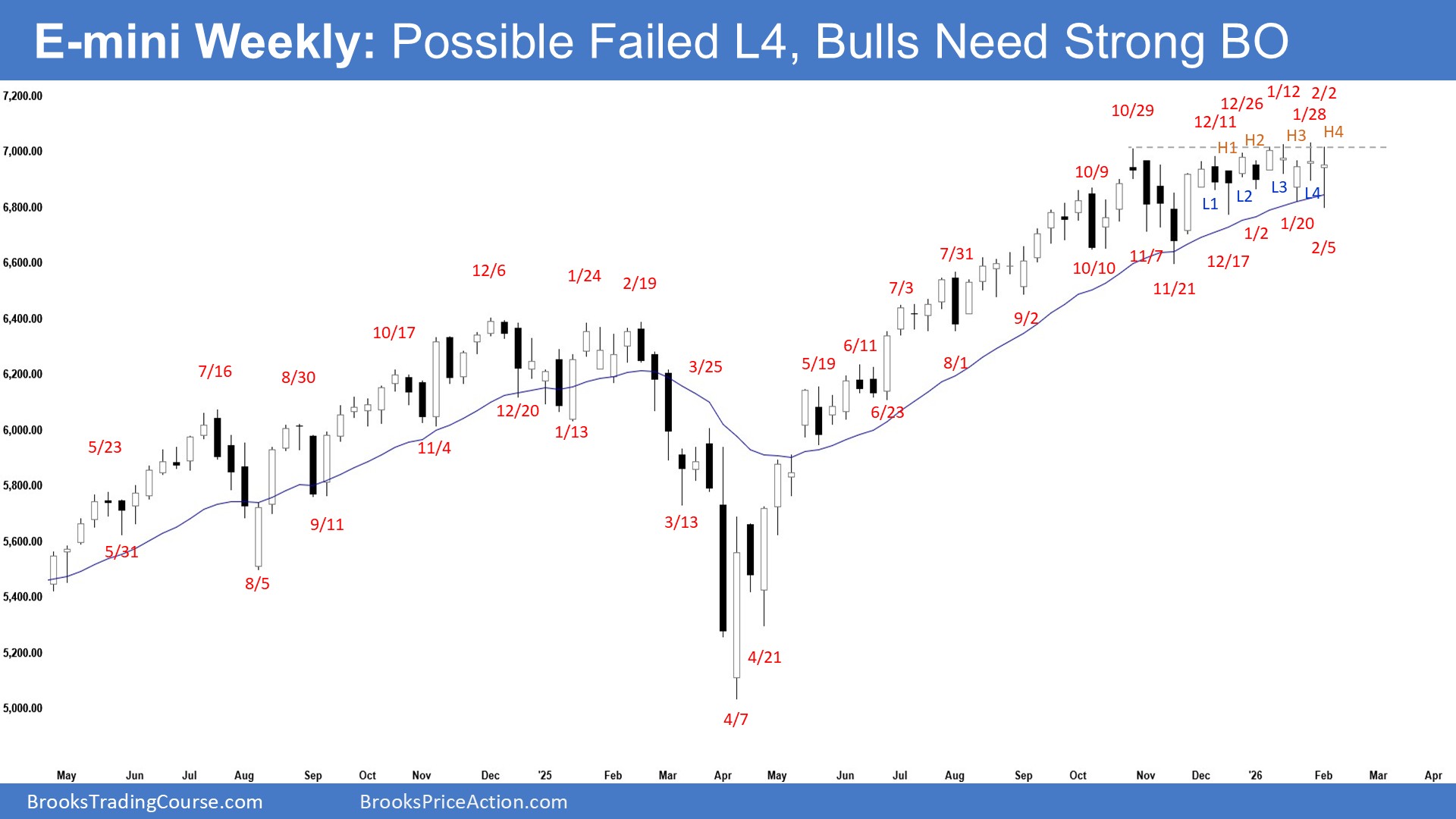
- This week’s E-mini candlestick was a bull doji closing above the middle of its range with a long lower tail. A doji is a 1-bar trading range.
- Last week, we said traders would watch whether bulls could produce further follow-through buying and break strongly to new all-time highs, or whether the market would continue to stall near the highs, followed by bear bars breaking below the 20-week EMA in the weeks ahead.
- The market briefly traded below the 20-week EMA this week but reversed to close above the middle of its range (doji).
- Bears see three pushes up (December 11, December 26, and January 12), forming a wedge top, a double top (October 29 and January 28), and a smaller double top (January 12 and January 28).
- Bears want the October 29 high area to act as resistance.
- They triggered the Low 4 sell setup this week, but the entry bar was a bull doji closing in its upper half with a long lower tail. This increases the risk of a failed Low 4 sell setup.
- Bears need more follow-through selling closing below the 20-week EMA to flip the market into Always In Short.
- If the market trades higher, they want follow-through buying to be weak, increasing the odds of a failed breakout.
- Bulls see this week as a pullback forming a larger double bottom bull flag (December 17 and February 5).
- Bulls see a High 4 buy setup forming.
- They need a strong breakout with sustained follow-through buying above the January 28 high to increase the odds of trend resumption, with a measured move target near 7,400 based on the height of the recent trading range.
- Bulls want the 20-week EMA to act as support, trapping eager bears who took the Low 4 sell setup. Some bears may be trapped from selling below last week’s low or the January 20 low, as both were weak signal bars — one was a doji and the other a bull bar closing near its high.
- Traders who took the Low 4 shorts likely have stops above this week’s high (February 2) or above the all-time high (January 28).
- The market has been in a tight range for the past 10 weeks, indicating balance between bulls and bears, as the bears’ strength has caught up with the prior strong bull trend.
- The last two weeks formed consecutive dojis, further reflecting this balance.
- The market could continue to trade sideways in the near term.
- Should traders take the High 4 buy setup? The setup bar is a large doji, a 1-bar trading range. Buying above its high, which is also near the top of the 10-week range, is not ideal. Traders buying here risk buying near the high of a trading range.
- Traders should continue to Buy Low, Sell High (BLSH) within the range until there is a decisive breakout with sustained follow-through in either direction.
- For now, traders will watch whether bulls can trigger the High 4 buy setup and the stops above the all-time high. If the market makes a new all-time high but lacks sustained follow-through buying, it will increase the odds of a failed breakout.
- Or whether bears can create more follow-through selling testing the 20-week EMA again.
- Or will the market remain in a tight trading range around the October high area instead?
- Traders will wait for a strong breakout with sustained follow-through, either above the all-time high or below the 20-week EMA, before trading aggressively.
The Daily S&P 500 E-mini chart
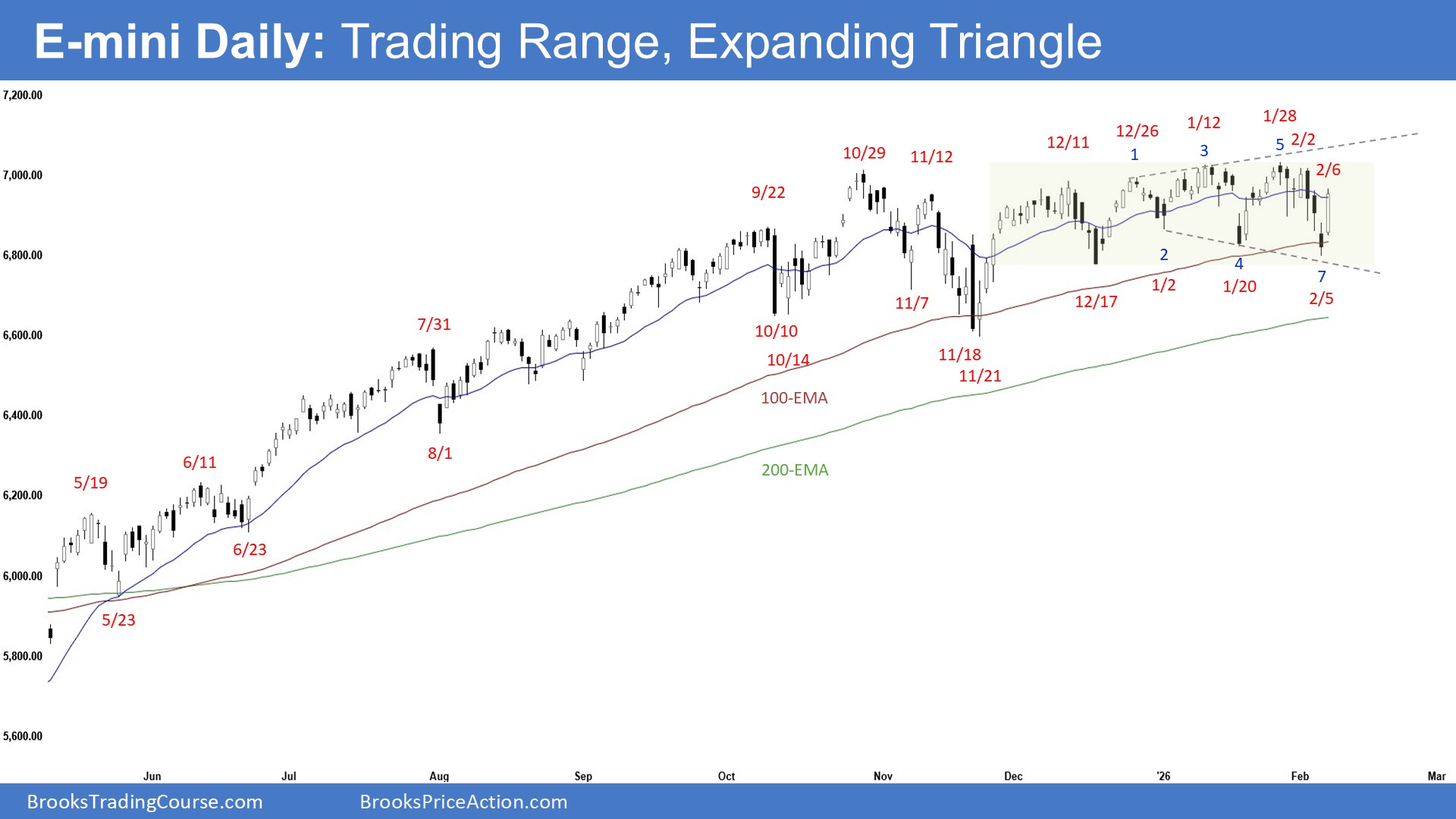
- The market traded slightly higher early in the week but sold off to test the January 20 low on Thursday. On Friday, it gapped up and closed slightly above the 20-day EMA.
- Previously, we said traders were watching whether bulls could produce further follow-through buying to new all-time highs, or whether the market would stall around the 20-day EMA, followed by a second leg sideways to down.
- Bulls see this week as a pullback forming a larger double bottom bull flag (December 17 and February 5) and a wedge bull flag (January 2, January 20, and February 5).
- Bulls want a strong breakout above the January 28 high with sustained follow-through buying and a measured move target near 7,400, based on the height of the recent trading range.
- Bulls need consecutive strong bull bars to increase the odds of a successful breakout and trend resumption.
- If the market trades lower, bulls want the February 5 low or the 100-day or 200-day EMA to act as support.
- Bears want a reversal from a wedge top (December 26, January 12, and January 28) and a double top (October 29 and January 28).
- They see the pullback on Friday (February 6) as a retest of the breakout point below the February 2 low and the 20-day EMA.
- Bears want the 20-day EMA to act as resistance, followed by a stronger second leg sideways to down.
- Bears need consecutive strong bear bars breaking well below the December 17 low and the 200-day EMA to flip the market into Always In Short.
- If the market trades higher and makes a new all-time high, bears want follow-through buying to be weak, increasing the odds of a failed breakout.
- The market remains in a small trading range that began near the end of November. Bulls want a breakout above it, while bears want a breakout below.
- The recent candlesticks since late December have formed an expanding triangle. An expanding triangle can act as either a major reversal or a continuation pattern, trapping traders on both sides with failed breakouts before reversing.
- For now, traders are watching whether the market stalls around the 20-day EMA, followed by a second leg sideways to down.
- Or whether bulls can produce further follow-through buying to new all-time highs instead. If the market makes a new all-time high, traders will watch for strong follow-through. Without it, the odds of a failed breakout increase.
- Until there is a strong breakout with sustained follow-through in either direction, traders may continue to Buy Low, Sell High (BLSH), buying near the lower third and selling near the upper third of the range.
Trading room
Al Brooks and other presenters talk about the detailed E-mini price action real-time each day in the Brooks Trading Course trading room. We offer a 2 day free trial.
Market analysis reports archive
You can access all weekend reports on the Market Analysis page.


