The support forum is built with (1) General and FAQ forums for common trading queries received from aspiring and experienced traders, and (2) forums for course video topics. How to Trade Price Action and How to Trade Forex Price Action videos are consolidated into common forums.
Brooks Trading Course social media communities
Brooks Trading Course Learning Resources >>>

Hello,
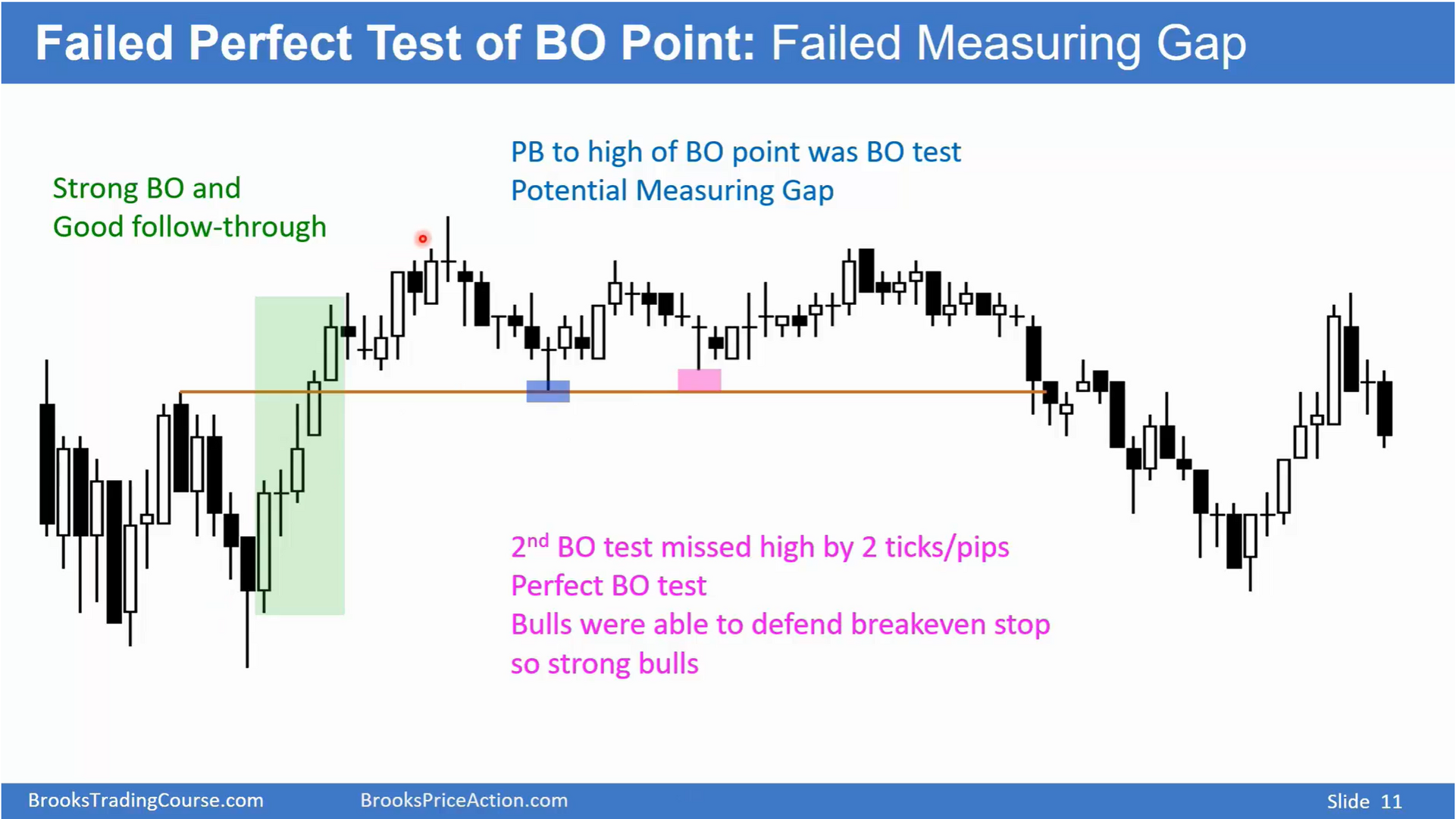
On slide 11 in 33G, Al describes the first breakout test of the orange neckline of a double bottom as a "perfect breakout test of the breakout point." This makes sense to me because price reverses exactly at this point (blue rectangle):
Confusingly, on the next slide (12), the second breakout test (pink rectangle) is also described as a "perfect breakout test", even though it misses the breakout point by 2 ticks:
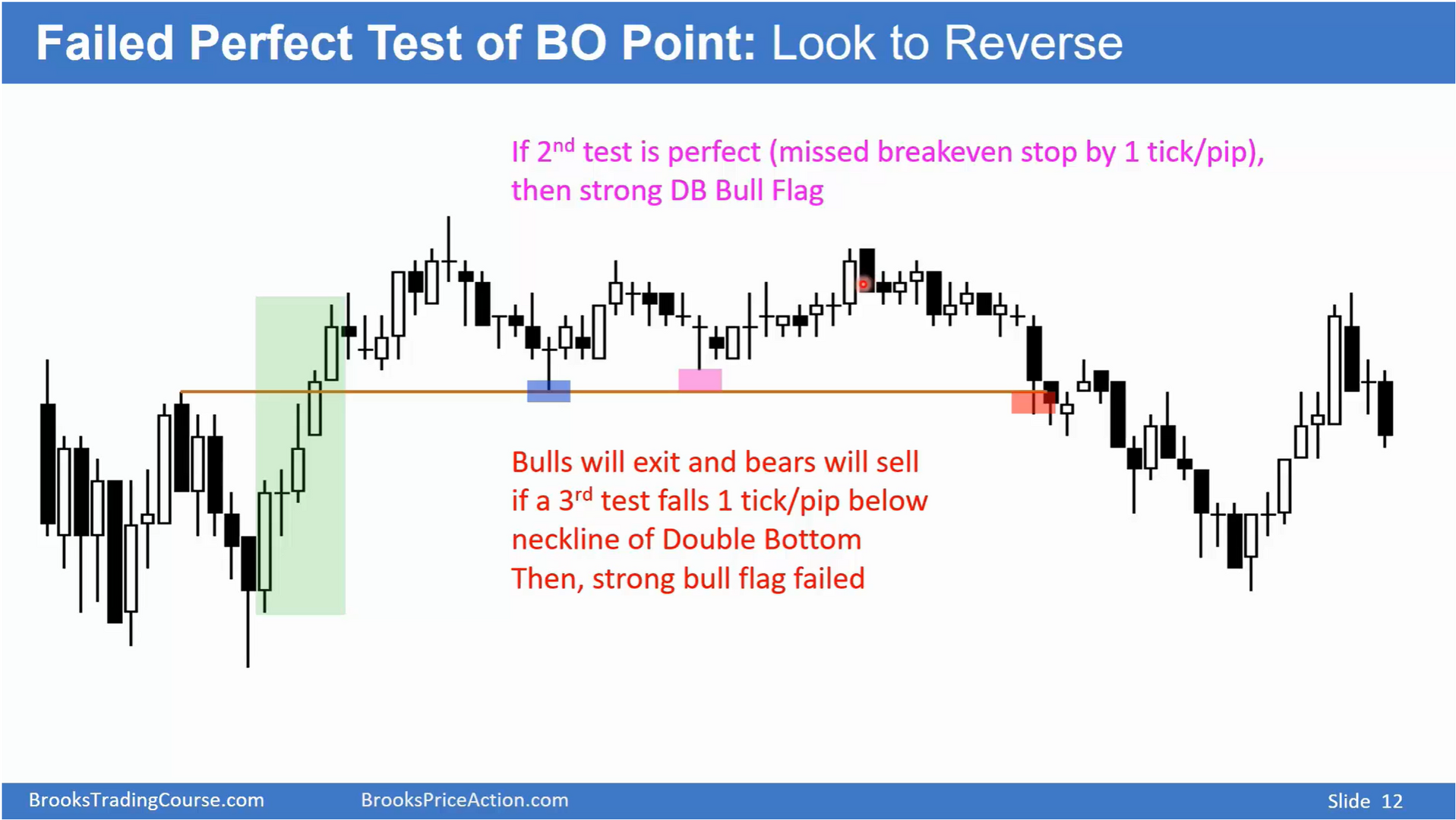
I understand that the gap between the breakout point and the test is a sign of bullish strength, and Al explains that the 2nd BO test is perfect in the sense of "good for the bulls" because their breakeven stop doesn't get hit.
Still, the terminology seems inconsistent with slide 11. How can both breakout tests be considered "perfect" if a (admittedly premature) breakeven stop would have been hit on the first test?
Could anyone, perhaps with Trading Room experience, clear up the correct usage of "perfect breakeven stop" for me? I know one could claim this is purely semantics, but it matters to me because the terminology implies a value judgement about the relative strength of a breakout test, which feels highly relevant to trading.
Thanks,
Julian

As you understand the reference, what is important is observing bar body overlap, and not just wick overlap. Wicks are tests, and bodies outline areas of price acceptance.
For the pink box, it tests the previous higher low, which was the breakout test. Noting that prices are not able to move closer over the next few bars lends weight to prices increasing in the near term because of 2 failure attempts by the bears. That gap is important.
For the same reason, on the right side, when prices move beyond 1 tick, bears are able to follow through cleanly. Note the bear BO test is similarly tested approx 76 bars later with the bear doji. The upper wick - - -you now can see what it is testing (that line).
Good trades to you!
Hi Eric,
Thanks for taking the time to share those insights. Paying close attention to bar body overlap and later tests of the same price level by the bears are incredibly helpful nuances for reading institutional flow on these charts.
While that structural behavior makes complete sense, I’m still trying to fully wrap my head around Al’s explicit choice of labels across these examples. My original question was less about directional probability and more about what technically constitutes a "perfect" breakout test.
To reconcile Al's wording, I have a hypothesis I'd love to get your thoughts on: Is it possible that he uses the word "perfect" in two distinct contexts depending on his perspective?
-
The blue box is a "perfect" breakout test from a geometric perspective because the wick kisses the neckline exactly to the tick.
-
The pink box is a "perfect" breakout test from a trade-management perspective because the gap keeps the breakout bulls' breakeven stops completely safe and untouched.
Would love to hear if you think this distinction holds weight, or if there is a unified definition Al uses for a "perfect" breakout test that encompasses both scenarios!
Good trades to you as well,
Julian
In reading the title, it may be that you are over analyzing some aspects. The perfect BO test is the first blue box and because there isn't body overlap, that potentially allows for the gap to be used as a measuring place for a measured move upwards. The second pink box helps to reaffirm that the bulls might "pull through", in which case one is looking for a measured move upwards.
However, measured moves are probabilistic and not written in stone. The move upwards was weak and the previous high was attempted and then failed. The gap closed afterwards as the bears gained strength.
In summary, the perfect test, which may have yielded a measured move upwards failed.
Good trades to you!


