The support forum is built with (1) General and FAQ forums for common trading queries received from aspiring and experienced traders, and (2) forums for course video topics. How to Trade Price Action and How to Trade Forex Price Action videos are consolidated into common forums.
Brooks Trading Course social media communities
Brooks Trading Course Learning Resources >>>

Hi. I have a few clarifications to make, so looking forward to your guidance.
1. Al seems to disregard previous day's major lows while marking the swing setups. For example, he is marking swing sell below 7, even when the price had not yet broken below previous day's major low(bottom of strong move up). He keeps marking sell below 9 and 10 too while he keeps mentioning a MM down from previous day and OOM in his BPA report. So, my question is while identifying swing setups, are major highs and lows, MM targets other magnets not important?
2. He keeps trying to find swing and scalp buy setups even after bar 17 broke below previous day's low(which was start of that huge swing up move and therefore clearly a very major low for me at least). I can understand that scalp setups do not look for big up moves and therefore might even be reasonable(is it though with low probability?). My question is, me being a beginner, would it have been okay if I was looking to only sell and not trying to buy at all(say near the top of TR) say after bar 33 or 68 or 76? Or am I missing something and the LL MTR on 27 and HL MTR on 44 were good setups even for beginners like me?
3. I sold below 18 on bar 25 as 24 was a H2 buy setup on SPX index(not on ES as I see today - I can't trade on ES during live markets as TradingView provides delayed data for ES). I scaled in higher below 34 and covered my shorts on 43 suspecting that the markets were entering TR. Is there something wrong here?
Thanks in advance.

Al seems to disregard previous day's major lows while marking the swing setups
Nop!
For example, he is marking swing sell below 7, even when the price had not yet broken below previous day's major low(bottom of strong move up). He keeps marking sell below 9 and 10 too while he keeps mentioning a MM down from previous day and OOM in his BPA report. So, my question is while identifying swing setups, are major highs and lows, MM targets other magnets not important?
They are very important because, as your see, Al talks about them all the time. But a magnet is a price level that attracts the price, so if it is a resistance and we are AIS, it makes sense to sell above until the MKT reaches it (3L, 7L). Then, if like yesterday, the resistance is broken traders keep selling (10-14 STC, 16 L1). Next resistance was LOY, there bulls were able to stop the bears so only then you can start thinking on buying: 18H or 26H were Ok but probably a minor reversal, so next could be major; 40H, 44H HL MTR or 49 HL in possible bull trend were great swing trades. It turned out that they didn't yield a swing profit and the MKT entered a TR for the rest of the session, which is the most probable outcome in MTRs.
My question is, me being a beginner, would it have been okay if I was looking to only sell and not trying to buy at all(say near the top of TR) say after bar 33 or 68 or 76? Or am I missing something and the LL MTR on 27 and HL MTR on 44 were good setups even for beginners like me?
I sold below 18 on bar 25 as 24 was a H2 buy setup on SPX index(not on ES as I see today - I can't trade on ES during live markets as TradingView provides delayed data for ES). I scaled in higher below 34 and covered my shorts on 43 suspecting that the markets were entering TR. Is there something wrong here?
Thanks ludopuig. That was extremely helpful. If you don't mind, I will keep coming back here whenever I get stuck. Hope that does not border on exploiting your time or generosity. 🙂
Just a follow-back question - what would be the stop if one chooses to buy below 18L? I guess, it would be a wide stop stop since I am buying below a TR expecting more TR price action but if I speak of numbers, what would have been my stop? 8-10 points below with the option to scale in lower?
This is the problem, you need a wide stop but at that time you don't know where the bottom of the TR is. Maybe a few points below the MM 18L-22H. Better to pass and once the first strong minor reversal ended at 34, start buying new lows because then the TR bottom was not going to be be much lower than 27L (TR PA). It turned out to be that 27 was the actual bottom of the TR.
Buying 18L is an institution trade, and even then, with the tightness of the channel down, it is very aggressive to take this buy and they might need to scale-in lower several times (which is a no-no for a beginner and for not-that-beginner). Therefore, for us, better to buy any of the following swing buys with stop orders.

Got it! Even more so after yesterday's upward rally. I was not in the markets due to some other business I had to attend to, but I did not expect market to rally that much after breaking a major low last day. Which incidentally made it clear that, the trading range after breaking a major high/low can be pretty wide - wide enough for MTRs to work just fine. Especially so, when we get MTR buy signals near the bottom of the TR and MTR sell signals near the top(which it incidentally did during the last few hours of trading).
Thanks. Needed that context in real-time to get a hands-on experience.

In this case, would it have been reasonable to sell below 34L, arguing double top, 20 MAG sell signal?
Absolutely!
6th September 2021 clarifications.
Adding the further days discussion to this thread itself. Hopefully, that would be better instead of creating a new thread every time. Would help collate the information in one single place as well. Looking forward to your guidance.
1. I shorted while bar 13 was forming, it was pretty much near the high. I was expecting bar 11 as the second leg up in a TR and a BVT of the high. Bars 1-8 provided me the context that the market might be in a TR - big up big down big confusion. I also waited to short after seeing SBU 11 and the bad FT on bar 12. I added more below 20 as a L2 sell near the top of a TR, expecting a test of OOD(as is customary for TRs). No clear BO above the MA also provided better context to me. I covered the short on bar 25 and did not enter the markets soon. Is there anything wrong with this trade?
I understand Al marked bar 11 as a SBUM turning the markets PP AIL. But, isn't it expected that the markets would face some resistance at the MA and might enter a TR after such big up big down and then big up resulting in big confusion? If any uptrend were to come, it would've come only after more FT buying right? Adding this to the fact that the market gapped down on the opening and the gap was not small.
2. Al does not talk about OOD in his markings on BPA report despite expecting TR or SWU movement. Is there any particular reason for not looking at it?
3. Al marks 51 and 52 as F BO of 60MA, when it was holding steady above it. In the end, it was a failure of F BO of 60MA. Was he just marking them as such just to be prepared or am I missing something here?
Thanks in advance.
Forgot to ask this - Al once again marked BLE4 and BRE4 yesterday. Did you get any clarification regarding that ludopuig?
1. I shorted while bar 13 was forming, it was pretty much near the high. I was expecting bar 11 as the second leg up in a TR and a BVT of the high. Bars 1-8 provided me the context that the market might be in a TR - big up big down big confusion. I also waited to short after seeing SBU 11 and the bad FT on bar 12. I added more below 20 as a L2 sell near the top of a TR, expecting a test of OOD(as is customary for TRs). No clear BO above the MA also provided better context to me. I covered the short on bar 25 and did not enter the markets soon. Is there anything wrong with this trade?
2. Al does not talk about OOD in his markings on BPA report despite expecting TR or SWU movement. Is there any particular reason for not looking at it?
As I mentioned above, the open of the day is important at the end of the day, not during the first hours, and only if the day stays as a TR day and the open price is at reach.
3. Al marks 51 and 52 as F BO of 60MA, when it was holding steady above it. In the end, it was a failure of F BO of 60MA. Was he just marking them as such just to be prepared or am I missing something here?
This is the way Al analyzes BOs: Once a bear bar comes after several bull bars in a BO, he calls it FBO but if the BO is strong, this does not mean that it will turn down but, as you said, that the failure will fail and will create a BO PB entry.
Forgot to ask this - Al once again marked BLE4 and BRE4 yesterday. Did you get any clarification regarding that ludopuig?
They agree there is a gap to be filled here so Al will come with some kind of clarification.

For the above, from a beginner trader and for an intermediate trader that wants his heart to stay fine for long years, any sell above 3H is to take profits from longs, the short at 22L can take it for a scalp but better to be thinking long and waiting for the bears to be trapped, at 26H. Expert traders can sell 3H but you won't reach that stage in your trading career if you do it now! 😉
Selling the 3H is a terrible trade only with the benefit of hindsight. This is how it looked real-time using ALL the market data (ETH included) on a 5 & 1 minute chart. As Al always says, "Every tick matters", so to pretend like the overnight trading didn't take place is...interesting.
I don't post very much because it just isn't the best use of my time (don't expect any replies from me), but trading happens when you are looking at the hard right edge of the chart, not with the benefit of hindsight.
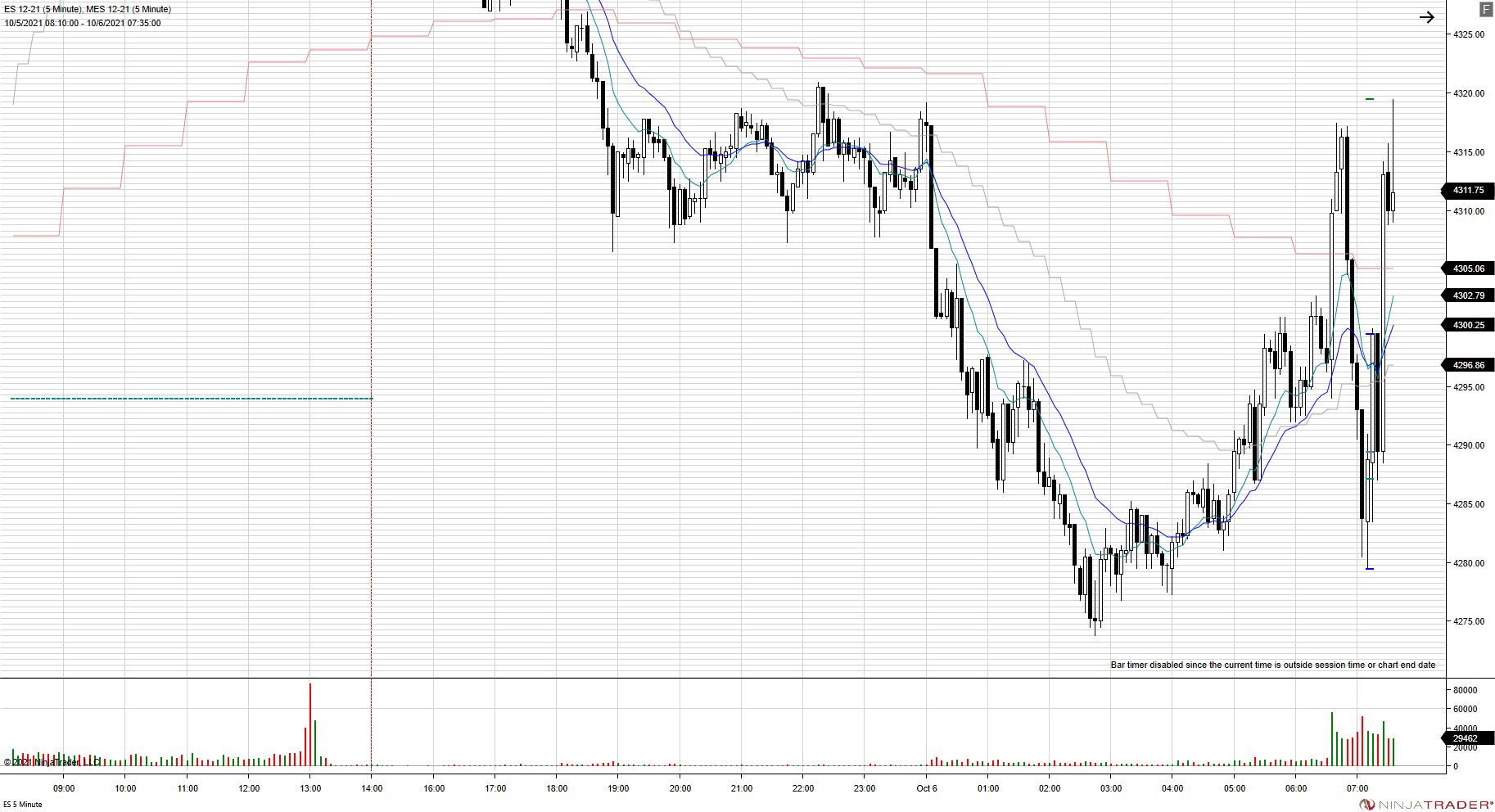
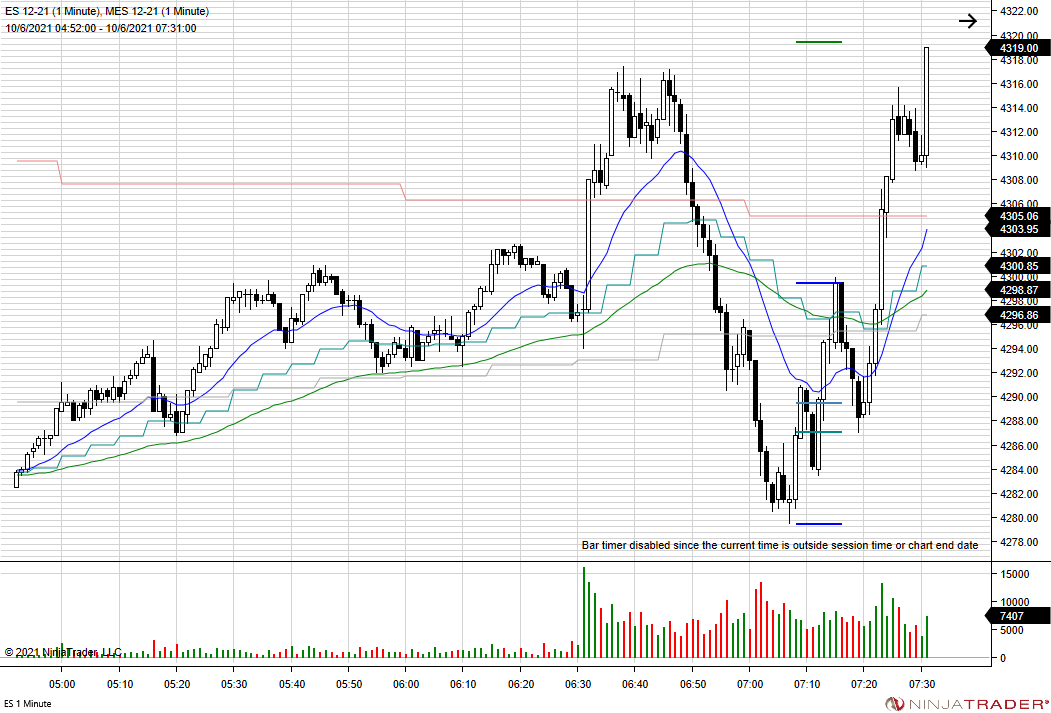

...but trading happens when you are looking at the hard right edge of the chart, not with the benefit of hindsight.
Bud Fox gets it.
...but trading happens when you are looking at the hard right edge of the chart, not with the benefit of hindsight.
Bud Fox gets it.
I am very happy that you both get it. I am here only to help newbies with the charts, not to fight with anyone. I wish you the best...
Thank you for always providing a level-headed feedback ludopuig. It must have taken a lot of time to develop such objectivity. I understand your points and accept them totally. I don't want to act like a pro trader when I am clearly not and have ways to go. In giving this feedback, you have also given me a wake-up call - I probably was looking for these kinds of trade in an effort to avoid putting in the hard work to read the even finer intricate details present on the chart.
Regarding the OOD question, I realize that now - I messed up royally there.
A couple follow up questions -
1. Would a buy above 26H been a good trade? Micro DB and a H2 in the direction of the swing.
2. Would a sell below 31L been a good trade? It was a lot more clear at this point that we were indeed at the top of a TR and I would've been entering with a stop. It was also a F of BO above the MA.
Thanks for the taking the time to clarify the doubts and providing such helpful suggestions. I would try and change the points you are highlighting.
They agree there is a gap to be filled here so Al will come with some kind of clarification.
Okay. Good to know. Thanks!
For the above, from a beginner trader and for an intermediate trader that wants his heart to stay fine for long years, any sell above 3H is to take profits from longs, the short at 22L can take it for a scalp but better to be thinking long and waiting for the bears to be trapped, at 26H. Expert traders can sell 3H but you won't reach that stage in your trading career if you do it now! 😉
Haha. 🤣 . Yes, I will definitely try and curb this instinct. Thanks again!
Thank you for always providing a level-headed feedback ludopuig. It must have taken a lot of time to develop such objectivity. I understand your points and accept them totally. I don't want to act like a pro trader when I am clearly not and have ways to go. In giving this feedback, you have also given me a wake-up call - I probably was looking for these kinds of trade in an effort to avoid putting in the hard work to read the even finer intricate details present on the chart.
I am sure you and the other wannabe traders put your best effort in what you are doing, otherwise we would not feel frustrated so often, but finding the intrincate details is a matter of experience and knowledge, so keep pushing to find them!
Anyway, don't take my reading as truth. Only, as for now that you are starting out, it is simply an opinion more likely to be closer to reality than yours. I am surely off many times but the key is to avoid taking trades when I don't feel completely sure of my reading. I want to lose because I take a trade with a good trader's equation that lose, not because I took a trade with a bad or, even worse, unknown trader's equation.
A couple follow up questions -
1. Would a buy above 26H been a good trade? Micro DB and a H2 in the direction of the swing.
2. Would a sell below 31L been a good trade? It was a lot more clear at this point that we were indeed at the top of a TR and I would've been entering with a stop. It was also a F of BO above the MA.
When having questions, first find what Al gives (markup in both sites), then ask Al (if you are a webinar suscriber), and only after that come here to ask. It is not that I don't want to help, but only that you go to find answers to the most reliable place first.
Your questions above can be answered looking at the blog's Al's markup below. You can see there that both were good trades. I could have also told you so, but you then would have have to guess if I was probably right or wrong, while with Al the probability goes as high as it can be.
If you are an encyclopedia subscriber you get daily access to a more detailed markup. With this markup and the bar-by-bar analysis, you have a wonderful tool to answer most of your questions, so you can come here to discuss some details. Maybe our discussion of the details might be wrong, but at least the essentials you got them right and, with time, you will be able to detect the flaws in my logic and I can learn as well!
If your trades are not marked in Al's report, you did wrong no matter if you won or lose. You have there both your entries and your exits. For instance, if you entered 26H, you can exit 31L, because both are marked, or hold with your stop-loss (this is what I did).
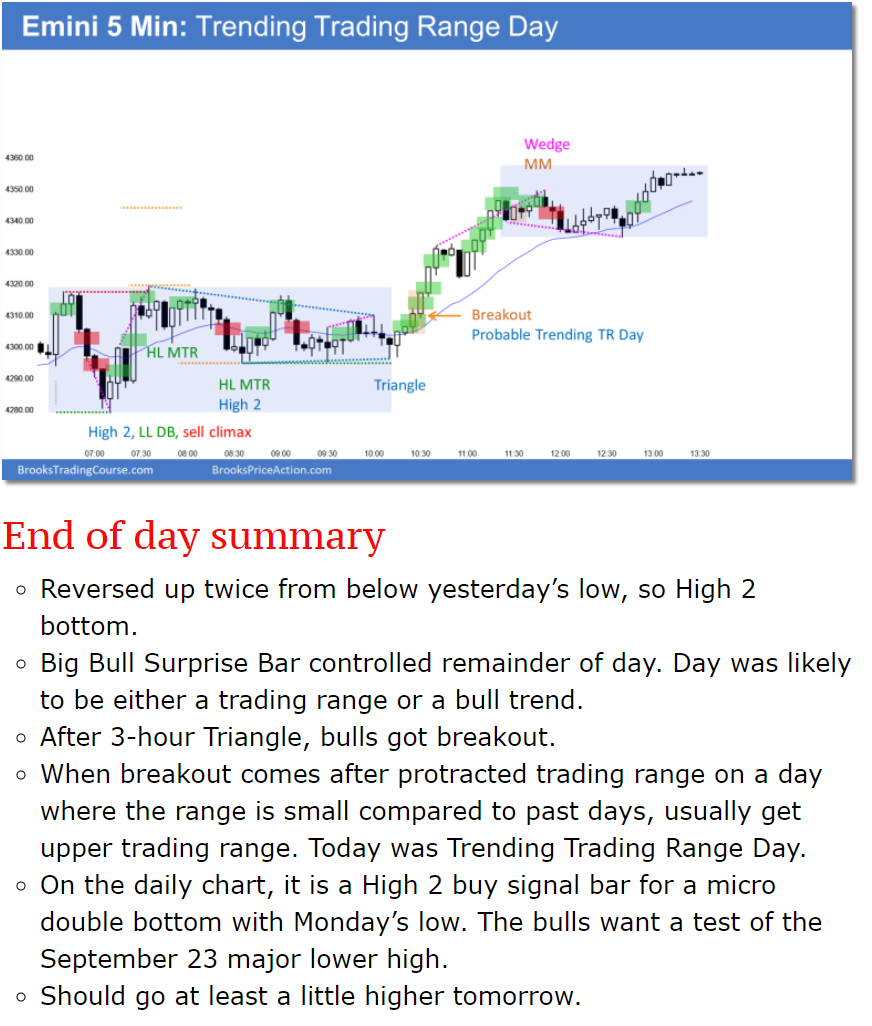
I was distracted at 26H so I didn't take it but I bought 29H, exited half off at 4p and I didn't exit below 31 the swing part; rather, I held with my stop-loss below 25 and even tho I was almost stopped-out, I bought more at the next signal, 37H, and exited all at 30L (as you can see, many other traders did the same) because the PB was stronger than I expected and because I trade only the first three hours.
Because I was with a long mindset, I didn't sell 31 to exit my longs nor enter short, tho Al tells you in his chart that you can, yet after a SBU 11 and a bear trap, it is better to be thinking long than short so, from my point of view, the trade that you have to take is 26H or 29H and use 31 to exit those longs (if you are concerned with risk) more than to initiate a short.
I was distracted at 26H so I didn't take it but I bought 29H, exited half off at 4p and I didn't exit below 31 the swing part; rather, I held with my stop-loss below 25 and even tho I was almost stopped-out, I bought more at the next signal, 37H, and exited all at 30L (as you can see, many other traders did the same) because the PB was stronger than I expected and because I trade only the first three hours.
This is what I mean about trade management.
I bought 29H, exited half off at 4p
Oh OK awesome. A newbie (wannabe sounds derogatory, not that you ment that) wouldn't have known to randomly do that.
I didn't exit below 31 the swing part; rather, I held with my stop-loss below 25 and even tho I was almost stopped-out, I bought more at the next signal, 37H
Again nothing to do with chart reading and everything to do with trade management.
I trade only the first three hours.
Again. Another factor that could influence your success that has nothing to do with chart reading.
All these nuances are the things that trip up newbie traders.
Chart trading is ONLY one peice of the puzzle.
There is only one way to trade this chart today and that's with limit orders.
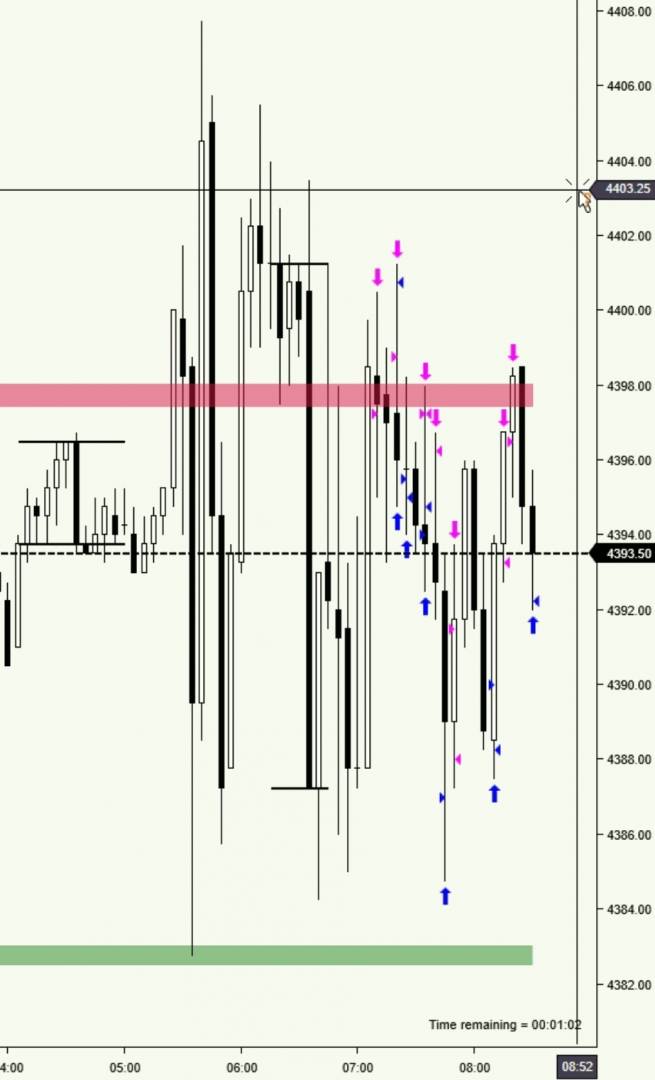
Scaling in. What are you nuts!?!!
For Abir my friend. Your are VERY focused on entries. My suggestion is you focus on the management AFTER you entered. You can take Al's charts and say OK Al would enter here... NOW WHAT? Where would I scale in? Where is my stop? Is this a swing or a scalp (decided before entry). Wheres my target? What's my "R" based on my entry, target and stoploss. You should know ALL of this to control your position sizing (EXTREMELY IMPORTANT)... and ALL BEFORE entry.
Just my two cents.
Good trading all!
When having questions, first find what Al gives (markup in both sites)
Yes, I always do that. Both BTC and BPA markings and then come here to ask questions.
then ask Al (if you are a webinar suscriber)
Unfortunately, I am not and I can't join at this moment.
If you are an encyclopedia subscriber you get daily access to a more detailed markup. With this markup and the bar-by-bar analysis, you have a wonderful tool to answer most of your questions, so you can come here to discuss some details. Maybe our discussion of the details might be wrong, but at least the essentials you got them right and, with time, you will be able to detect the flaws in my logic and I can learn as well!
Long ways to go before that happens but that will always be the attempt on my part. I was asking a bit more because you said here
For what I said above, you did exactly the opposite that should be doing: a trader would have taken a great trade had he bought 18L and exited 34L or EMA, and bought again 43C. This is not a beginner trade, instead you should have waited for 27H, exited 43L, and bught again 40H or 44H...
while discussing 4th October trades and Al had marked that bar as sell on his BTC markups as well, as you can find here Emini-bear-trend-from-the-open-with-sell-climaxes-then-trading-range.png (1920×1080) (brookstradingcourse.com) . I have found that some of the times, BTC and BPA markups differ as for example some of the times Al marks some bar as say a buy and marks the exact same bar as STC on his BPA. So, I was under the impression that there remains bit of a gap between his markings on BTC charts and his BPA commentary which is not always filled. However, now that you say that I should take his BTC swing markups as good trades, I feel confused and find a little bit of contradiction here.
I am not sure, if I could get my point through to you but I would like to know what you think of it.
while discussing 4th October trades and Al had marked that bar as sell on his BTC
Sorry, what bar are you referring to?
while discussing 4th October trades and Al had marked that bar as sell on his BTC markups as well, as you can find here Emini-bear-trend-from-the-open-with-sell-climaxes-then-trading-range.png (1920×1080) (brookstradingcourse.com) . I have found that some of the times, BTC and BPA markups differ as for example some of the times Al marks some bar as say a buy and marks the exact same bar as STC on his BPA. So, I was under the impression that there remains bit of a gap between his markings on BTC charts and his BPA commentary which is not always filled. However, now that you say that I should take his BTC swing markups as good trades, I feel confused and find a little bit of contradiction here.
I am not sure, if I could get my point through to you but I would like to know what you think of it.
Of course, this is a very important point and creates a lot of confusion: they differ because they are different but complementary PA analysis. BTC analysis is done purely from an always-in perspective while BPA analysis is a bar-by-bar analysis for both sides.
Because most of the time you can either buy or sell and make money if you correctly manage the trade, you many times can both buy and sell at the same bar. I don't know what bar you were referring to but here another example: bar 23L is both a buy and a sell, both made money with the correct management, but BPA might tell you (I haven't checked, this is just an example) that this is a BTC bar (for a scalp up, because you are low in a TR) but BTC might tell you it is a swing short (and if the trader scaled-in higher, he made money as well).
So, when the BPA is marking a trade and at the same time the BTC is marking the opposite side, the BPA is the scalp side and BTC the swing side. Because you should be doing swing trading, you should be in the side that marks the BTC analysis more often.
A newbie (wannabe sounds derogatory, not that you ment that)
Yes, far from intention, sorry if so...
Again nothing to do with chart reading and everything to do with trade management.
I rally don't get why you say that it is about trade management and not about chart reading when I am managing my trade based in what I read. Management comes after reading, not before nor it is a completely separated thing, you need both to make money with PA.
Chart trading is ONLY one peice of the puzzle.
Absolutely, but who is saying other thing? But if you can't read, you can't manage based on your read, you have to base it in something else. Here we rely on PA to do so.
There is only one way to trade this chart today and that's with limit orders.
No offense but this is absolutely wrong. You can also trade it like this: doing nothing until a stop order setup forms (18L, 20H, 21L). Yes, boring, but with higher probability of success in the long-term!
Again nothing to do with chart reading and everything to do with trade management.
I rally don't get why you say that it is about trade management and not about chart reading when I am managing my trade based in what I read. Management comes after reading, not before nor it is a completely separated thing, you need both to make money with PA.
Agreed that PA is integral to reading charts but I personally believe (and maybe this is why I create confusion) is that chart reading and trading are separate skills.
Yes you need to understand charts but not rely on them as they are not the future. They are the past. Sure they let you set up good R/R but even that's a fantasy because you really dont know the future. It just enables us to place a trade.
What's far more important is YOUR win/loss ratio. YOUR avg win. YOUR average loss. YOUR win rate... your REAL LIVE TRADERS EQUATION. YOUR real stats.
Otherwise the chart dictates what that should be.
If you can enter almost anywhere and make money. Can't you enter randomly and make money? Can't you exit randomly and make money?
I'm not being facetious or argumentative I'm serious.
Also for me it's NEVER about this ONE trade. It's about the aggregate.
YES charts are important but it's not about buying above a bull bar after a MTR and a DB and holding for 2 "R" or a few points below a bear bar.
Chart trading is ONLY one peice of the puzzle.
Absolutely, but who is saying other thing? But if you can't read, you can't manage based on your read, you have to base it in something else. Here we rely on PA to do so.
Um like absolutely everybody!
Nobody talks about right hand edge trading or STATS.
Everything is hindsight. It's about this pattern equals do this.
Learning and trading are different. Once its seen it's not "out of sample" per say. You can't unseen it. YOU CANNOT LOOK AT A CHART IN RETROSPECT WITHOUT INFLUENCING YOUR VIEW OF IT.
We trade from the hard right not from the soft glow of the whole chart in retrospect. I get you have to teach that way but it's like saying just learn in this kiddy pool it's the same as the open ocean. If you can swim in one you can swim in both.
I also have come from trying system building and have learnt a few things doing that. One being your entry+exit = profit/loss.
What if you were to systematize Als teachings? Seems it's SUPER CLEAR EXACTLY what to do so this should be pretty easy to code right?
My god Al has just repeated the same thing five hundred thousand times. In books, blogs, videos, encyclopedias of charts... Just code it. Little blue boxes Buy, little red ones Sell.
Al's success has so much more to do with Als intuition of knowing what hes trying to teach than teaching I think.
I remember working for a company early in my career and was blown away by this salesman. He held regular meetings and taught everyone how he did it... till I was told to shadow with him one day. He skipped all the steps. Only seen his best customers. Rarely tried gaining new ones. And broke every rule he was teaching in these weekly super sales meetings. That changed me forever. (Maybe for the worst. I dunno)
There is only one way to trade this chart today and that's with limit orders.
No offense but this is absolutely wrong. You can also trade it like this: doing nothing until a stop order setup forms (18L, 20H, 21L). Yes, boring, but with higher probability of success in the long-term!
Again I respect your point of view. Mines just different.
Yes you could have made money the way you say I don't even need to look. But that's typical Al teaching and it's just another way I trade differently. (I really don't get it. Don't know why you'd trade with stops in there) I came out OK that day but I know I'd probably trade it differently given a groundhog day situation but I would think Al sould have traded it EXACTLY the same way for a thousand years if he woke up to that day everday for eternity?
Again I mean no disrespect. I just enjoy the clarity that I'm missing.
I trade my way and it varies but theres ONLY ONE Al way?
As always... good trading to all!
Sorry, what bar are you referring to?
4th October, when I asked if my sim trade was alright, you said that I traded just the opposite of what I should have. The sell below bar 24. It is marked by Al on his BTC EOD markups as a sell.
I asked because I am finding some divergence between BTC and BPA markups which you say is normal. So, I was clarifying the tricky trades.
Because most of the time you can either buy or sell and make money if you correctly manage the trade, you many times can both buy and sell at the same bar.
Yes, Al does say that is true for 90% of the bars and I try to drill that psychology into myself always which has significantly helped me stay calm during trading.
but BPA might tell you (I haven't checked, this is just an example) that this is a BTC bar (for a scalp up, because you are low in a TR) but BTC might tell you it is a swing short (and if the trader scaled-in higher, he made money as well).
Yes, on that very day, I traded a bit different and that is exactly what happened. I shorted below 24L and scaled in higher which resulted in a BE exit(small profit) on my first short and an okay profit on my second entry.

"4th October, when I asked if my sim trade was alright, you said that I traded just the opposite of what I should have. The sell below bar 24. It is marked by Al on his BTC EOD markups as a sell.
I asked because I am finding some divergence between BTC and BPA markups which you say is normal. So, I was clarifying the tricky trades."
I have rarely seen any divergence between BTC and BPA markups, unless they have been typos. I have seen a few typos made on BPA markups.
Talking about Oct. 4th, the sell is not below B24 but below B25. On BTC is looks like the sell is marked below 24 because of the spacing or the lack of spacing between bars but if you look closely at the chart, you will see the sell is marked below B25.
The markups on BTC charts are for swing traders who trade Always-In. This means traders who buy or sell below a bull bar closing on its high or bear bar closing on its lows when they occur in a reasonable context.
So selling below 25 even though it is a loosing entry, it is still an entry for an Always-In swing trader because we are still in a swing down since Bar 3 and theoretically you can enter at any time during a swing as long as you use the proper swing stop.
So bar 25 is a bear bar closing on its low, we are still in a swing down meaning the direction of the market is Always-In Short, so an Always-In trader can short below 25 but he has to exit above a bull bar closing on its high, which is 27.
This whole thing brings up to the issue that I raised regarding BLE4 and BRE4 and Always-In trading. I have been spending a lot of time learning this new approach to trading and trade management but has had to watch a lot of webinars and connect the dots by myself.
It is a long topic. But mostly remember that BTC shows trades for a swing trader who is trading Always-In and BPA markups are for a trader with a scalper's mentality and approach to trading. So a trader with a scalper's mentality will not short below 25 since we might be in a trading range since 14 and if so we are at the bottom of a possible trading range and therefore it is bad to short 25 for a scalp.
Now a swing trader sees 25 as a breakout below the neckline of a Double Top Bear Flag with 15 and 22, he is looking for a Measured Move down based on the pattern and shorts the 25 bar which also closes on its low.
My advice to you is to first find out for yourself what kind of a trading style you have. And based on your trading style pick one of those approaching to trading and study and practice it intensely. At the beginning don't try to reconcile them for you will get confused. Just understand that there are different approaches to trading.
Your are VERY focused on entries.
Yes, absolutely. If I don't enter correctly, I won't really have a trade to manage. Moreover, I think I am still in the beginner stage, so I prefer to break the big problem down to small pieces and conquer them one at a time. Once I become fluent in one, I can finally move on to the next part and I wouldn't have to worry about completeness.
Where would I scale in? Where is my stop?
This is easier, at least for me at this point. I would obviously scale in on pull-backs, namely second entries and even perhaps third entries which are rare to find if the original trade was alright(especially if you prefer near-perfect entries).
My stops would always be at the bottom of the trend if I am entering breakouts and if I am trading reversals, it would be the bottom of the reversal bar usually. Difficult to explain without any reference but you should get the idea given the long time you are trading.
Although, we all know that Al hardly ever waits for the stop to trigger and he often exits much before things start to look bad and he just takes the next entry if the exit was just a false alarm.
Is this a swing or a scalp (decided before entry).
That part hardly remains unclear. The trick I will have to try and learn is, to identify good setups that can result in swing profits and scalp out the ones that would not. I am given to understand, that will be the ace up my sleeve. I was not fully comfortable with this mentality very much as it will rely a lot on my abilities(which will develop slowly over time), I went ahead and found a trick that Al probably mentioned few times but never fully explored. I sharpen my edge in the traders' equation by finding lopsided option strategies which will improve the RR ratio compared to the underlying.
Wheres my target? What's my "R" based on my entry, target and stoploss. You should know ALL of this to control your position sizing (EXTREMELY IMPORTANT)... and ALL BEFORE entry.
Again, I am trying to control all this using lopsided option strategies which are often found in galore. In most of the cases, I am having uniform stop value even when that uniformity is not present in the underlying(say because of increased volatility) as it is quite easy to control with options.
Appreciate your suggestions Sandpaddict. I am thinking of all the factors you mentioned and like I said, I am trying and breaking the problem into smaller pieces and that way, it will be easier for me to manage.
I felt sad learning how much money you lost in the markets. I have too and have learnt my lesson in the past. I ain't trading this time unless I know that I will be profitable and I will do extensive testing before I trade actual money.
All the best! Happy learning and trading!