The support forum is built with (1) General and FAQ forums for common trading queries received from aspiring and experienced traders, and (2) forums for course video topics. How to Trade Price Action and How to Trade Forex Price Action videos are consolidated into common forums.
Brooks Trading Course social media communities
Brooks Trading Course Learning Resources >>>

Hello,
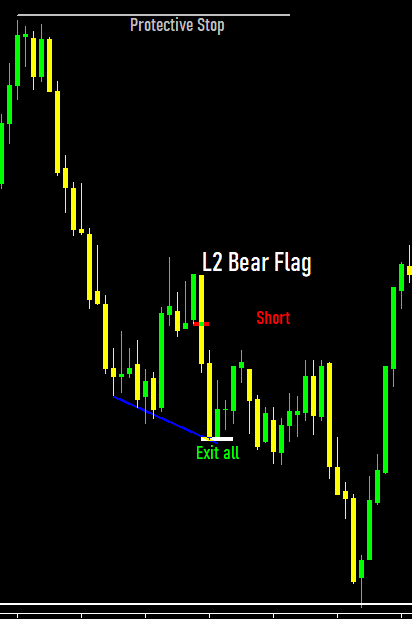
Setup: Low 2 Bear Flag
Risk is several times greater than the Reward
Exit all on WB (Wedge Bottom)
---
I wonder if this kind of Trade Management makes sense for Scalping?
Does it have a positive trader's equation?
Reward a third of the stop size
please share me your idea
Thanks in advance

Each trade has to be looked at in terms of probability of that trade being a win. One's general win rate has nothing to do with the traders equation.
Reward is the distance to your profit target and risk is the distance to your stop loss. But there is another component and that is the probability.
To use the traders equation you have to assign the probability of success (your best guess of the chances of price hitting your profit target before it would hit your stop loss) and you have to assign the probability of failure to each individual trade (the probability of price hitting your stop loss before would hit your profit target).
It has little to do win one's general in rate. You may have a general win rate of 75% but let's say a particular trade has a probability of 60% of being successful within the context of which it is found. Therefore you have to use the assigned probability in the equation not your general win rate. Each trade is different in terms of assigned probability and to arrive at the probability figure you have to look at context which includes last 3 bars...along with price patterns (such as trends, flags, triangles)...and finally the larger context i.e. the market cycle. In addition look at "how" price is acting i.e. volatility (fast and big slow and grinding) and momentum (especially for scalpers) to determine if a particular setup has a good enough likelihood of the trade being a winner.
So the traders equation is: Probability of success x the potential reward (>needs to be greater) than the probability of failure x the risk. If it is then you have a positive traders equation. In high probability trades the profit target needs to be smaller. Why?because much of the move has already been made. So not much is left before a probe in the opposite direction or a strong reversal. The market is constantly probing in both bullish and bearish directions. A scalper wants to capture a portion of the probe. So let's look at your trade.
From the context looking at the previous move down (top left of your chart to your L2 short. I would assign a 70% PROVISIONAL probability of a successful scalp being likely. How much depends on if I can structure a positive traders equation. Let's pretend your chart is the ES. Let's plug in the figures into the traders equation. Your initial PT and SL is you are going to risk 9 points to gain 3 points. So:
70x3=210 and 30X9=270 (note 30: is the probability of failure)
210 is less than 270 so not a positive traders equation. So what do you do? you have four options.
1) Reduce the risk (use a tighter SL)
2) reduce the reward (smaller PT)
3) Reduce both reward and risk to render a positive traders equation.
4) increase the probability of success and decrease the probability of failure and in this case I would do neither as I think bask upon context there exists a 70% chance for a successful scalp.
Since your SL is 3 times your reward I would adjust the risk first.
Reduce SL to 6 points since probability is fairly high for a successful scalp.
So: (70X3=210) (30x6=180)
210 is > 180 so now a positive traders equation,. Therefore even though it is an upside down R:R of 3:6 (3 being the reward and 6 being the risk} you can still maintain a positive traders equation to take the trade. Now before taking the trade I ask myself does price have a better chance of hitting my PT BEFORE it would hit my SL and in this case I would answer YES and take the trade. In the first calculation I would likely answer NO because it is not a positive traders equation and R:R is way upside down.
You could reduce your reward and increase probability and reduce risk some too if going for a small quick scalp. and doing so would make the positive traders equation go up even more thus increasing the likelihood of a quick and successful scalp.
(90X1 point) > (10X5 points) 90 is greater than 50. R:R is 1:5 upside down but still positive traders equation. Quick locked in scalp.
However if you assign higher probability of a successful trade you have to accept smaller reward. Many traders understand this right backwards. They think higher probability means bigger rewards but it is right the opposite.
Maybe this will help?
Let's say the Win Rate is 80%

With reward being one third of the risk and win rate of 80% your trader's equation will be 80% 0.33RR
(1 * 0.80) - (3 * 0.20) = 0.2
About the same as with 40% 2RR (classic Al Brooks beginners swing trade)
(2 * 0.40) - (1 * 0.60) = 0.2
If you are sure that you can maintain that win rate, mathematically it is alright.
Add fees and slippage and human error against your favour too.
But it's variable. Sometimes, SL is 4-5 times greater than the Reward
And in some situations win rate jumps to 90-95%
Is it true for those as well?
You can calculate that using the trader's equation formula, and I assume that an expert with >80% win rate would not be asking this question, so I'd just better stick to Al' guidelines until you become so good that you will not be in need to ask this question anymore
I'm waiting for your nice ideas
Every time I refresh the page for the post's answers, unfortunately, it seems no one wanna take my hand
@Carpet
Help!

With a wide stop like that, the goal is to exit early if the premise is invalid, before your stop gets hit. So your actual R:R shouldnt be as bad as your initial R:R, which means your winrate doesnt have to be as good as you would need with that initial R:R.

Each trade has to be looked at in terms of probability of that trade being a win. One's general win rate has nothing to do with the traders equation.
Reward is the distance to your profit target and risk is the distance to your stop loss. But there is another component and that is the probability.
To use the traders equation you have to assign the probability of success (your best guess of the chances of price hitting your profit target before it would hit your stop loss) and you have to assign the probability of failure to each individual trade (the probability of price hitting your stop loss before would hit your profit target).
It has little to do win one's general in rate. You may have a general win rate of 75% but let's say a particular trade has a probability of 60% of being successful within the context of which it is found. Therefore you have to use the assigned probability in the equation not your general win rate. Each trade is different in terms of assigned probability and to arrive at the probability figure you have to look at context which includes last 3 bars...along with price patterns (such as trends, flags, triangles)...and finally the larger context i.e. the market cycle. In addition look at "how" price is acting i.e. volatility (fast and big slow and grinding) and momentum (especially for scalpers) to determine if a particular setup has a good enough likelihood of the trade being a winner.
So the traders equation is: Probability of success x the potential reward (>needs to be greater) than the probability of failure x the risk. If it is then you have a positive traders equation. In high probability trades the profit target needs to be smaller. Why?because much of the move has already been made. So not much is left before a probe in the opposite direction or a strong reversal. The market is constantly probing in both bullish and bearish directions. A scalper wants to capture a portion of the probe. So let's look at your trade.
From the context looking at the previous move down (top left of your chart to your L2 short. I would assign a 70% PROVISIONAL probability of a successful scalp being likely. How much depends on if I can structure a positive traders equation. Let's pretend your chart is the ES. Let's plug in the figures into the traders equation. Your initial PT and SL is you are going to risk 9 points to gain 3 points. So:
70x3=210 and 30X9=270 (note 30: is the probability of failure)
210 is less than 270 so not a positive traders equation. So what do you do? you have four options.
1) Reduce the risk (use a tighter SL)
2) reduce the reward (smaller PT)
3) Reduce both reward and risk to render a positive traders equation.
4) increase the probability of success and decrease the probability of failure and in this case I would do neither as I think bask upon context there exists a 70% chance for a successful scalp.
Since your SL is 3 times your reward I would adjust the risk first.
Reduce SL to 6 points since probability is fairly high for a successful scalp.
So: (70X3=210) (30x6=180)
210 is > 180 so now a positive traders equation,. Therefore even though it is an upside down R:R of 3:6 (3 being the reward and 6 being the risk} you can still maintain a positive traders equation to take the trade. Now before taking the trade I ask myself does price have a better chance of hitting my PT BEFORE it would hit my SL and in this case I would answer YES and take the trade. In the first calculation I would likely answer NO because it is not a positive traders equation and R:R is way upside down.
You could reduce your reward and increase probability and reduce risk some too if going for a small quick scalp. and doing so would make the positive traders equation go up even more thus increasing the likelihood of a quick and successful scalp.
(90X1 point) > (10X5 points) 90 is greater than 50. R:R is 1:5 upside down but still positive traders equation. Quick locked in scalp.
However if you assign higher probability of a successful trade you have to accept smaller reward. Many traders understand this right backwards. They think higher probability means bigger rewards but it is right the opposite.
Maybe this will help?

You shouldn't be scalping. In the long run you will loose money taking scalp trades.
So this is all theoretical discussion.
Plus, the L2 you took as a scalp is a bad scalp to begin with. You are shorting below a bull trend bar closing on its high.
You just got lucky in this trade.
Using wide stops when scalping WITHOUT being able to scale in is a loosing strategy.
You use wide stops for scalps only if you can scale in and by doing so increase your probability of success.


