Market Video Report: Bitcoin

Duration 36:29 mins.
Summary
The report analyzes Bitcoin’s 20% drop, identifying the weekly bear bar as a sell climax within a major trading range. Although macro fair value remains around $90,000, immediate price action may favors a second leg lower. In this situations, investors should remain calm and traders should be objective and keep managing risk tightly, eyeing potential limit order buys within the $50,000 to $55,000 support zone.
Transcript
Hello everyone, and welcome to this week’s Bitcoin price action analysis. My name is Joseph Capo, and I am a trader and author for the Brooks Trading Course website. I am sure many of you were expecting this video after a sharp 20% drop in the Bitcoin price from the weekly open to current price levels. I hope you enjoy the following analysis.
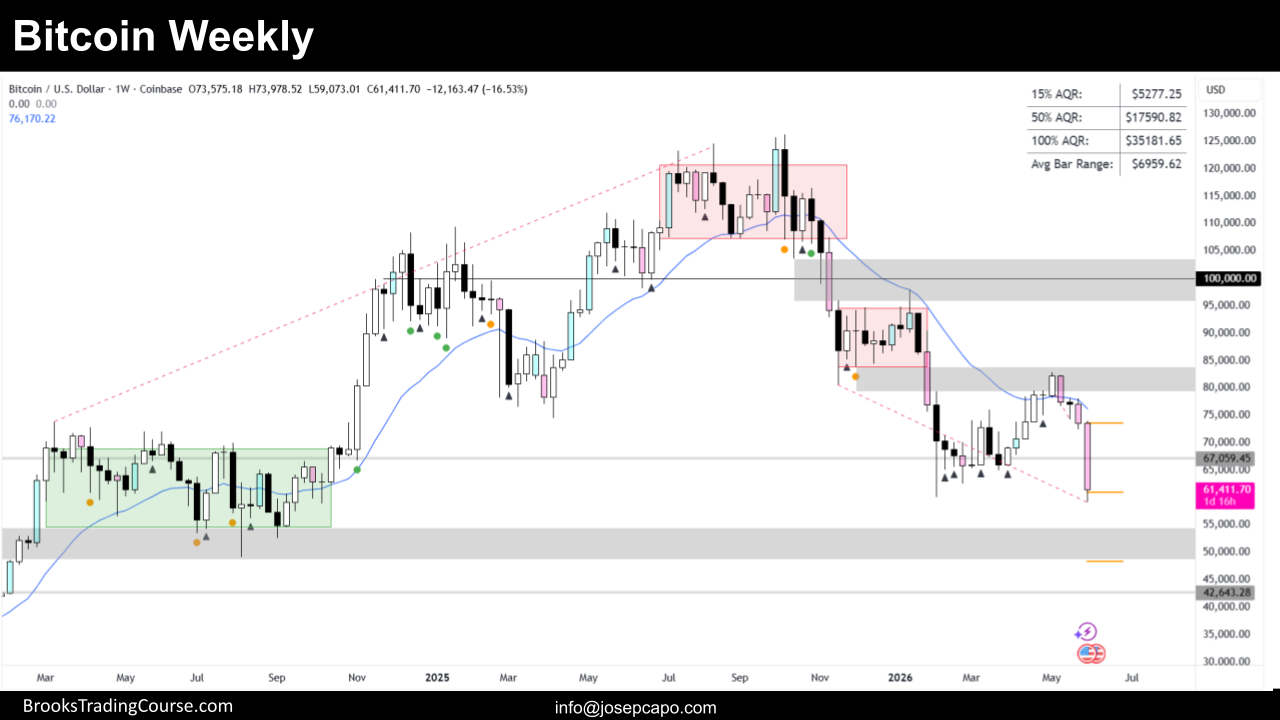
Looking at the weekly Bitcoin chart using Coinbase exchange quotes, this massive bear bar—this climactic bar—is our current week’s bar. First of all, we want to understand what this bar represents in the overall context. This bar is following a reversal down from a breakout point test, and it has proven to be a successful test. This occurs when a resistance level holds; the price fails to break out above that resistance, rejects it, and resumes the prior downward pressure.
This also marks a third leg down (leg one down, leg two down, and leg three down) within a broader bear channel. You may wonder where this bear channel originated and what the macroeconomic context was. This bear channel developed after a long-term bull trend that created a three-leg structure with pullbacks, ultimately forming a wedge top.
After a wedge top, there is typically a 70% to 75% chance of a reversal if the context is ideal. However, because our broader context was an incredibly strong, long-term bull trend, the inertia lowered those odds to perhaps a 50% to 60% chance of a reversal. Nevertheless, that still represents a significant probability.
Normally, when a trend is this dominant, it is more likely that the price will transition sideways for a while rather than dropping immediately. However, the market chose to test the lows of the previous legs within the wedge structure. The first target for the bears was to reach the low of the last bull leg, which was achieved around here. The ultimate target for the bears is to test the absolute low of the entire wedge top pattern.
Still, what this kind of pattern ultimately evolves into is a trading range. What we are seeing is essentially a two-legs up structure (with the second leg being a complex move) followed by a complex two-legs down structure. We are highly likely witnessing a major trading range where the market will eventually gravitate toward the middle third of the entire range. In my opinion, this is the most likely macro scenario for Bitcoin at current prices.
Market Psychology: Investors vs. Traders
Many market participants are panicking right now because a 20% drop in a single week is a violent move for spot holders. However, if you are a Bitcoin investor, by definition, you are in this for the very long term—meaning a minimum of 5, 10, or preferably 10 to 20 years. Therefore, you should not be overly emotional about these drawdowns. If you find yourself panicking, it is a sign that you may be overallocated and have too much of your savings invested in this asset.
In the world of investing, when public panic peaks, it is usually an ideal time to accumulate because it means prices are historically cheap. We are currently in a 50% to 60% drawdown from the all-time highs. It is indeed a massive drop, and it is completely natural to feel uncomfortable with the investment right now.
From a trader’s perspective, if you allow yourself to be overwhelmed by emotion, you cannot analyze the technical technicals objectively. The first thing you must do is calm down and achieve a state of mind where you can evaluate the charts neutrally—which is exactly what I am doing today. I have no emotional attachment to this major price drop.
Traders manage risk. If you were long because of the prior bull breakout, you should have had a proper position size and accepted the loss, because trading is entirely a game of probabilities. When professional traders size their positions correctly, a single loss does not phase them. It is simply a cost of doing business.
Key Levels, Supports, and Price Magnets
I personally was not long here; I wanted to short, but I initially saw too much strength from the bulls. In hindsight, it is easy to say, “Yeah Joseph, you warned us about this breakout point and told us this area was ripe for either a breakout or a reversal.”
These gray areas on my chart represent zones of minor price development (thin volume). There is typically very little market participation inside these zones. When price enters them, it either rejects sharply or breaks out rapidly, making them true support and resistance levels.
Between these supports and resistances, we have fair value zones from previous trading ranges. The middle third of those ranges act as powerful magnets. I draw them as gray lines, and in this specific case, a major fair value magnet sits around the $90,000 level. Price tends to gravitate toward these zones. As new information arrives, we adapt to market conditions in real time.
How does this apply to current price action?
- First, the $67,000 level above us is a clear magnet. I expect the price to eventually test this level, even if the hypothetical bear trend intends to continue lower afterward.
- Do I believe a deep, prolonged bear trend will continue indefinitely? As I stated, I believe we are in a major trading range, and fair value sits between $80,000 and $100,000 (centered around $90,000).
- While I checked this equilibrium using volume profiles, pure price action is precise enough to gather this exact same information using nothing but candlesticks. Because current prices represent a significant imbalance, I expect the market to eventually head back upward, meaning traders should look for buy setups.
Strategic Trading Approaches
Traders approach this market using different styles:
- Timing/Momentum Traders: If you prefer not to scale into positions and instead bet on precise timing, it is much better to wait for a clear bull reversal to form before placing your longs.
- Scale-in Traders/Institutions: Other traders are comfortable buying blindly below key lows, scaling in lower if the price continues to drop.
If I am looking to buy the dip with a limit order, my preferred zone is between $50,000 and $55,000. If my macro trading range thesis is correct, this minor price development area (gap area) will act as major support. It will give me an answer quickly: either the market will reverse sharply in my favor, or it will slice through and stop me out.
If I were placing a single limit order, that is where I would look. Institutions, however, do not trade with that kind of pinpoint precision; they trade using liquidity. They will scale in chunks below $80,000.
For the bears who managed to short below the bear reversal bar or the failed inside bar at the top: you caught a massive windfall. The initial bull breakout failed to reach its 1-to-1 measured move target, turning into a bull trap. Shorting below that inside bar allowed bears to hit their profit targets instantly.
What to Expect Next
The primary question now is how to handle this huge, climactic bear breakout bar. On my chart, you can see blue and pink highlighted bars; these automatically highlight exceptionally large, climactic bars. Following a massive sell climax, we generally expect a second leg sideways-to-down.
The structural invalidation point for any short theses is above the high of this weekly bear bar. If bears want more downside, a conservative short setup would be waiting for a retracement to test the $67,000 area and looking for a reversal back down.
If you are a bull, you want to see a bad follow-through bar next week—ideally closing above the close of this week’s bear bar. Even if next week remains a bear bar, if it tests the lower gray support zone and leaves a large bottoming tail to close above its midpoint, that would still signal a very weak showing for the bears.
I am not buying blindly just yet. Right now, the average bar range (the average of the last five weekly bars) is roughly $7,000. If you buy near $55,000, you need a wider structural stop—placing a stop loss below $45,000 offers an acceptable risk profile. If the market returns to fair value, this trade sets up a highly attractive two-to-one or three-to-one reward-to-risk ratio, fulfilling a positive Trader’s Equation.
Risk Management References
How much risk should you take per trade? It depends on your account parameters. In my own account, I despise large drawdowns. My baseline risk is a conservative 0.25% per trade when I am building consistency relative to my monthly or quarterly balance. When your performance is strong or you spot a high-confidence setup, you can scale up your risk to a maximum of 2%.
Other traders often risk significantly more, but they usually do so on small accounts that they allow themselves to blow up because they run multiple accounts. If you are managing your main, unified trading capital, your risk should be strictly contained. Al Brooks famously never risks more than 1% of his total account equity on any single trade. That is the gold standard reference.
Ultimately, to make a decent annual return with small risk parameters, you must master a trading style that provides adequate trade frequency.
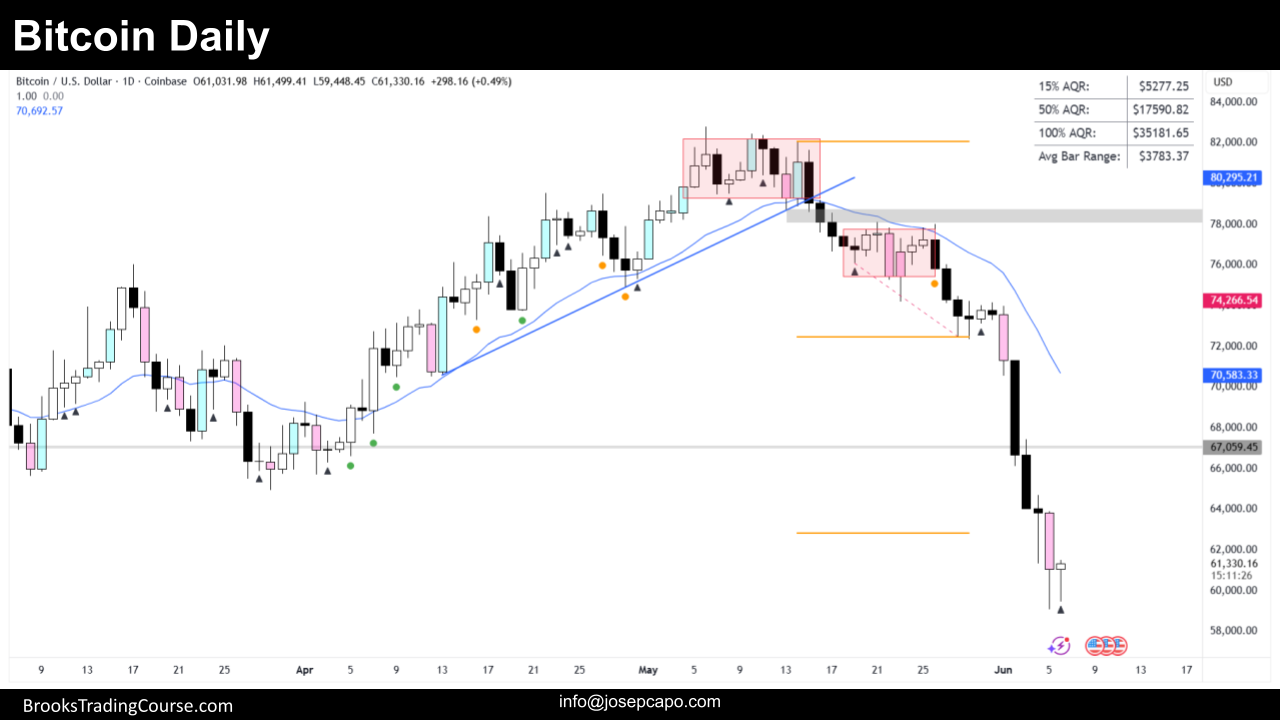
While the daily chart simply highlights a massive, vertical bear breakout, it reveals a few nuanced details. This drop left a massive gap, creating a zone of minor price development. Just like an intraday gap or a stock market gap, when a breakout gap is exceptionally large, there is a greater than 60% probability that the market will transition into a trading range.
In a trading range, 80% of breakouts eventually fail, and most gaps are eventually filled. One classic beginner mistake is selling right at the bottom of a massive breakout out of excitement. The market will almost always shake you out if you do this, because V-bottom reversals only have a 20% chance of succeeding. The best the bulls can likely do right now is force the market into a consolidation block, which will eventually drift back to test the Exponential Moving Average (EMA).
This entire breakdown is technically a lower-high major trend reversal following the break of the macro bull trendline. In hindsight, its structural logic makes perfect sense, though it was a difficult trade to execute in real time.
The breakout below the parabolic wedge bottom was technically a low-probability event (typically a 20% to 30% chance). I often hear beginners complain that these moves make “no sense” or “shouldn’t happen.” But a 20% probability means it will happen 2 or 3 times out of 10. Over a large sample size of charts, you will see that while the market usually favors the higher-probability side, you must accept and adapt when low-probability surprises occur. Following this major sell climax, we expect the market to eventually exhaust its measured move targets and transition cleanly back into a structured trading range.
Conclusion
That covers everything I have for you today. If you struggled to catch some of the terms due to my accent, remember that a full, clean transcript of this report is available under the blog tab on the Brooks Trading Course website.
Thank you so much for watching. I look forward to reading your thoughts in the comment section below. If you value our price action approach to reading the markets, please consider joining our active Discord community.
To fast-track your trading education, feel free to check out the Brooks Trading Course Video Archive, where you can find comprehensive daily and weekend market reports designed to help you independently read price action.
Market analysis reports archive
You can access all weekend reports on the Market Analysis page.


