Trading Update: Thursday June 4, 2026
S&P E-mini market analysis
E-mini daily chart
- The E-mini continues to form a tight bull channel; yesterday sold off and broke below the previous day’s low, forming a bear bar.
- The bears tried to get a strong close, but because the channel was tight, the odds were against traders selling the close of yesterday’s bar, which increased the potential that traders would buy as yesterday’s bar sold off.
- So far, today has found buyers below yesterday’s low and is going to form a weak follow-through bar for the bears.
- This is expected: the bull channel is tight, so any reversal down is likely to be minor, even with the market going sideways where it is.
- The moving average is getting dragged up closer to the current price; at the moment, the odds still favor a test of the moving average and a test of the May 20 most recent higher low.
- The market has not touched the moving average since April 8 on the Globex chart, and the odds are that the market will test the moving average.
- The bulls were trying to form a High 1 by closing on its high; however, even if today forms a High 1 buy signal bar, there will likely be increased risk of more sellers above the bar rather than buyers.
- 7,600 is an important round number, and there is an increased probability that it will act as resistance and limit the upside potential.
- The odds favor continued sideways trading around this price level, even if the bulls form a strong buy signal bar for the High 1 today in a bull bar closing on its high.
- The context is not ideal: the market is far from the moving average and has been far from the moving average for the past several weeks, which increases the odds that the market will have to reach the moving average over the next couple of days.
- Because the market has been away from the moving average for an unusually long stretch, the upside is probably limited.
E-mini 5-minute chart and what to expect today
- The E-mini gapped down on the open and formed a bull reversal bar closing on its high, completing a wedge bottom with yesterday’s bar 5 low, yesterday’s bar 39 low, and today’s bar 1 low.
- With bar 1 being a strong bull reversal bar closing on its high, the probability increased that the bulls were going to get a couple of legs up and a test of the most recent low or high — in this case, yesterday’s bar 60 high.
- The bulls formed a micro double bottom and a second-entry buy with bar 4, and then the market formed a wedge with bar 10.
- The bears tried to get a wedge top at the moving average, hoping it would form a bear flag and lead to a downside breakout; however, because of the overall context on the daily chart — with yesterday forming a decent bear bar — the odds favored buyers below yesterday’s low on the open of today, given the tight bull channel on the daily chart.
- All those reasons increased the probability that the market would likely test higher, and therefore the bar 10 low was likely to be a bear trap, trapping traders into a bad sell.
- The bulls got a strong break on bar 11; the market went sideways to bar 16, and those bears who sold the wedge below bar 10 and got trapped on bar 11 ended up exiting their shorts somewhere around bar 16.
- The market broke strongly to the upside on bars 18, 19, and 20; by bar 20, the market was clearly always-in long and likely to get a second leg, and therefore the first reversal down was likely to be a minor one.
- Whenever the market forms a strong breakout like bars 20 and 21, the odds favor a second leg; however, because the market is already in a bull channel, there is increased risk that the market will have to test down to the moving average, which it did on bar 28.
- It is reasonable for traders to exit around bar 25 and then look to re-enter around the moving average, either on bar 29 or on the entry bar 30.
- As of bar 35, the market is near the 7,600 round number and will likely have to reach it; the market is forming a micro channel from the bar 29 low to the bar 35 high, which increases the odds that there are buyers not far below and that the bulls will need some kind of second leg up.
- This lowers the probability of the bears getting a sharp reversal down, and if the bears do get a reversal down below bar 35, it will likely be limited by buyers at a minimum.
- The bears will likely have to form some kind of major trend reversal before they can get a sharp reversal down.
- Overall, the bears can likely expect a trading range because the market is approaching the 7,600 round number, and the odds of the market going much higher without first going sideways are limited.
Yesterday’s E-mini setups
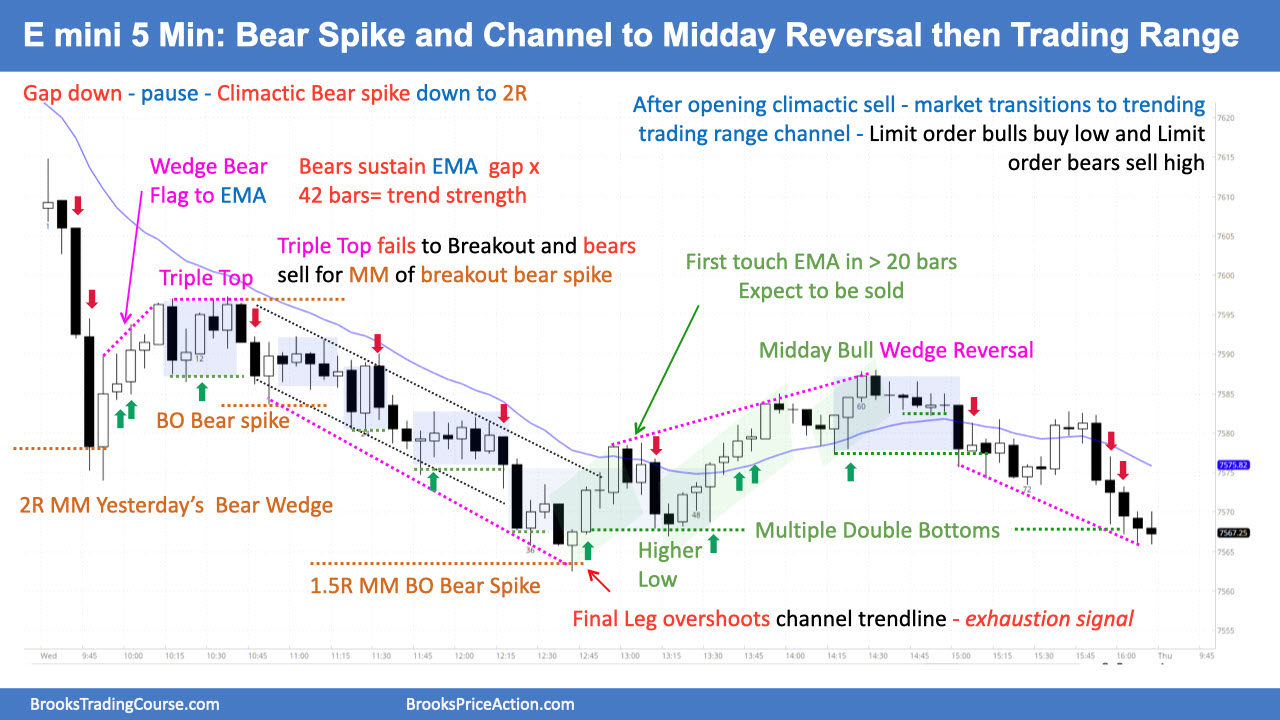
Jed created the SP500 E-mini chart.
Here are reasonable stop entry setups from yesterday. Chart shows each buy entry bar with a green arrow and each sell entry bar with a red arrow. Buyers of the Brooks Trading Course have access to a near 4-year library of detailed explanations of swing trade setups (see Online Course/BTC Daily Setups) linked to the Brooks Encyclopedia of Chart Patterns product.
The goal with these charts is to present an Always In perspective. If a trader was trying to be Always In or nearly Always In a position all day, and he was not currently in the market, these entries would be logical times for him to enter. These therefore are swing entries.
It is important to understand that most swing setups do not lead to swing trades. As soon as traders are disappointed, many exit. Those who exit prefer to get out with a small profit (scalp), but often have to exit with a small loss.
If the risk is too big for your account, you should wait for trades with less risk or trade an alternative market like the Micro E-mini.
Summary of today’s S&P E-mini price action
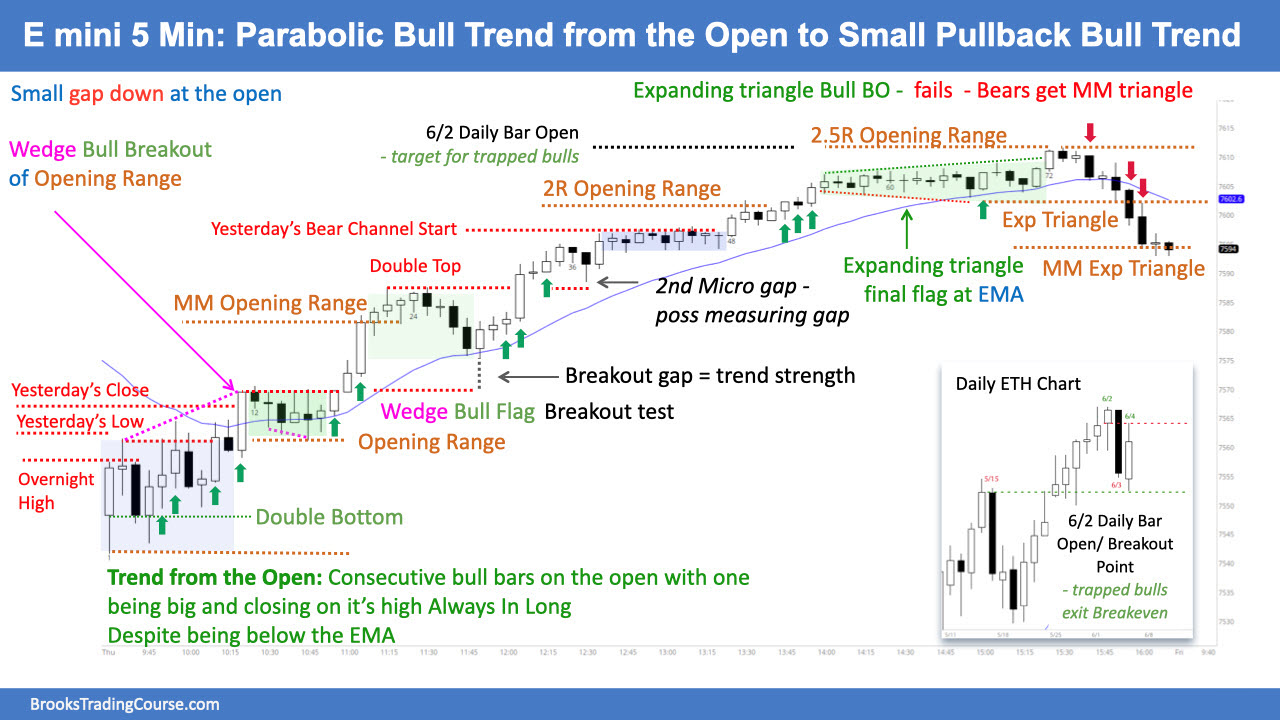
Jed created the SP500 E-mini chart.
E-mini end of day video review
Periodic end of day review videos will be moved to top of page when done.
See the weekly update for a discussion of the price action on the weekly chart and for what to expect going into next week.
Trading Room
Al Brooks and other presenters talk about the detailed E-mini price action real-time each day in the Brooks Trading Course trading room. We offer a 2 day free trial.
Charts use Pacific Time
When times are mentioned, it is USA Pacific Time. The E-mini day session charts begin at 6:30 am PT and end at 1:15 pm PT which is 15 minutes after the NYSE closes. You can read background information on the market reports on the Market Update page.


