The support forum is built with (1) General and FAQ forums for common trading queries received from aspiring and experienced traders, and (2) forums for course video topics. How to Trade Price Action and How to Trade Forex Price Action videos are consolidated into common forums.
Brooks Trading Course social media communities
Brooks Trading Course Learning Resources >>>

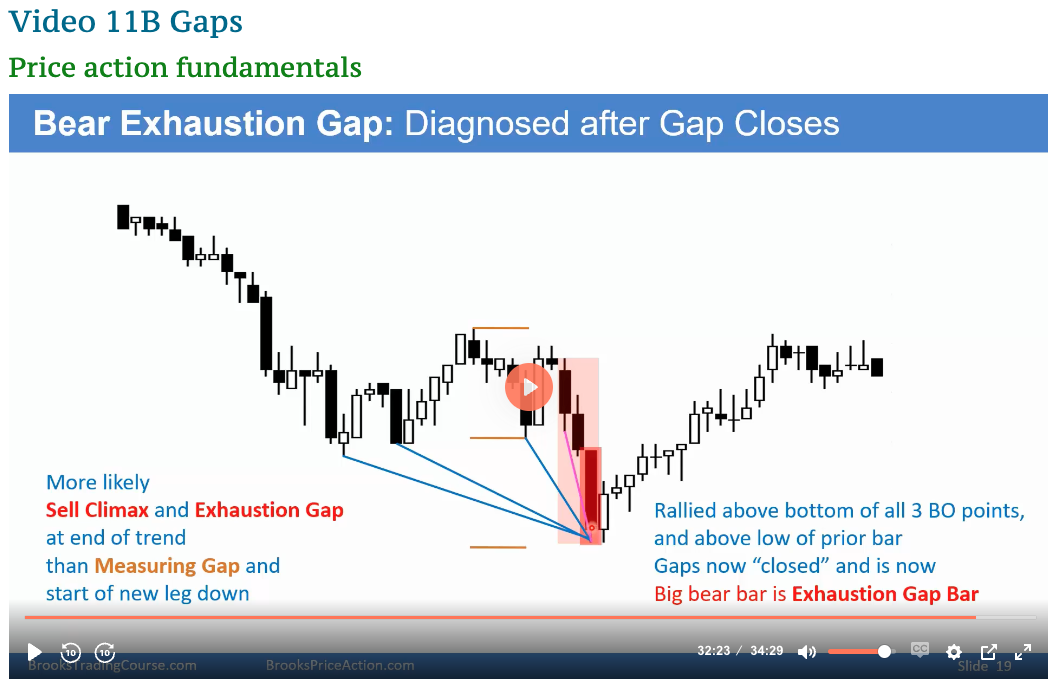
In Slide 19 of the Video 11B, Al mentioned that because bears aren't able to get out from the sell climax, the chances are that we get down to the sell climax or bottom. Why would the market allow the bears to get out at their breakeven points instead of squeezing the bears out after the exhaustion gap bars? Should I understand that it is a nature of a shift, within probabilities, of the market cycle from strong bear trend to trading range instead of changing the market behavior abruptly like sharp up trending? Or, would that be because of bull bars after the climax that are not particularly strong?
I am not picking on one sentence but more curious and trying to understand about the Al's reasoning behind why market has to search for more sellers over buyers in this context. Always there are so much valuable comment from his subtle nuance when it comes to his understanding of market moves. Thank you very much for taking your time to answer in advance. 🙂

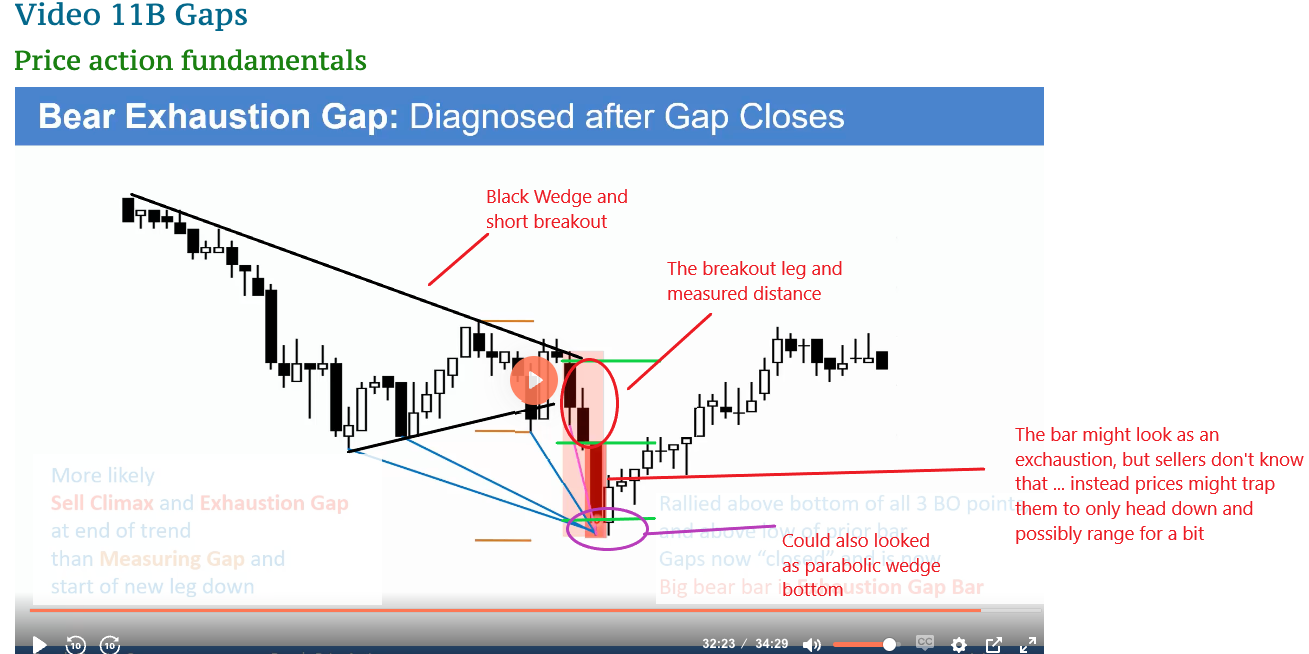
Hongkee, it doesn't answer your question, but there are some additional PA that may shed some light more (or not) ... just my 2c - could be wrong

I have the same question !!
would a give up bull bar decrease the odds of a test down

Why would the market allow the bears to get out at their breakeven points instead of squeezing the bears out after the exhaustion gap bars?
Hello Hongkee, The market doesn't favor bulls or bears even if they are trapped. Market always tries to find the equilibrium, meaning that markets almost always in TR.
That's why Al says that you can find only 10% of bars to be in BO in any chart. 90% of times the market is going to be 50-50 helping both bulls and bears to make money.
I remember Al talking about a trader(can't remember the name) who bought in a bear trend every time it fell 10% and managed the trade properly, He ended up making money once the market went back to his first entry price.
Even in a strong Bear BO/trend like the chart you mentioned, people who have a lot of money(institution, banks etc.) would buy the market, scale in and manage the trade properly. They know that the market won't keep falling down and would eventually come back up. So, the weak bull leg we see right after that strong bear EG is mostly something like that.
Should I understand that it is a nature of a shift, within probabilities, of the market cycle from strong bear trend to trading range instead of changing the market behavior abruptly like sharp up trending? Or, would that be because of bull bars after the climax that are not particularly strong?
Yes, the reasons that you mentioned above are all correct.
Hope my answer helped.


