The support forum is built with (1) General and FAQ forums for common trading queries received from aspiring and experienced traders, and (2) forums for course video topics. How to Trade Price Action and How to Trade Forex Price Action videos are consolidated into common forums.
Brooks Trading Course social media communities
Brooks Trading Course Learning Resources >>>

I am considering to extrapolate the strategies of the Open of a day session to other timeframes. The reason is clear, it is easy to recognize the Common Outcomes of the Open: BOs, DT/DB, WT/WB, failed BO above/below prior session H/L.
The primary idea that I had it is to look for a 80/100 bars range TF that fitted into the most common time periods: Week, Month, Quarter (or a 1/3 of a Year.)
Timeframes Examples with a US Stock:
- Week: 15 minutes TF (1 week=100 bars)
- Month: 120 minutes TF (1 month=87 bars)
- 1/3 of a Year: Daily TF (1/3 of a year=81 bars)
- Year: 2 weeks TF (Year=104 bars)
What would be your thoughs about this approach?
Thank you in advance for your response.
Best wishes.

The opening range strategies can't be extrapolated to continous charts. Al only talks about the opening range when trading the 5 min daily session chart. You will never find such analysis in his weekly report, where he comments daily, weekly and monthly charts.
@ludopuig Thank you for your answer.
It is a bit confusing what you have written because within the Brooks Forex Trading Course markets are continuous charts and he teach us to trade the opening range of the day as he trades the emini (the only difference it is that the opening time it is not exact).
On the other hand, Al has a "fractals approch", he always says that it is a must to trade all the timeframes the same and that he cannot find any difference between a monthly chart or a 1 minute chart.
Ultimately, I think the question it is something to consider. I have been studying the pattern and seems it works, I checked mostly with weekly charts (where I look for the patterns to unfold between 10-20 weeks after the Open of the Year) and daily charts (where I look for the patterns to unfold between 10-20 days after the Open of a Quarter (or even after the Quarter's expiration of futures contracts)). I find importants the Supports or Resistence of last year high/low at a Weekly chart or a last quarter high/low at a Daily chart. ¿What would be then the difference?
A picture to keep ilustrating the point:
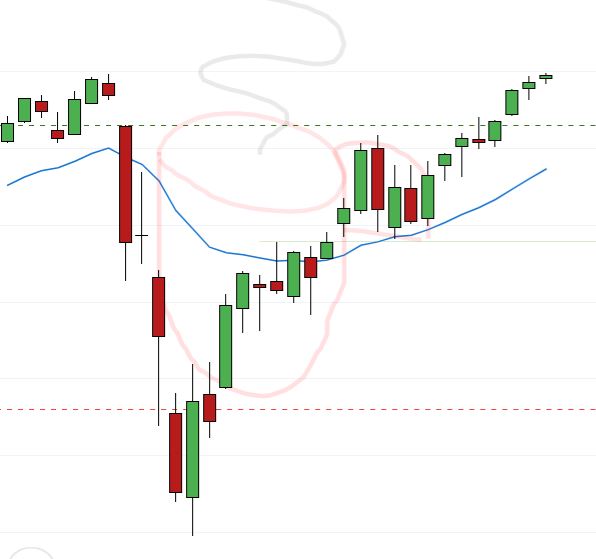
This is the weekly chart of emini. There is early in the year a huge bear Breakout that tests last year's low and fail. No matter how strong it is a Breakout at the open, 50% change that will reverse. Therefore, one of the most conservative patterns to trade would be waiting until you see a V bottom with a pullback and then enter a trade afger a good signal bar -or H2- (cup and handle) for example. The Breakout early in the session (year) has been so strong that even if the market reverses completely will not go very far. ¿It is really something to not consider?
¿Could you please transfer this question to get a direct answer from Al?
¡Thank you in advance!
Kindest Regards, Josep.
It seems you have a very strong opinion about that so go to the webinar's end of day Q&A section and place the question there, Al will be answering it live. He doesn't take questions here and only Emini questions in the BPA forum.

Was this question answered ? the gentleman had a good question and i am interested to know the answer as i have the same question as i am a daily/ weekly trader
No, he didn't come back to share the answer from Al...

Hi I am using Als method to swing trade the day chart. I am also interested in this topic as I'd like to use the encyclopedia of charts as well.
Hi! To be honest, I went no further with this experiment, so I’m not certain how well those specific "opening patterns" can help on higher timeframes.
If you're looking for a reliable way to swing trade the daily timeframes, here is what I’ve found most effective:
-
Buying All-Time Highs (ATH): I prioritize stocks hitting new highs, especially after a long consolidation or a clear shift from "Always In Short" to "Always In Long." The Logic: An ATH is often a signal of strong fundamental support. Retail traders rarely push a stock to record highs; that is almost always the work of institutions. By waiting for a breakout after a long base, you ensure you aren’t entering a climax or "getting in too late" on an exhausted trend, which is poor strategy.
-
Targeting Mid-Caps: I find this directional breakout strategy works exceptionally well with mid-cap names.
When trading Daily charts of Stocks, I believe Al focuses on strong trends, either bull or bear trends (tight channels or small pullback trends).
Hope this helps!
Josep
Thanks for the reply. I don't trade any different no matter what time frame at all. A chart is a chart is a chart as Al says. I think the encyclopedia is more than breakouts and any large trend bar(or series of them) is a breakout. I think there is a way to use it just not sure exactly how.


