The support forum is built with (1) General and FAQ forums for common trading queries received from aspiring and experienced traders, and (2) forums for course video topics. How to Trade Price Action and How to Trade Forex Price Action videos are consolidated into common forums.
Brooks Trading Course social media communities
Brooks Trading Course Learning Resources >>>

Hello everyone,
I have a background in statistics, and after learning about the concept of the 18-bar range in an Brooks course, I wanted to investigate its significance. So, I conducted an experiment.
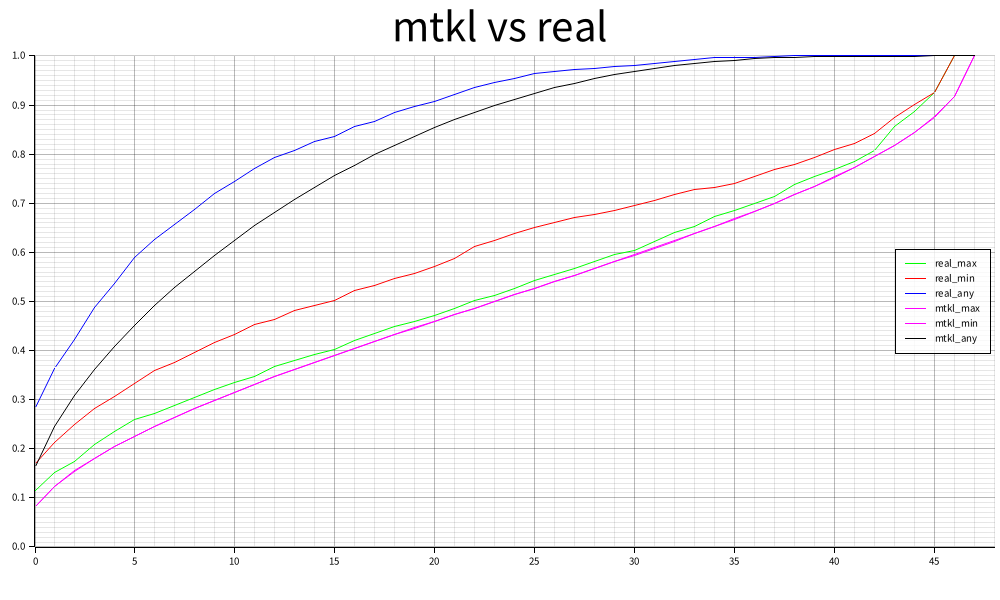
In the Cumulative Probability Distribution Chart below:
mtkl represents a computer-simulated random walk sequence.
The black line indicates the probability of having already appeared at least one of the highest or lowest points at the x-th value.
real represents the actual performance of the CSI 300 index futures from 2020 to 2025.
The blue line is indeed higher than the black line, but does this have statistical significance? Additionally, the green line is very close to the results of the random simulation.
computer-simulated random walk sequence
$A_n=A_{n-1}+N(0,1)$
$A_0=0, Max(n)=48$

18 isn't a magical number, as you can see in your chart the line is smooth as you go left to right, it doesn't jump up or down at 18. One thing about b18 (and 6 and 12) is that it is a close of a 30min bar, which could be of some meaning, but I think the reason 18 is looked at is because it is somewhat early in the day yet still gets you to a 'high percentage' point for saying that we have seen the high or low of day (80%). Would be less meaningful to say oh at bar 79 we're 99% to see the HOD or LOD.
Why do we care if it is highly likely to see the HOD/LOD? Well, it just helps to give you some perspective on what you can reasonably expect for the day, which can help you in identifying or structuring trades.
But my personal opinion is stats like these are mostly (not completely!) just sound-bites and it is better to simply focus on the action and on price action principles.


