The support forum is built with (1) General and FAQ forums for common trading queries received from aspiring and experienced traders, and (2) forums for course video topics. How to Trade Price Action and How to Trade Forex Price Action videos are consolidated into common forums.
Brooks Trading Course social media communities
Brooks Trading Course Learning Resources >>>

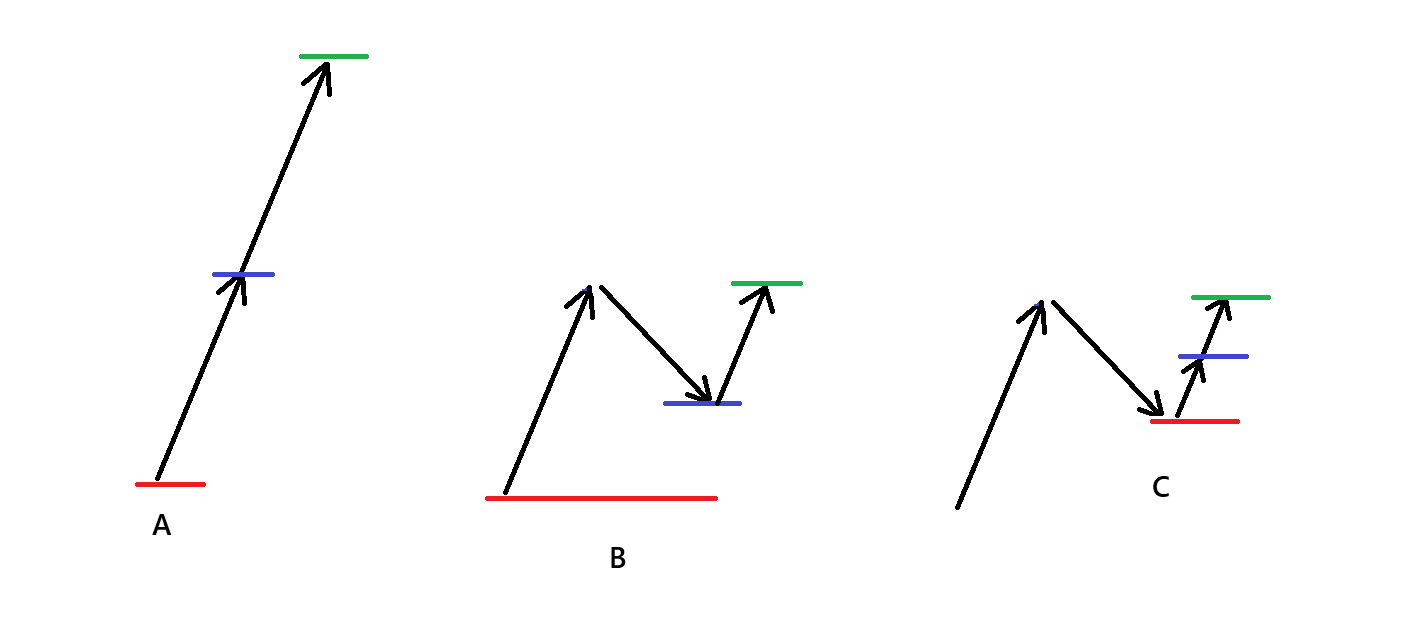
Based on the included picture with three 1:1 setups (A, B & C), assuming the context is identical in all 3 setups, do you think the probabilities are similar in all three cases or are some of these setups more likely to work than others?
I'm having trouble coming up with an answer so if anyone has any input on this, thanks in advance!
PS: I understand the odds will likely be between 50% and 70% but I still have a hard time ranking them from most likely to least likely to succeed because there are pros and cons unique to each of them.
Cheers,
J

I would say A is the highest probability as it looks like a strong breakout (maybe 70% or higher depending on the context), B is bit lower probability as it represents a 50% PB in a bull trend (60%) and C is even lower probability as it represents a H1 buy (most first legs up fail, especially late in trends, especially if it's preceding a strong first leg down) (and you have to understand that you're buying inside a TR on LTF so BO-mode) and because you use the incorrect SL the probability gets even lower (40 - 50%), as we could easily get a 2nd leg sideways to down.
But again, context is everything and sometimes A can be a low probability trade (e.g. strong spike at top of TR / broad bull channel) and C can be high probability (climactic reversal restarting market cycle or surprise BO out of TR followed by multiple H1 buys)

yes that's how I was seeing it... something like 70% A, 60% B and 50% C (or maybe even less)
I was thinking that A > B mainly because like you say strong breakout so 70% plus if good context, but also because with B you are entering while price is moving opposite to your direction.
But I was not sure about B > C because while C uses the wrong stop loss it at least has price moving in the correct direction as the trade is open, but then again like you say I view C as having a lower quality stop loss location and I feel like that might have a bigger impact on the trade's EV than entering with a 50% correction fade.
Maybe I'm completely wrong though, I'm not sure, so I find it interesting that we have similar opinions.
Cheers!
J

Well, you can't separate them from context. Here is the issue which you are going to run against. Part of the aspect is what can you take?
In A, you have taken the trade and it goes to target. You are trading the spike situation, which is often the more difficult entry to take because the market is moving. You have made the assumption you can take that - - - can you reliably?
B situation is a limit order entry. You are indicating that you are reading the always in direction confidently and you do not mind entering at 50% knowing that prices may continue farther and some will even break down and out the other side. Can you site with that? Limit order entries are a bit more challening.
C is the easiest and it is essentially looking for a 2EL in a trending market and waiting for a good bull bar to enter.
C is the easiest situation to develop your trading if you are not profitable yet.
Good trades to you!
Yes Eric! Thanks a lot!
I mean, a part of me also says C is easier. But it contradicts the other part lol. That's why I'm so confused.
There are at least one positive aspect and one negative aspect to each setup. But what I struggle with is weighing these aspects objectively.
You seem to give more weight to the quality of the bull signal bar on setup C while others might give more weight to the quality of the stop loss location in setup A or B, while others might give more weight to the strength of the trend in setup A. That's partly why I'm so hesitant to come up with a clear answer.
What if we assume AIL and perfect execution for all 3 setups, would this change your opinion? (also, assuming we are using a line chart so we don't know the quality of signal bars)
Ok - you want to measure objectively. Then measure :).
For C, over a series of trades, if you are reading the market well it should come out the same. Who is to say for C the stop loss can't be the same for A & B? You are including many variable functions at once w/o measuring what you are able to do. The question, which is even more important is, realistically, which one can you perform well? C will be the easiest to begin with and is listed as a top pattern to begin with - Al Brooks -> trading with trend using second entries with a good signal bar. There is a reason he lists this as a great place to begin. A is breakout trading and can be much more stressful. For C you have time, and the signal bar makes things easier. In B, you are saying - limit orders, I'm good! Al emphasizes beginning with stop orders because you benefit from the market moving in your direction. B you are saying - nah, I got this. Maybe you do. Testing will verify. If you can do B, then Cs also can be added into the mix. If one can do C, one may not be able to do B yet. . . A is the most difficult as you are predetermining that you can read the market well in breakout situations (spikes) and can react very fast. A is most often market order entries because, well, they "just happen" a lot of the time. MTRs are only 40% but individuals have plenty of time to study and wait. That is 2:1. For 1:1, that is high probability already.
In all 3 situations you have already declared AIL. When you say, and as soon as you say 1:1, that is what you have declared. What can you do, reliably, and with the fewest errors? That is what you want to focus on - not theoretically, but realistically. The easiest one, through your feelings and testing, will take you the farthest. Low stress (not no stress because this is trading).
You may want something, and not be able to do it. So, the question becomes, what can you recognize and do? Measure :).
Finally, there is value in candlesticks so why trade with line charts? Why make things any more difficult than they have to be. . .
Hopefully a good path forward & good trades to you!
Thanks so much!
I trade with candlesticks of course, line charts were only for my limited thought experiment.
After reading your last post Eric I think I understand and agree with everything you said. I did a bit of backtesting too and it seems to align with what you are saying, which is contradicting my initial hypothesis but it seems I was wrong in my first assumption.
Trading the A setup does seem very difficult, with a lot of things that a beginner might get wrong.
Trading the C setup with a good entry candle and stop orders does seem to be the easiest.
Trading the B setup might offer just as much EV or perhaps more than the C setup but is more advanced and might lead to more mistakes for a beginner.
So I understand why you say that what matters more is what I'm able to do, and why the easiest setup to begin with would be C and why the most difficult to make money with might be A.
PS: I'm not sure where you found this: "Al Brooks -> trading with trend using second entries with a good signal bar. There is a reason he lists this as a great place to begin." but if you have a reference I would be interested, is this a video or blog article?
Thanks,
J
You are welcome & nice testing!! In trading a lot of non-obvious things create success.
References:
1. Al's 1st book on best trades (Blue book last chapter).
2. Al's Top 10 patterns to trade. Web post.
3. Al's highest probability setups. Reversals page 459. He lists setups in probability order. The 1st 2 listings are reversals (which are more difficult and that is the reason they are published in the 3rd book). . . Followed by, "Buying a high 2 pullback to the moving average in a bull trend", and "Selling a low 2 pullback to the moving average in a bear trend".
4. Many Al Brooks trading room video with a 2nd entry. "If you want to buy, wait for a good setup with a strong signal bar, closing near its high and place a stop order". :). When he did the daily review, he would cover stop order entries and those characteristics were just about always present.
5. Al's daily chart markups. It isn't "written", but after reviewing many charts, you'll just say - yes, of course :).
Wishing you much success.
Good trades to you!
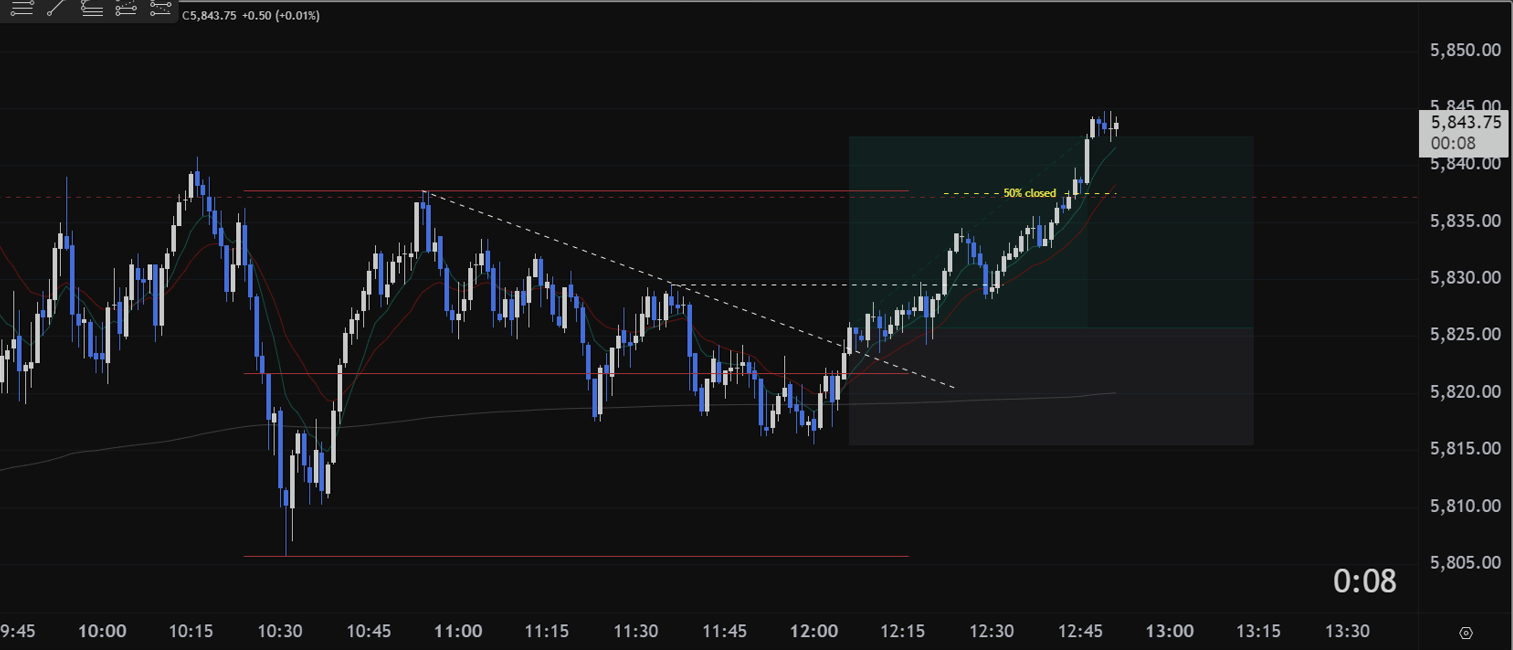
Thanks for the references Eric!
I was looking for C type setups today on MES and found a nice one that ended up working nicely with very low stress. I'm glad we had this discussion yesterday, it's already having an impact!
Sorry. Insufficient setup and description. The context means everything, so even though you say it is the same, without detailing -> strong bull/bear market, trading range, etc, the graphics do not mean much.
1:1 is predefining a high probability setup to begin with. Probability must be 60%+ to allow for that so that errors, slippage, etc do not overly erode profits. A 60% trade has characteristics too it.
Example, strong bull trend - spike: The solution is just to buy. Any of the 3 forms is correct if the stop is well placed. It is raining in Manhattan - Buy. Walmart has a blue light special -> buy. It is Saturday - - - well, you probably will not buy because the market is stagnant but you get the point.
Also, probabilities are not always 50-60%. This assumption creates the environment that you are trading in the direction of a trend or that you are in the middle of a trading range. If you are reversal trading, or not reading the market well, probabilities can be very much less than 50%, or 40%.
with 40%, swing trading, the MTR can provide great opportunities.
I encourage you to review Al's daily setup charts and selections to help define the situations where probability is 60% (for a scalp). Defining the context when a trade begins has more value, because it determines what happens, and appropriate actions afterwards.
Hopefully somewhat helpful and good trades to you!
In short, by defining 1:1, you have already predeclared a high probability situation. What happens after that will depend on the initial context. For a spike/successful breakout, prices will be going higher and work according to the transitions from spike -> channel -> trading range. All 3 would be alright. Out of a trading range, well the probability isn't high probability to begin. From a channeling phase and buying probably a h2 what comes next is not as well known, but good odds are in your favor in the direction of the trend. Hopefully you can see the context and where the trade is happening with respect to the price patterns determines which of those 3 come next.
Good trades to you!
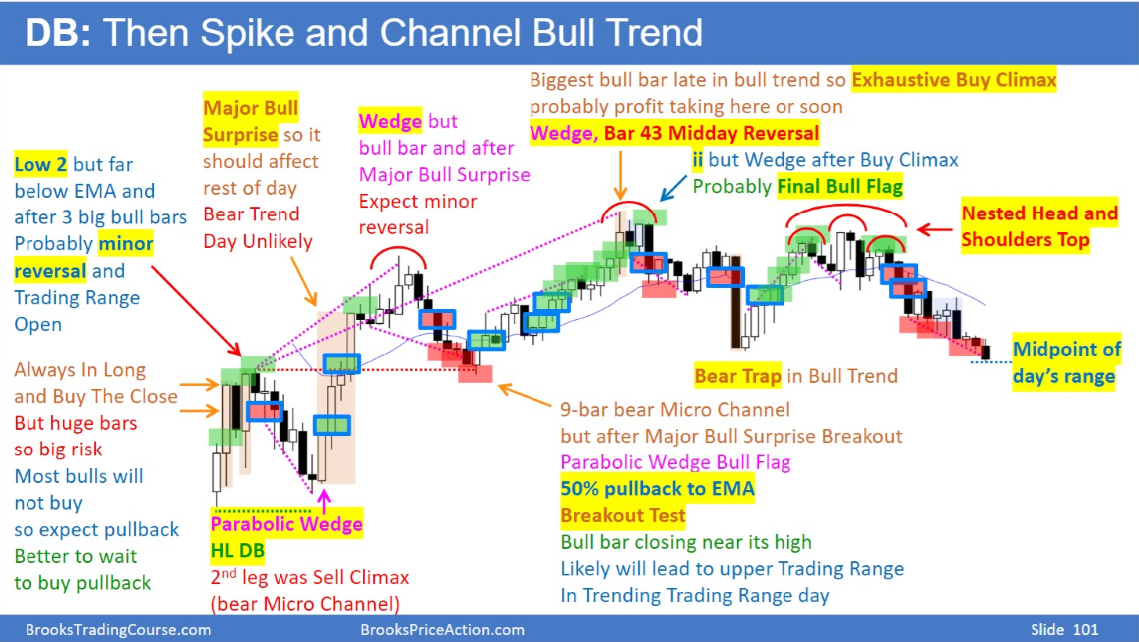
Last follow up and an example of why the Brooks Encyclopedia is an exceptional value. I'm enclosing an older chart. The blue boxes are trades at which, entering with a stop is at least a 60% probability. You'll note though that what is "to the left" in each situation is a bit different. Those differences ARE THE CONTEXT, and reading that first statically, and then in real time is the critical skill. Predefining 1:1 means that you are deciphering exactly why those blue boxes are 1:1 initially. This is not to say the other markings are not valuable, but they are swing trades and therefore are not 1:1 initially.
Good trades to you!
Thanks for all the time you took to explain your replies, very appreciated!
But if we forget about the context for a minute and just compare these setups in a vaccum. You have a bull breakout, in another setup you have a bull breakout followed by a less agressive 50% correction, in another setup you have the bull breakout, the less agressive 50% correction and then a resumption of the trend that recovers 50% of the correction. In the first 2 setups, your stop is below the breakout, in the 3rd setup, your stop is below the bull flag. All three setups are targetting either the prior major high or a measured move projection, for 1:1. So if you couldn't have any clues about the context but had no choice but to choose only one of those setups as the only setup you were allowed to trade for the rest of your life, would you have a preference?
I tend to think that it's easier to make money with A, then B, then C. But others see it completely different so maybe I'm wrong. Also, perhaps there are differences but not significant enough to treat these differently.
Cheers,
J


