Trading Update: Tuesday June 9, 2026
E-mini end of day video review

S&P E-mini market analysis
E-mini daily chart
- The E-mini formed a strong downside breakout last Friday, and the odds favored a bounce yesterday.
- Yesterday got the bounce and formed a bull bar; however, because the bar failed to close on its high in the overall context of last Friday’s breakout, the odds favored sellers above yesterday’s high.
- Today rallied above yesterday’s high, found sellers, and then went outside down, breaking below the May 19 low.
- Because the May 19 low is a support level, the odds favored buyers below it willing to scale in lower, which reduced the probability that the bears would get a bear bar closing on its low today.
- While the bears have done a good job with the selling, the odds favor a trading range rather than the start of a strong sell-off.
- Therefore, even if the bulls bought 7,600 and are willing to scale in lower, the downside potential is probably limited.
- This means the bulls who bought 7,600 and are willing to buy more at lower prices, around 7,400 and 7,200, will probably make money.
- This increases the odds that the market will start going sideways soon and will probably test back up to the June 4 low, which is the breakout point that began last Friday’s downside breakout.
- Overall, the odds are that the market will start going sideways for the next several weeks, and therefore, the downside risk is probably limited.
E-mini 5-minute chart and what to expect today
- Today gapped up on the open, forming four consecutive bull bars, and then sold off strongly to the bar 10 low.
- The bear breakout on bars 9 and 10 was strong enough to expect a second leg down, which the bears got with the sell-off on bars 14 and 15.
- By bar 16, the market was getting climactic, and the odds favored a second leg up; however, the odds were that any reversal up would likely be minor.
- The bulls did a good job with bars 17 and 18, and the odds favored a second leg up; however, the bears got a second-entry sell with bar 21 and a bear bar closing on its low on bar 22.
- That forced the bulls to exit their longs, and the bears started selling, betting on a second leg down after bars 15 and 16.
- The bears got a strong breakout down to bar 24, breaking below last week’s low, which was enough of a surprise that the odds favored a second leg down, and at this point, the market was getting fairly climactic.
- The bears managed to get a tight channel down to bar 35 with a bull bar closing on its high. This increased the odds of the downside being limited. Bulls would likely be willing to buy and scale in lower betting the market evolving into a trading range.
- The bears got another leg down to bar 39 and a bull reversal bar closing on its high.
- Because of the prior buying pressure at bar 35 and the current bull bar at bar 39, the odds favored bulls buying and getting a second leg up, testing the bar 37 high and the moving average.
- The location of bar 39 was bad for the bears: the market had formed a consecutive sell climax and was testing support on the daily chart, and the odds favored a rally back to last week’s low.
- As of bar 60, the rally has been strong for the bulls and is approaching the bar 17 high; it is reasonable for the bulls to buy the bar 17 high, so it is reasonable to think the market will have to test back to bar 17 over the next several bars.
- 7,400 is an important round number, and the market will probably test it over the next several bars as of bar 61.
- The channel up is tight, which limits the downside without more selling pressure; with the market getting far from the moving average, it will probably pull back soon.
- Overall, the bulls have done a good job getting a rally with bar 39, which increases the odds that there are buyers on any pullback — disappointing for the bears on the daily chart.
Yesterday’s E-mini setups
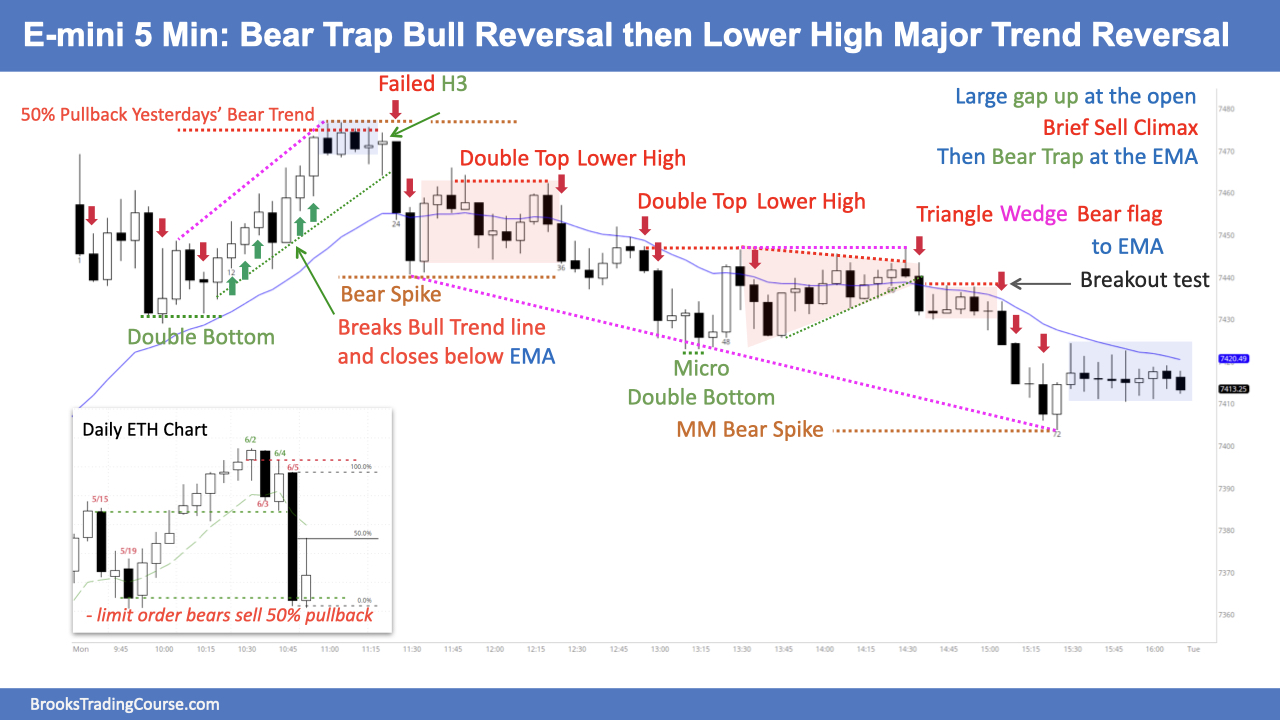
Jed created the SP500 E-mini chart.
Here are reasonable stop entry setups from yesterday. Chart shows each buy entry bar with a green arrow and each sell entry bar with a red arrow. Buyers of the Brooks Trading Course have access to a near 4-year library of detailed explanations of swing trade setups (see Online Course/BTC Daily Setups) linked to the Brooks Encyclopedia of Chart Patterns product.
The goal with these charts is to present an Always In perspective. If a trader was trying to be Always In or nearly Always In a position all day, and he was not currently in the market, these entries would be logical times for him to enter. These therefore are swing entries.
It is important to understand that most swing setups do not lead to swing trades. As soon as traders are disappointed, many exit. Those who exit prefer to get out with a small profit (scalp), but often have to exit with a small loss.
If the risk is too big for your account, you should wait for trades with less risk or trade an alternative market like the Micro E-mini.
Summary of today’s S&P E-mini price action
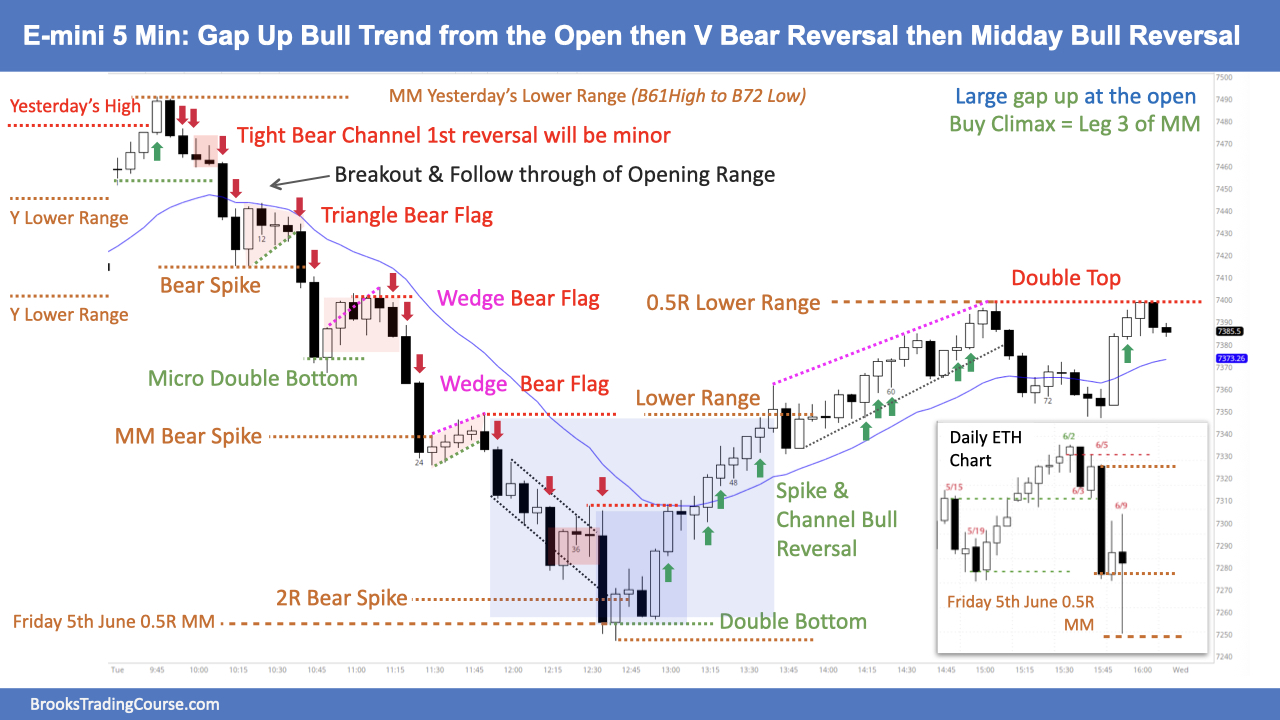
Jed created the SP500 E-mini chart.
See the weekly update for a discussion of the price action on the weekly chart and for what to expect going into next week.
Trading Room
Al Brooks and other presenters talk about the detailed E-mini price action real-time each day in the Brooks Trading Course trading room. We offer a 2 day free trial.
Charts use Pacific Time
When times are mentioned, it is USA Pacific Time. The E-mini day session charts begin at 6:30 am PT and end at 1:15 pm PT which is 15 minutes after the NYSE closes. You can read background information on the market reports on the Market Update page.


