The support forum is built with (1) General and FAQ forums for common trading queries received from aspiring and experienced traders, and (2) forums for course video topics. How to Trade Price Action and How to Trade Forex Price Action videos are consolidated into common forums.
Brooks Trading Course social media communities
Brooks Trading Course Learning Resources >>>

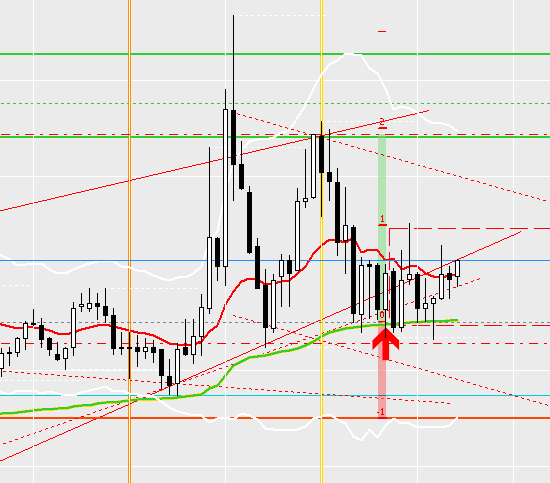
Hello Traders,
I bought this as a 2x risk/reward ratio & more than 40% probability setup.
I skipped the first exit opportunity (at 10 pips above the entry (1xIR / top of the red rectangle) & also more than 2xAR) because I thought I should wait for 2xIR to make trader's equation positive, and now it is a tight trading range, going sideways.
I think Al was saying that going sideways means the probability is getting closer to 50/50%.
According to Al, does the 40% entry now have a better probability than it did at the beginning?
Do I need to exit earlier (say 1xIR) than I was planning (2xIR), because better probability sets off risk/reward?
Or does exiting earlier mean that I am trading this position with a negative trader's equation because I am exiting the 40% trade at 1xIR? So should I hold?
Or the situation is better now because reaching 2xIR has a 50% chance? So should I hold?
If I entered with 60% setup and then PA starts to hesitate, I plan to exit earlier because trader's equation goes negative and never try to hold and manage it as a swing trade, but I'm not sure if holding in this situation makes money in long run or not.
Thanks 🙂

From my point of view it depends on your premise and if this is still valid. What was it and why you took the trade? From there you are able to evaluate what probability you have and how to manage the trade. If it is still valid you have to stay in, if it isn't you have to get out.
With more and more bards sideways it's correct that Al speaks about 50/50 in context that this leads the market to neutrality from the direction before.

From my point of view it depends on your premise and if this is still valid. What was it and why you took the trade? From there you are able to evaluate what probability you have and how to manage the trade. If it is still valid you have to stay in, if it isn't you have to get out.
With more and more bards sideways it's correct that Al speaks about 50/50 in context that this leads the market to neutrality from the direction before.
My premise of the trade was to buy low at the bottom of TR. Betting that bear BO of TR will fail and test the TR top.
- I saw a TR consisting of two bull legs and two bear legs late in the bull trend.
- I expected to the price go up to the previous bull leg high (last bull bar close).
- The point I bought was at bottom third of TR so it offers 2 RR ratio.
- It was on the bull trend line (red line).
- Double bottom bull flag in bull trend.
- I saw the last bear leg is strong enough to have 2nd leg down or at least its attempt. So the tight trading range / micro double bottom before the entry is acceptable to me.
- Enter after the 2nd leg down attempt of the last bear leg, which creates micro double bottom.
- I used limit order to buy at the bottom of the tight trading range, because I did not want to buy at the top of the tight trading range, which is also around 20EMA and bad RR ratio.
- Other supports were there…
I estimated the probability of getting 2xIR to be at least 40%.
Price continued to hold above the TR bottom, so yes, my premise was still valid, so I held.
But the hesitation at the TR bottom was longer than I was expected so I wondered how I should re-evaluate the probability.
My question is how the "sideways-makes-50/50" rule affects this trader's equation.

The 40% probability is of getting a 1:2 RR ratio.
In TRs, the 50% probability is of getting a BO in either direction AND if you're in the middle third of the range, then there is a 50% probability that the market would reach the upper third and a 50% probability that the market will reach the lower third. The 50% probability isn't of getting a 1:2 RR.
While, you can create a positive trader's equation in the first case, it is not easy to create a positive trader's equation in a TR since the it's hard to find 1:2 RR ratio trades. That is primarily why you use limit orders and not stop orders(to create favorable trader's equation).
Per usual, it is better to BLSHS in a TR and scalp, use wide stops. If you're a beginner, better don't trade TRs.
The 40% probability is of getting a 1:2 RR ratio.
In TRs, the 50% probability is of getting a BO in either direction AND if you're in the middle third of the range, then there is a 50% probability that the market would reach the upper third and a 50% probability that the market will reach the lower third. The 50% probability isn't of getting a 1:2 RR.
While, you can create a positive trader's equation in the first case, it is not easy to create a positive trader's equation in a TR since the it's hard to find 1:2 RR ratio trades. That is primarily why you use limit orders and not stop orders(to create favorable trader's equation).
Per usual, it is better to BLSHS in a TR and scalp, use wide stops. If you're a beginner, better don't trade TRs.
So there are two types of probabilities you mentioned.
A: Probability of reaching the target, here 2 RR ratio, I guess more than 40%.
B: Directional probability in a trading range, 50%.
What I mentioned about “50% in TR” is that the rule (law, effect or whatever) of going sideways neutralizes the directional probabilities towards equivalent, 50%. Let’s call this "sideways-makes-50/50" rule.
What I’m asking here is how the "sideways-makes-50/50" rule affects the probability A.
And the “sideways” I’m pointing is the tight trading range around/after the entry, bars below the EMA, and not the broad one that consisting of 4 legs.
Sorry, that wasn’t clear.
Or are you saying that the tight trading range does not significantly affect the probability A because it is only a tiny part of the TR (which provides trading opportunities)? What really matters is probability B?
Or are you saying that the tight trading range does not significantly affect the probability A because it is only a tiny part of the TR (which provides trading opportunities)? What really matters is probability B?
If you're asking if a TTR affects the probability while the market is in a TR, then no, it doesn't. Al has mentioned this at a few places that TTR inside a TR is meaningless. Both are breakout mode patterns and does not provide you with additional information.
I mentioned 3 probabilities actually. In addition to the 40% rule, I said the direction of BO while in a TR is 50-50(I'm assuming that's what you mean by directional probability).
I also mentioned that the probability that the market will reach the upper or lower third is 50% when the market is in the middle third of the TR.
This also means, that the probability is as high as 60-80% if you use wide stops that the market will reach the middle third while in the upper or lower third of the TR. That probability drops to 40% if your target is the upper third of the TR while you're in the lower third of the TR and vice-versa. Since, you don't get good signals while in the upper or lower third of the TR, that is what makes creating a positive trader's equation difficult and hence beginners should avoid trading TRs.
What remains of a TTR, if you buy high or sell low in a TTR, it is even more difficult to make money. At the same time, getting TTR after you've entered a trade does not increase your probability. That would be counter intuitive. Alternatively, if you enter a 60% probability trade and the PA starts to hesitate, then your probability stops falling towards 50%. So, you can say that if you had printed against a high probability trade, taking the 40% side, if the trade instead of moving against you, starts showing hesitation, then yes, your probability slightly improves bit it will still take about 30 bars to reach very close to 50-50.
I'm not sure if I answered your question adequately because currently yours doubts are all over the place. If you still have doubts, please form precise and crisp questions using bullet points if possible. Also, if you're interested in discussing a scenario, kindly attach a chart. That discussion would add value to this forum.
Hi Abir,
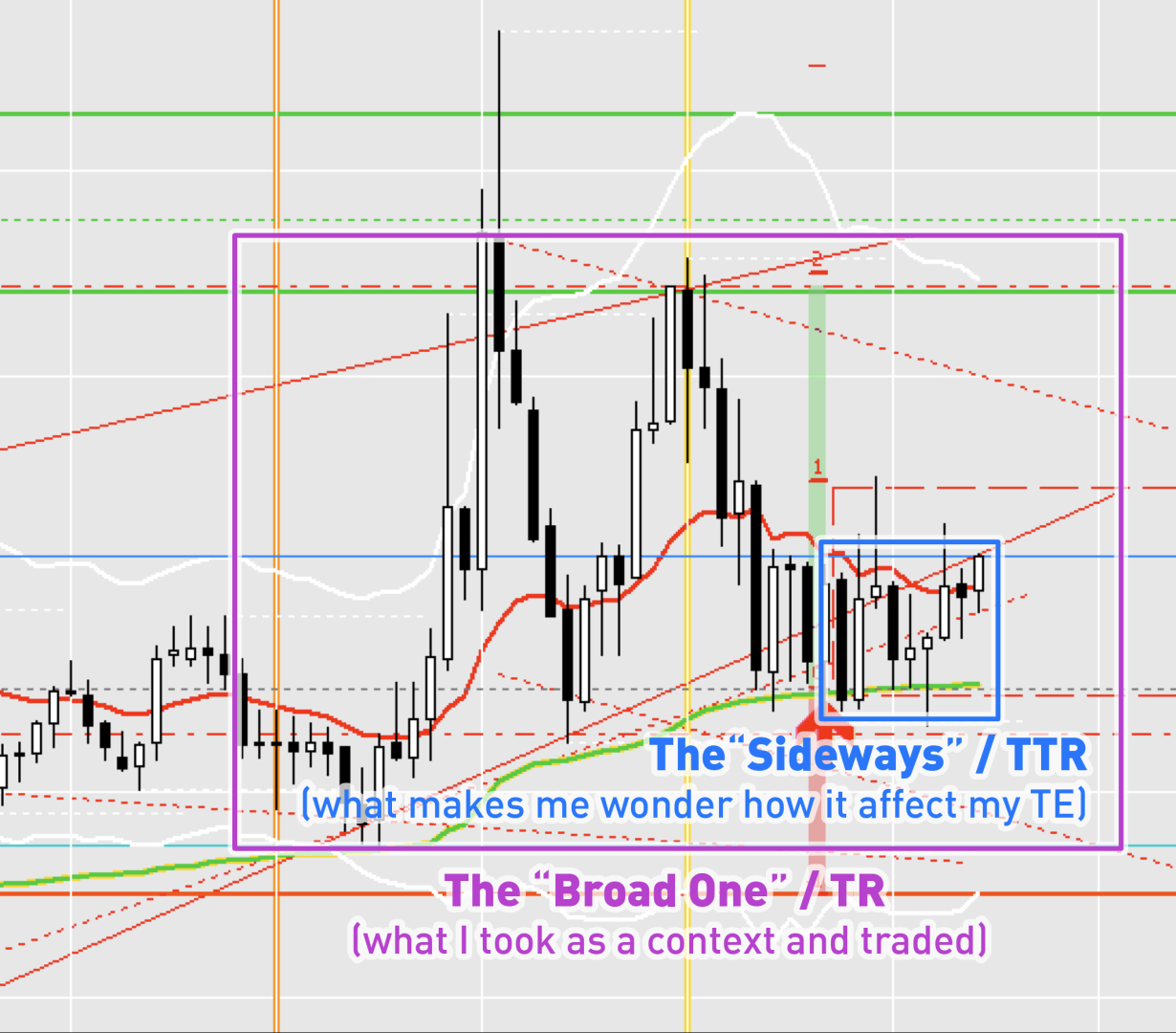
Thank you for your dedicated reply and clarification. You’ve answered and addressed the topics I wanted to discuss. Here is what has become clear from your answer.
My main wonder:
Is it possible that going sideways increases the probability?
(In other words, How the "sideways-makes-50/50" rule affects the trader's equation? or Is getting TTR after you've entered a trade does increase your probability?)
What makes me wonder:
The counterintuitive logic.
If the sideways makes a 60% trade drop to 50%, why not a 40% trade up to 50%?
(Where the hell is the 10% going? Probability of never reaching the stop or target forever?)
Why I’d like to figure out this:
Gaining a better understanding of what Al’s talking about.
(Maybe maybe maybe there is no need to consider this agenda as long as you are satisfied with your profitability. However, I would still like to know more. I just believe that gaining a better understanding of Al will make a trader better.)
At the same time, I see two points that unclear and seem to contradicting so I would love to know more what you mean by that.
1. “Getting TTR after you've entered a trade does not increase your probability” VS. “your probability slightly improves”
At the same time, getting TTR after you've entered a trade does not increase your probability. That would be counter intuitive. Alternatively, if you enter a 60% probability trade and the PA starts to hesitate, then your probability stops falling towards 50%. So, you can say that if you had printed against a high probability trade, taking the 40% side, if the trade instead of moving against you, starts showing hesitation, then yes, your probability slightly improves bit it will still take about 30 bars to reach very close to 50-50.
So, are you saying basically YES to my main question?
2. “TTR inside a TR is meaningless” VS. TTR affects your trade probability (the point 1)
If you're asking if a TTR affects the probability while the market is in a TR, then no, it doesn't. Al has mentioned this at a few places that TTR inside a TR is meaningless. Both are breakout mode patterns and does not provide you with additional information.
So, are you saying TTR affects your trade probability in usual caae, but not like this particular case such as in a TR?
(By the way, I was not asking this. I just wanted know what did you mean by the first reply. But very helpful. And if it is possible, would you kindly tell me where did Al mention this? I have the 4 books as well)
Also, if you're interested in discussing a scenario, kindly attach a chart. That discussion would add value to this forum.
Sure, I'll look for other examples! Give me a time:)
Let me reply to you guys first. It took me a day😅
Thanks again.
Price continued to hold above the TR bottom, so yes, my premise was still valid, so I held.
It's on you how you handle it from there if
the hesitation at the TR bottom was longer than I was expected
would be the best way to have a rule for it depending on time, behavior or intuition/experience.
It depends what fits you best in such situations and then to train your mind to go for it.
My question is how the "sideways-makes-50/50" rule affects this trader's equation.
From my perspective this is a time based rule, if the market needs longer than X minutes I would have to reevaluate the situation to not be biased with the PA which took place before.
Hi Hubert,
would be the best way to have a rule for it depending on time, behavior or intuition/experience.
Thank you for giving me another view point. The time aspects.
And yes, I agree with all what you’ve mentioned 🙂
I usually start to think about BE exiting if the price doesn't move for long time more than I expected, as I did in this particular trade. And I'd like to talk about how I should see this case.
Sorry for repeating this, but again, I'm wondering HOW TO REEVALUATE in this particular case exactly.
How to I take those TR price action rules and use them for the assessment?
If it goes sideways longer than expected, means probability is more likely to be around 50%. If so, I have to REEVALUATE as the my 40% entry with counterintuitive logic.
So I’d love to know how I am misunderstanding / making wrong assumption / or just market can do very counter intuitive trick like this.
Thank you!

I usually start to think about BE exiting if the price doesn't move for long time more than I expected, as I did in this particular trade. And I'd like to talk about how I should see this case.
It depends on your personality, your patience and if your premise is still valid. Everyone is different and see the current situation from the own perspective. You should define what it's mean for you, when you are saying "...for long time more..." from there you can evaluate if that should be bar wise or time wise, depending on your TF.
What is it and why you are wanting to act, if your premise is still valid could be a question at this point. What expectations you have when deciding to change your mind and act at that point? Do I have a rule which let me take only one trade at a time so I have to decide if to get out to wait for a better trade than I'm in right now? Am I able to make quick decisions based on the current situation and act on those?
All these are possible questions to answer honestly for yourself. Try to act even if the outcome doesn't match your expectations, in the long run we have to learn to act as clear and calm as possible on every bar.
If it goes sideways longer than expected, means probability is more likely to be around 50%. If so, I have to REEVALUATE as the my 40% entry with counterintuitive logic.
Yes, as Carpet wrote already. Al is mentioning this but I do not remember if in course or in the Trading Range book, or even in both.
So I’d love to know how I am misunderstanding / making wrong assumption / or just market can do very counter intuitive trick like this.
Be prepared that market is always doing what it wants and your assumption have only a probability of X % so you have to accept to get different outcomes than expected.
So, are you saying basically YES to my main question?
It appears that at least this part of my answer had a major typo, so much so that the grammar does not even make any sense. Let me rephrase this part for you.
If you take a 60% probability trade, that is a scalp class trade, so you shouldn't usually have to wait too long before the trade moves in your direction. So, yes, if the PA starts hesitating, starts getting PB or even enters a TTR, there is for sure something wrong with the premise. That's the market telling you, that the probability is not as high as you thought. However, the probability drops to about 50% only after 30 bars or so(Al's words). I don't recall seeing a 60% probability trade get a 30 bar TR as of yet but it might be possible. Usually, the trade will get some kind of a decent reversal pattern and start moving against you.
Alternatively, if you bet against a 60% probability trade(NOT RECOMMENDED), and the PA starts hesitating, enters a TR, then yes, the probability starts falling. Like I said before, it takes 30 bars or so though for the Bulls and Bears to have roughly equal probability.
So, are you saying TTR affects your trade probability in usual caae, but not like this particular case such as in a TR?
Yes. That is what I'm saying. You see, a TR is already a 40% probability proposition. So, you have both bulls and bears getting 40% probability in their respective areas and respective conditions. So, the question of a TTR affecting an already low probability does not arise. However, the TTR could be an indication of buying or selling pressure under right circumstances. Check out the encyclopedia and you'll see what I mean. One example would be, 5 bull dojis all above the moving average is an indication of buying pressure and makes a bull BO more likely than a bear BO.
However, this is an off-topic discussion meant to be discussed elsewhere.
Hope this clarified all your present doubts.
Thank you guys for the replies. I seriously learned a lot from this thread.
And I appreciate the video reference, Mr Carpet. I really enjoyed that video. I didn’t see this TTR I mention in the first post as a endless PB so this gives me a good sight for the PA.
Then I read the "Glossary of terms for price action trading" again, then I realized Al has never mentioned about the type of probability I’m talking in this thread. The probability of reaching its TP before the SL of an entry. But only "probability of success" or "directional probability". I think it's because he manages trades. Simple.
What I have always been concerned about since the beginning of this thread is how the directional probability affects the TP/SL probability. However, I really should care about is the effects on the "probability of success". Even though you use "TP/SL probability" for TE with "probability of success" at the entry. Now it seems mathematically WRONG.
I must rewatch the Trader's Equation video as well.
P.S. I was just writing down what I had learned from this thread and I realized it was never-ending, with new questions arising constantly. I hope to organize my thoughts well and post new topics in the near future.
Quick thanks here.


