The support forum is built with (1) General and FAQ forums for common trading queries received from aspiring and experienced traders, and (2) forums for course video topics. How to Trade Price Action and How to Trade Forex Price Action videos are consolidated into common forums.
Brooks Trading Course social media communities
Brooks Trading Course Learning Resources >>>

Hi everyone, first time posting here.
I always wanted to be trader mostly using price action. Since 2006, I read lots of books, tried different strategies, even algorithmic trading, and spent tons of time looking at charts. But making money was always tough. Constantly loosing, I had no clue what to do. I was doing stupid things for sure !
During the COVID lockdown, I found Al Brooks' books and courses. I liked them, so I joined. After watching some videos, things started making sense. Al's courses were super clear, and my trading got better quite quickly. I felt like success was possible !
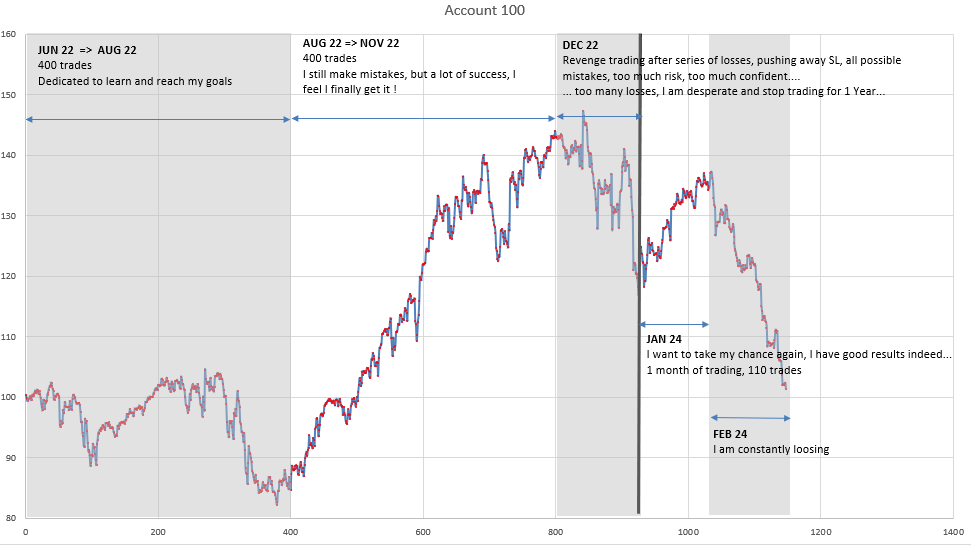
I've attached a little graph of my account (100 as a basis). After some learning phase, mostly loosing, I had a good time making profits for 4 months... it was quite significant to me !!!
But everything went wrong. It's almost like, from one day to another, nothing was working anymore, losses after losses,... of course, I made more mistakes as I was revenge trading. Worse and worse, I was risking too much. But... even when I was calm and trying to do my best, risking less, I was loosing.... So, after so many loosig trades, I stopped trading for a long time, thinking I was just lucky for some time before.
This year, in January 2024, I gave it another shot. Spent hours again into the videos, and I had a good month in fact !, and felt hopeful again. But after one month... I was constantly loosing, all my trades were wrong, and I am here there now... quite desperate in fact, confused, doubtfull.
I still think Al Brooks is the best teacher, and I believe I can do it. But part of me feels like being a trader is impossible. It's like flipping a coin. Sometimes you're lucky, sometimes not. And that's it. Market always evolves, so sometimes your strategy works, sometime not.
I know trading is hard and takes time. But how many of you here are profitable and can make a living with this activity ? i need some hope, I think I need some people to clearly tell me that 's possible !

I'm not sure, I think I kind of understand you. Al often says he doesn't recommend scalping for beginners because he's worried beginners will exit good trades too early. But here's a problem: no one can 100% accurately tell us whether the market is in a trading range or a trend right now, can they? Let me guess - sometimes you might set your stop loss at a swing low, but then the market starts to reverse. At that point, your brain tells you, "Hey, Al says to rely on your stop," and eventually you get stopped out. You can indeed rely on stop, but if the market is currently in a trading range, shouldn't you exit 2 ~ 3 bars after entry bar if you feel your premise was wrong? You might think it's in a trend right now, and that's the biggest issue. You can check Al's Q&A articles from 2015-2017, where he mentioned that "skilled traders will eventually combine swing and scalp together." You don't have to do scalping, but you must learn it, so you'll know when exiting early is reasonable - like going short in a bull flag, exiting early on pullbacks in H2, right? My English might not be very good, but I hope this helps you.

A lot of individuals have contributed here, and therefore there may not be much here that hasn't been said other than my perspective.
Money is a poor initial measurement of skill. It is what most look at, because the "experts" say so. Gotta love these "experts". . . . Anonymous idiots in my opinion, and individuals give too much credence to these "so called experts". But it can be difficult then to determine who has the skill and where to learn. First, Al is the real deal and through time and study more and more of the aspects may come together. Getting good feedback is the critical part. As mentioned:
1. Review your trades against Al's markups - every single day. This is not optional. For quite some time, individual's vision of what the market is and how it reacts is not correct. One of the most critical skills is the determination of bias. Al's markings are exceptional and his understanding of how that bias is manufactured is in every single chart he marks up. I have been through them thousands of times. 99%+ spot on with what he is teaching and sharing. Where your markings or trades differ from his marked up chart shows a lack of understanding in context, bias or both. Simple, elegant, and one of the best ways to quickly get feedback on knowledge gap deltas.
2. Why is money not a good reference. Edge is shown through application of bias over many contexts. The issue becomes reading the context, and the market shifts certain biases based on events, news, time of year and many other factors that inexperienced traders are unable to account for. . . sorry but it is the reality. Within a year perhaps 80%+ of the contextual aspects needed for awareness of appropriate edge are encountered. That makes any month or consecutive 2-3 month period irrelevant in measurement. Example, the beginning of 2025 -> new US President whose release of news at ambiguous times results in many more H1, L1 successes and market situations than probability wise had occurred for quite some time. This aspect required traders to shift how they operate with H1, L1 and trends a lot more often than many previous years had been encountered. And not just on 1 day, but series of days with trends. The change in volatility necessitates the reduction in size to account for "the same management across any given trade". . . Something experts naturally do, while the inexperienced are counting the additional dollars. Catch a bad trade and the "account is blown". That isn't a $$$ thing but a account management thing. So hopefully this gives a sense of why $$$$ and one's account is a poor reference initially.
3. So, from the beginning, skill should be developed through the reduction of errors, matching against Al and reviewing context and decision. It isn't about "being right" but learning to focus on how edge is manufactured and where it exists.
4. Stop loss as a function of account management. This is often overlooked as Al has some reference to it but for most individuals learning it takes a "back seat" to attempting to learn how edge is developed. It actually is the other side of the coin of edge. Without the appropriate stop loss placement, the edge can not manifest well (swing trading or scalping). There is a balancing probability shift between the trade and the stop loss/account size management.
5. Personal factors. Base personality can make some aspects more difficult.
6. Swing trading vs scalping. Scalping requires being able to identify, recognize, and execute high probability well. Higher probability situations do not last very long by definition of how the market operates. This means that a much higher degree of concentration as well as skill is needed. Like everything else there are tradeoffs. Lower probability situations (swing trading) have a higher failure rate and often require a much longer time interval for things to "play out". It is often much easier for individuals to learn to swing trade first. Professions which often are the exception, are based on personalities that are more risk adverse: Doctors (Al), lawyers, Engineers (probably one of the least flexible personalities), and other more "rigid" performance professions. This is probably why individuals with military background succeed in the profession - simply because of the rigid focus on process based decisions vs outcome ($$$) (will this trade work?!!!!). . . Trade plan: 1 (check), 2 (check) 3 setup (check) 4 execute (roger)! Edge can be measured through experience as opposed to how many attempt to track it - did it win?!!! (a trade can win for a variety of reasons and not all variables can ever be completely known). Having to "know" is a hinderance to trader development.
The good news is that the BTC community has individuals with talent who are open to share and provide feedback. Performance pressure will delay learning capability. This is also where $$$$ can be an issue -> pressure to perform. Perform what -> being profitable (nope wrong answer). The objective is to become aware of the variety of contexts and how setups can present an edge (but not a guarantee).
Use the resources which Al has compiled and ask questions within the community. It is a great place to acquire skill.
Good trades to you!


