The support forum is built with (1) General and FAQ forums for common trading queries received from aspiring and experienced traders, and (2) forums for course video topics. How to Trade Price Action and How to Trade Forex Price Action videos are consolidated into common forums.
Brooks Trading Course social media communities
Brooks Trading Course Learning Resources >>>

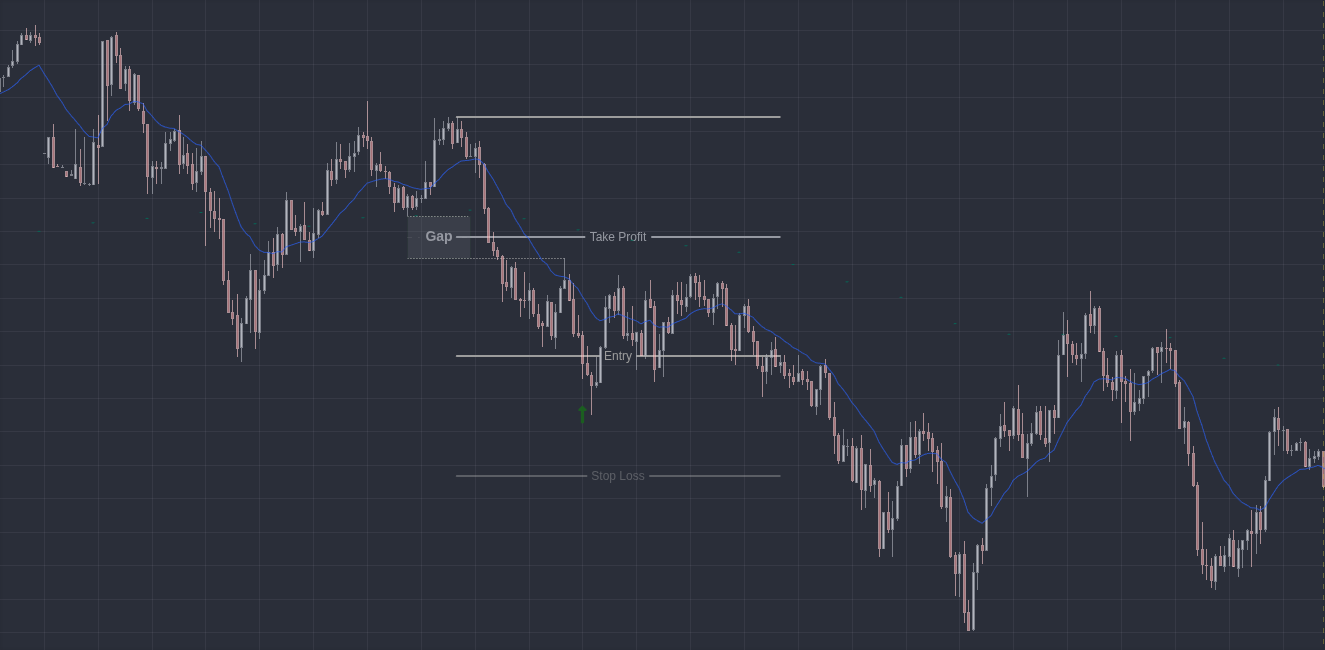
My thesis for the trade is that once price moves to the first measured move target it will probably return to the "Take Profit" line before it reaches the "Stop Loss" line. In this trade I based the MM off the gap, though in hindsight I can see I should have based it off the ensuing ~60 bar trading range.
What I can't quite figure out is if it was a bad trade from the get-go or if it was an acceptable trade but I should have exited when the extended trading range developed or if the whole thing was fine but the trade just happened not to turn out this time.
Advice appreciated.

Are there any other specifics the led you to take the trade in the 1st place? What other specific factors led you to believe that this would hit the measured move before hitting the stop loss? HTF context, overlap, wedges, parabolic wedges, building selling pressure, climatic buying, etc.

I had recently started to execute trades this way (i.e., basing my entries, TP, SL mostly -- almost solely -- off of MM projections) and they were profitable over a handful of trades. I was essentially finding them a more predictable way of trading MTRs than by waiting for a trend line break plus MA gap bar plus final correction. I give that backdrop just to say that part of the motivation for this trade was to see how far I could push a more or less "pure" MM-based trade.
That being said, the requirements I had set out for my trades were that there needed to be 1) a MM based on either a gap, the middle of a TR, or the height of the TR [that I thought was in the middle-ish of a trend] and 2) a three push pattern with a climactic third push (bonus points if the pushes are equidistant-ish).
For this trade the three pushes were: 1) the push down that made the bottom extreme above the gap, 2) the spike/wedge going into the TR, and 3) the next spike that made the low of the TR. I also considered the move down to be a double bottom with the previous price action some 80 bars back or so.
Then, after I had entered the trade I thought that the first strong bull spike that might be followed by a channel that would go up for a MM (based on the spike) up to my TP.

I think your Trade was a Bet for Test of the bottom of the TR After a strong Sell of from a DT Bear flag.
Usually the start of the Channel-wedge will be tested in a Spike & Channel Trend Like above. Thats what Happend.
You bought not the First leg of the TR and Looked for the Channel start Test as Target, you bought After the second leg. The Sell of from the DT bear Flag. Wich was quite strong.
After the second leg you have to Look for more Price Action because the Spike and Channel Trend Ended. Usually After the 2nd leg a 25% Test of the TR Happens at least, and then a proctrated TR, a Triangle, Sometimes a BO below the TR or much less a reversal Happens.
If you think about this opportunitis i think your Trade was more Like a Bet.
In my opinion there isnt a real Edge, if you have this cycle in mind compared to your Trade. Because you Are entered to Late for your Target.
All in all you Concept might theoreticaly work if you use it in Spike and Channel Trends and you Are hoping for a Channel start Test, But then is the question if it isnt safer to work with stop orders, and the System has more sucess.
Best regards.

No worries. Everyone finds what "suits" them and they feel most comfortable with. The process has to be built around your knowledge. What you may find is that measure moves "move" based on how the initial structure begins and grows. This is different than price structural elements, such as the "look left" for previous highs or lows that have accumulated resting orders or targets. Also, observing the tightness of channels can provide feedback on when buying at a measured move may have lower probability. The tightness of that channel provides directional feedback. Good trades to you!
Measured moves are often target for profit taking based on probability. However, I wouldn't necessarily use it for buying. There isn't a rulebook for, well the trend has to end here. . .
Instead, I would have preferred you look left and see that there was major support and prices did originate from the bottom previously. This is a stronger "event" than a measured move / profit taking. As the move downwards was strong, a second leg may have been expected.
It is easier to buy when there are bull bars in your favor, on a stop above a good bull bar closing on its high. This is often easier to become profitable, than working with limit orders.
Hopefully helpful and good trades to you!
Thanks for your reply, Eric.
Many MM targets do retest the halfway point before going down for a second MM. Take for instance a MM based on the move down into the middle of the extended TR that developed, as well as a MM based on the height of that TR. Both of these would have have resulted in profitable trades, and taken together they give a MM projection of virtually the exact same price. I would think this confluence indicates a high probability of success, even when bought with limit orders.
I have had the most success by using MM levels for my entry, TP, and SL levels. I still use the other elements of Al's methodology but more for the avoidance of certain trades or more optimal entry points.


