The support forum is built with (1) General and FAQ forums for common trading queries received from aspiring and experienced traders, and (2) forums for course video topics. How to Trade Price Action and How to Trade Forex Price Action videos are consolidated into common forums.
Brooks Trading Course social media communities
Brooks Trading Course Learning Resources >>>

Could you give me some advice on trading and trade management on TR day?
My biggest issue is that I repeatedly lose money on TR day, resulting in large total losses.
I can easily see on the chart later that it is a TR day, but I can't see the possibility of a TR in advance on a chart where I can't see the future, and as a result I buy high and sell low.
Trade management is also poor, and in hindsight, I often lose money on the longs I bought at high, get out at low with loss (and shorts I sold at low, get out at high with loss, respectively).
My trading diary shows that I have been failing at this since before I started studying in the Brooks Trading Course, and I have been losing money for about 5 years now.
As an example, here is a simulated practice run on 2022/09/12 E-mini in the Daily Setups Archive.
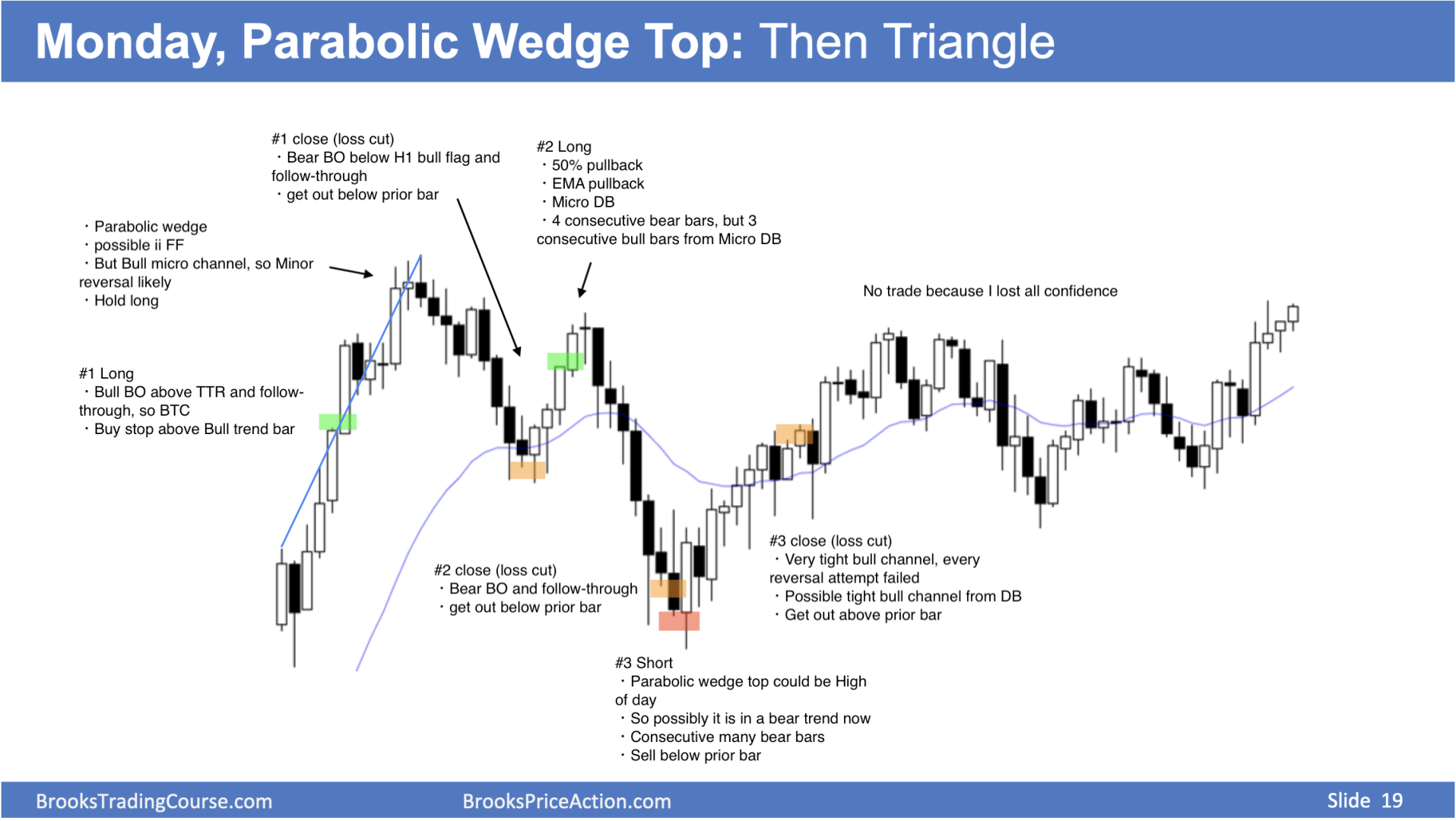

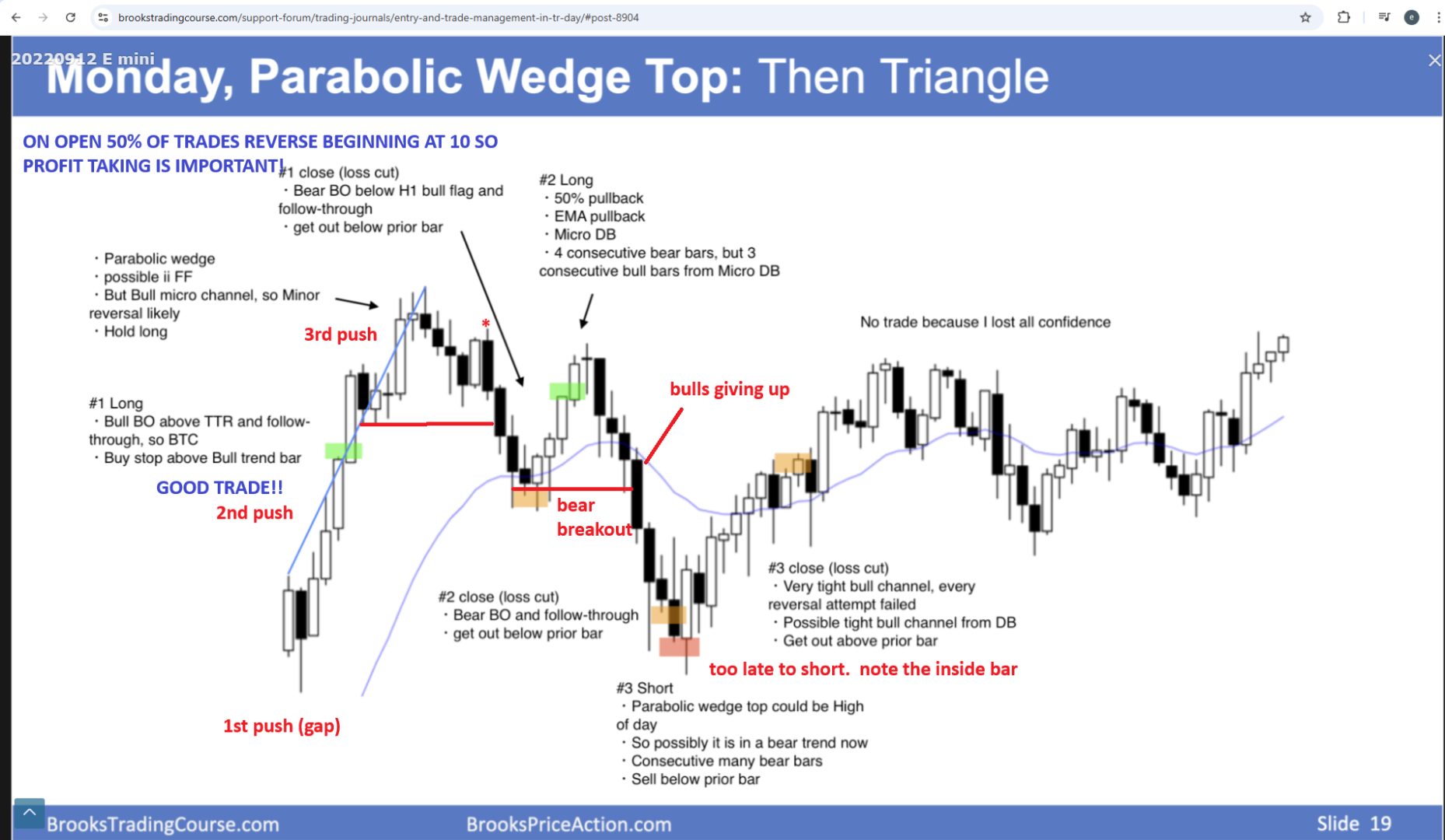
Well, first I would like to say thank you for posting your analysis because it helps to decipher the issues. What Al has published is absolutely fantastic, and it has great depth to it, which should be very welcomed in an industry of obfuscation and much fraud. The issue becomes taking the volumes of information into a construct which an individual uses well. As individuals have biases, and each can be different, this becomes the issue. Also, issues are often a concept thing and not a time thing. Keep pushing forward no matter what and hopefully the following is helpful.
1. Trading ranges are areas of lower probability. For these areas wider stop losses are used because -> lower probability. However, there are a few forms of trading ranges. There are tight ones, as well as ones formed from trends running back and forth. This one is more of the latter. Review many charts to discern.
2. Swing trading vs scalping. You are swing trading, and this is a great place to start. In swing trading, there is a rule though. Get out when the bias has potentially changed. This could be strengthened. Please see picture notes.
3. Price action probabilities. Prices often replace specific patterns but not perfectly. With a bias, as in the 1st trade, the expectation is potentially to attempt to retest the highs. This is because of the strength of the opening and prices do this, but do not achieve full retracement. However, enough for bulls to be able to get out at break even (this is advanced).
4. Entering too late (common). The second trade buying where bulls are getting out at break even. After 2 bear bars and then the third, the premise is no longer valid and the trade should be exited.
5. The third trade is shorting too low. After 7 bear bars the short is decided to be taken. While it is a bear micro channel, note all of the tails on the bottom of bear bars. The short is also taken where the beginning of the strong bull move occurred. This trade should be avoided by deciding within 1-3 bars to take a trade.
Very wide stop management can be useful, however with trends there is caution needed and transition points can become challenging. Initially, recommendation is to be able to decide within 1-3 bars of initial trending push to get into the trade. This will prevent FOMO, keep stop losses reasonable, and allow for a more relaxing learning experience. If one "misses" a trade -> there are hundreds of other trades coming up. Neither a single day or trade should make a difference.
6. Review Always In concepts because this affects when one should exit a trade.
7. Review Al's daily setup chats including your own stop/exit references. This is an invaluable resource which is provided for free and is under utilized by many in the community. The 1st trade should have been exited for a profit at the "*" bar.
Hopefully helpful and good trades to you! Keep moving forward!!

Hi Eric,
Thank you for the detailed explanation.
Al says that almost any bar can be used as a signal bar for entry, but I realized once again that beginners like me should not enter too late and should focus on better signals.
Another major issue is that I am not properly processing the information and utilizing it in trade management even though my initial assumption of the entry has changed, so I would like to look back on what you explained in detail again and use it for improvement.


